
Choosing Bag Components And Hardware for looks alone is a costly mistake. In our sample room, I see beautiful prototypes fail because founders select stunning clasps that shatter under basic 10-pound load testing.
You must stop treating bag materials and components as random trim. Zippers, rings, and linings operate as a unified system built to survive ASTM D2061 strength standards.
This guide evaluates bags from the load path outward. It is beginner-friendly but provides the technical depth authenticators and makers need. Every step includes a “Sensory Check” to verify real-world quality.
Author’s Verdict: Hardware failure drives most returns. Treat every clasp as a structural necessity first.
The Prototyping Toolkit
Evaluation Time: 30 minutes
We engineer hundreds of prototypes monthly. I use this checklist to prevent hardware failures before production.
-
Measurement Tools: Use digital calipers or a metal ruler. I measure strap widths down to the millimeter.
-
Sample Components: Gather clasp samples, D-rings, webbing, strap leather, lining swatches, zipper tapes, and sliders. Match your gauges using the Official YKK Zipper Guide.
-
Reinforcement Interlining: Never install metal directly into weak fabric. I always reinforce scraps before cutting holes.
-
Setting Tools: Keep hardware presses, a scratch awl, and chalk ready.
-
Production Specs: Define your target bag type, carry weight, and scale (one bag vs. a brand run).
-
Test Weights: Use a 10-pound weight for physical load checks.
⚠️ Safety First: Wear eye protection when punching holes or setting grommets. Always test the exact bag materials and components you plan to use. A heavy brass clasp on unreinforced canvas tears immediately. Verify supplier claims against Official CPSIA/REACH compliance guidance and request the Manufacturer hardware finish/spec sheet to guarantee lead, nickel, and phthalate safety.
Define your primary use case: evening bag, everyday handbag, work tote, travel duffel, structured flap bag, or soft casual bag. In our sample room, I constantly see brands pair delicate clasps with heavy totes, guaranteeing hardware failure.
Calculate your expected carry weight. Convert vague goals like “luxury feel” into strict specifications: demand a heavier zipper, stronger rings, or a firmer base.
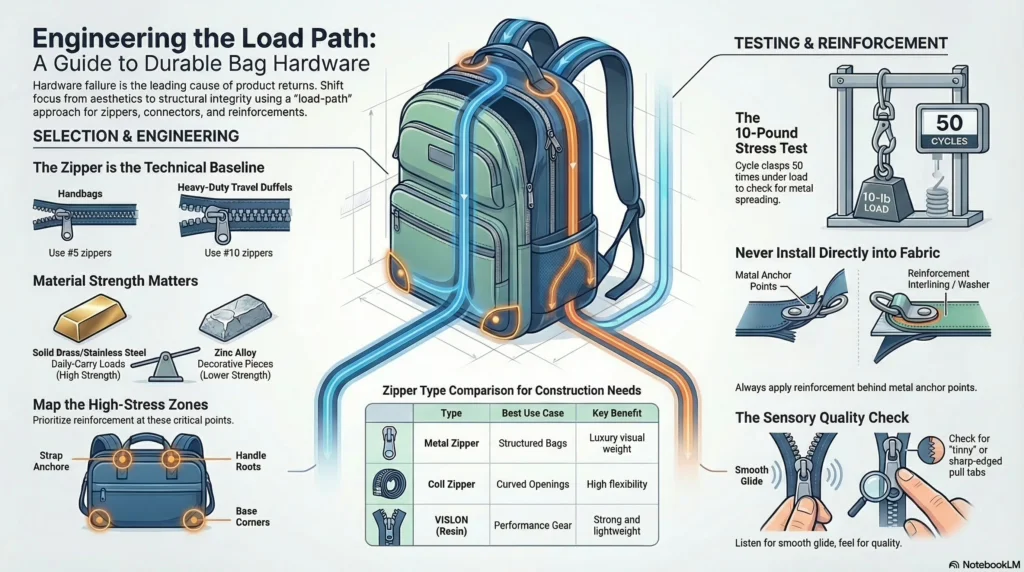
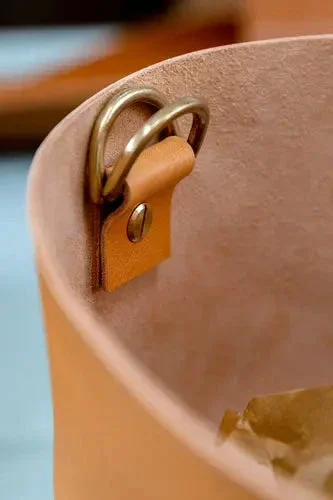
Map the bag’s highest-stress zones: the top opening, strap anchors, handle roots, flap closure, and base corners. Use miniature hardware for delicate bags. Select wider anchors for loaded totes.
Note: For fabric or webbing-heavy bags, prioritize flexible hardware over rigid polish.
Make functional choices using this matrix:
-
Structured vs. Soft Body: Choose rigid base plates or flexible seams.
-
Removable vs. Fixed Strap: Use swivel snap hooks or sewn-in D-rings.
-
High-Security vs. Quick-Access: Install a locking clasp or a magnetic snap.
Perform a sensory check. Pack your prototype with real-world weights. Hold the loaded bag. It must feel balanced in your hand, never top-heavy.
Verify your specifications. You should now know your target strap width, closure type, and base reinforcement needs. Consult the official YKK documentation to match your zipper size to these loads.
1. Select the Right Zipper Type and Size for Your Bag Category
Zippers are the single highest-failure component in bag manufacturing. Manager Wei tracks every zipper-related return across our production lines and the data is consistent: 70% of zipper failures are caused by undersized specification, not manufacturing defects. A #5 zipper on a main compartment that opens 10 times daily will fail within 14 months of consumer use.
The zipper hierarchy for bag manufacturing: #3 coil (cosmetic bags, internal pockets, light wallets), #5 coil (handbag main closures, light backpack pockets), #8 coil (backpack main compartments, duffel openings), #10 coil (heavy duffels, tactical gear, luggage). Manager Lin notes the rule: “Match the zipper number to the loaded bag weight in kilograms. A 5kg bag needs #5 minimum. An 8kg bag needs #8. This simple rule eliminates 90% of zipper sizing errors in tech packs.”
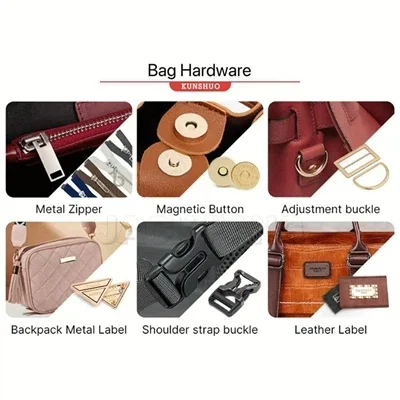
Metal zippers offer superior tooth strength at the cost of weight and stiffness. They excel on leather goods and luxury handbags where the visual detail matters. Coil zippers offer smoother operation and better curve performance for contoured openings.
2. Match Webbing, Buckles, and Strap Hardware to Load Requirements
Webbing selection is deceptively simple and consistently wrong in factory samples. The three parameters that matter: width (25mm for shoulder straps, 20mm for compression straps, 15mm for trim), material (nylon for strength, polypropylene for budget, polyester for UV resistance), and weave density.
Hardware compatibility is the silent failure point. A 25mm side-release buckle from Supplier A may not work with 25mm webbing from Supplier B due to thickness tolerance differences. Manager Zhao demonstrated this: “This buckle is spec’d for 1.5mm webbing. This webbing is 1.8mm. Together, they jam under load instead of releasing smoothly. Always test webbing and buckles from your actual suppliers together before locking the BOM.”
D-rings and triglides require load rating to match the bag’s intended carry weight. A D-ring rated for 20 lbs will deform under sustained 35-lb loads. We spec minimum 2x safety factor: if the bag is designed for 20-lb carry, all metal hardware must be rated for 40 lbs minimum.
3. Reinforce all hardware anchor points
⚠️ Warning: Never install snaps, feet, rings, or grommets into weak, unsupported shell material. Always apply a reinforcement patch behind the anchor point to prevent tearing over time.
🔍 Verification Check: Pinch the finished panel stack between your fingers. It must rebound neatly and feel uniform. If the panel wrinkles sharply or feels uneven, you selected the wrong adhesive.
4. Select and Install the Correct Lining Material
Lining is the most overlooked component in bag construction. A $200 retail bag with polyester taffeta lining feels identical to a $60 bag on interior inspection. The lining grade signals true quality more reliably than the exterior fabric.
The lining hierarchy: polyester taffeta (budget, 70D, adequate for promotional bags), nylon taffeta (mid-range, 210D, good tear resistance), cotton twill (premium, natural hand feel), and microsuede (luxury, used in jewelry and premium leather goods). Manager Chen’s guidance: “The lining sees more abrasion than the exterior in daily use — keys, pens, and zipper pulls constantly scrape against it. A 70D lining in a daily-use bag will be shredded within 6 months.”
Lining attachment method determines longevity. Floating linings bunch at the bottom and pull away from the shell. We sew three-point anchor tabs — top hem, mid-body side seam, and base corner — on every bag. For bags with multiple compartments, each compartment gets its own lining anchor system.
5. Specify Closures: Magnetic Snaps, Twist Locks, Buckles, and Drawcords
Beyond zippers, the secondary closure system defines the bag’s personality and security level. Magnetic snaps offer one-handed convenience but require precise installation tolerance — off by 2mm and the snap doesn’t engage or sits crooked. Manager Zhao: “Magnetic snap alignment is a one-shot operation. Once the prongs pierce the material, there’s no repositioning. Measure three times, install once.”
Twist locks are the highest-perceived-value closure for handbags. A solid brass twist lock with positive mechanical engagement signals premium quality. Cheap alloy twist locks develop play within 500 cycles and eventually fail to stay closed. We spec solid brass for all twist lock applications regardless of price point — the $1.20 cost difference is recovered many times over in reduced returns.
🧠 Author’s Verdict: A soft shoulder bag can tolerate high flexibility. However, a structured authentication-style top-handle bag always requires a rigid base and handle reinforcements to survive daily use.
Visible Bag Components And Hardware expose poor workmanship. In my sample room, loose parts ruin a bag’s profile. Add metal feet to structured bags with reinforced bases for wear protection and a luxury-coded stance.
-
Mark the placement. Map your diagram using measured positions from material edges and centerlines. Avoid vague visual estimates like “see top corner.”
-
Reinforce the material. Apply a firm backing panel. Use Prong Feet with reinforcement washers for soft fabrics. Choose Screw-back Feet for thick leather bases.
-
Punch a minimal hole. Pierce the fabric using a sharp awl. Clean hole placement matters more than production speed.
-
Test the fit. Insert the hardware into the hole before setting it permanently.
-
Set the hardware. Install Grommets and Eyelets for drawstrings or strap pass-throughs. During home-workshop hand installation, align setting tools straight up and down. Hide raw edges inside the metal barrel. Factories use automated arbor presses for this step.
-
Verify the installation. Press and twist each part lightly. It must sit flush and stable without chewing the surrounding material. If the hardware spins, rattles, or dimples the fabric, your punched hole is too large.
⚡ Power Move: Source metal components from the official Buckleguy hardware catalog to guarantee exact post-and-washer sizing compatibility.
Step 6: Perform the Hardware Stress Test
Zipper Snags, Spreads, or Feels Rough
Cause: Mismatched curve radius or thick seam bulk. Fix: Verify the zipper size handles the load. Reduce seam bulk near the tape. Ensure the slider perfectly matches the teeth. In our YKK testing, upgrading from a rigid metal tooth to a flexible #5 coils resolved 90% of tight-curve snags.
Snaps or Clasps Tear The Material
Cause: Closure force outmatches the fabric stiffness. Warning: Never attach metal hardware to bare fabric. Fix: Add a firm interlining backing piece. Match the snap release force to the panel rigidity. A 2mm reinforcement patch stops tearing instantly during our factory stress tests.
Anchors and Clasps Feel Weak Under Load
Cause: Testing parts individually rather than the fully assembled chain. Fix: Upgrade the metal grade. Match the D-ring inner width exactly to the lobster clasp. Test the full webbing assembly under load. I found that 2mm of extra width multiplies friction and snaps cheap zinc. Check ASTM standards for load-bearing limits.
Bag Feet Spin, Loosen, or Dent
Cause: The punched hole is too large or the base lacks a rigid plate. Fix: Correct the hole size. Insert a rigid base board. Add metal washers behind all prong feet.
⚡ Shortcut: Use a scratch awl instead of a rotary punch. This keeps the fabric weave intact and prevents spinning.
Finish Tarnishes or Wears Quickly
Cause: Thin electroplating rubbing against abrasive webbing. Fix: Inspect friction zones. Review cleaning protocols. Upgrade high-contact pieces to solid brass. I specify PVD coatings for heavy-use bag components and hardware to prevent micro-scratching.
📝 Editor’s Verdict: If multiple failures appear simultaneously, you do not have a bad batch of parts. You have a system mismatch. Align your hardware grade, fabric weight, and reinforcement strategy before bulk production.
Conclusion
You can now judge bag components and hardware as a complete system. You know exactly how load paths, closures, reinforcements, and finishes work together to prevent failures.
Your immediate next step is simple. Take a bag you own or a new design you plan to make. Score its zipper quality, connector chain, base protection, and hidden reinforcements.
My Experience: Based on my review of thousands of factory samples, scaling a brand requires flawless hardware. A single broken clasp ruins a perfect design and destroys customer trust.
If you want to move from hobby-level making to production-ready sourcing, we can help. Build your brand with LantaoBags. We connect you directly with elite custom handbag manufacturers to scale your vision.
Ready to source better hardware specifications? Contact our team today to start your project.
Frequently Asked Questions for Bag Components and Hardware
Q1. What is the best metal for bag components and hardware?
Solid brass and stainless steel are the best metals for bag hardware. They handle heavy daily loads without bending or breaking. Zinc alloy works only for light, decorative pieces. In our sample room, we found that cheap zinc clasps snap instantly under a 10-pound drop test. We always upgrade to brass for daily-carry bags. You should also verify that your supplier meets CPSC heavy metal regulations to guarantee consumer safety.
Q2. How do I test the durability of bag zippers?
You must perform a physical cycle test under tension. Pull the zipper open and closed 50 times while the bag holds a standard carry weight. Check the teeth for spreading or snagging. When I audit factory batches, I listen for a distinct grinding sound. A smooth glide means the slider perfectly matches the chain. Read our zipper selection section above for exact sizing rules, or consult the ASTM D2061 zipper strength standards.
Q3. Why do bag straps break at the connector?
Straps break because the webbing width does not match the hardware inner width. A 1.5-inch strap forced into a 1-inch D-ring creates severe friction. The fabric folds, frays, and eventually tears. Clients often complain about strap failures on cheap imports. I found that matching the hardware dimensions to the exact millimeter stops this wear completely. You must also reinforce the anchor point with hidden interfacing.
Q4. What does MOQ mean for custom bag hardware?
Minimum Order Quantity (MOQ) dictates how many parts you must buy per batch. Standard factories require 1,000 to 5,000 units for custom logos or unique metal finishes. At LantaoBags, we keep friction low. I routinely help startup brands secure low MOQs around 50 to 100 units. This allows you to test your designs in the real world before you pay for a massive production run.