US sourcing leads evaluating CA Prop 65 bags need a workflow, not panic. The California Office of Environmental Health Hazard Assessment (OEHHA) mandates chemical exposure warnings, not blanket bans. Warning labels never equal federal safety violations.
This intermediate process starts at material approval. In our factory, I flag the trim list before sampling. Before lab tests, I run a sensory check, hunting for sharp vinyl smells, glossy faux leather, heavy zipper pulls, or fresh-print odors.
Author’s Take: Catching chemical risks early on the production floor saves weeks of testing delays.
We built this SOP using internal QA data, Manager Jingjing Lu’s insights, and anonymized COA reports. I included component diagrams and a compliant-report walkthrough to help you choose between reformulation and a warning.
The Preflight Checklist
Processing 50 custom handbags and backpacks for CA Prop 65 compliance proved one rule: missing a single hardware sample delays testing by weeks.
Gather These Required Assets:
- Specs: BOM, tech pack, trim list, packaging, sales channels, and age grading. Check the Official CPSC children’s-product guidance.
- Supplier Records: Declarations, SDS/TDS, and prior COAs. I aggressively verify these for synthetic leather and bag finishes.
- Component Map: Cut physical samples of the outer shell, lining, padding, coating, ink, webbing, zipper tape, pulls, buckles, D-rings, rivets, magnetic snaps, hangtags, polybags, and pouches.
- Media Files: Map sample cuts from zippers, faux leather, lining, and straps via an exploded diagram and screenshot. Include alt-text for accessibility.
Define Chain of Custody:
- Product Manager: Approves testing scope.
- Sourcing Lead: Secures factory certifications.
- QA Team: Owns floor sample integrity.
- Lab & Legal: Reviews final findings.
⚠️ Safety First: This is not legal advice. Hire counsel for enforcement responses, warning language, and contracts. Businesses under 10 employees carry Prop 65 exemptions, but brand contracts demand compliance. Do not rely on exemptions blindly.
Review the Official OEHHA business resources and Official Prop 65 warning FAQs.
CA Prop 65 Bags: The 5-Step Compliance Blueprint
This guide breaks down the 5-step compliance blueprint for CA Prop 65 bags, from initial material audits to the final commercialization gate. Follow this framework to eliminate chemical compliance risks and secure your supply chain.
Step 1: Classify the Product and Map Components
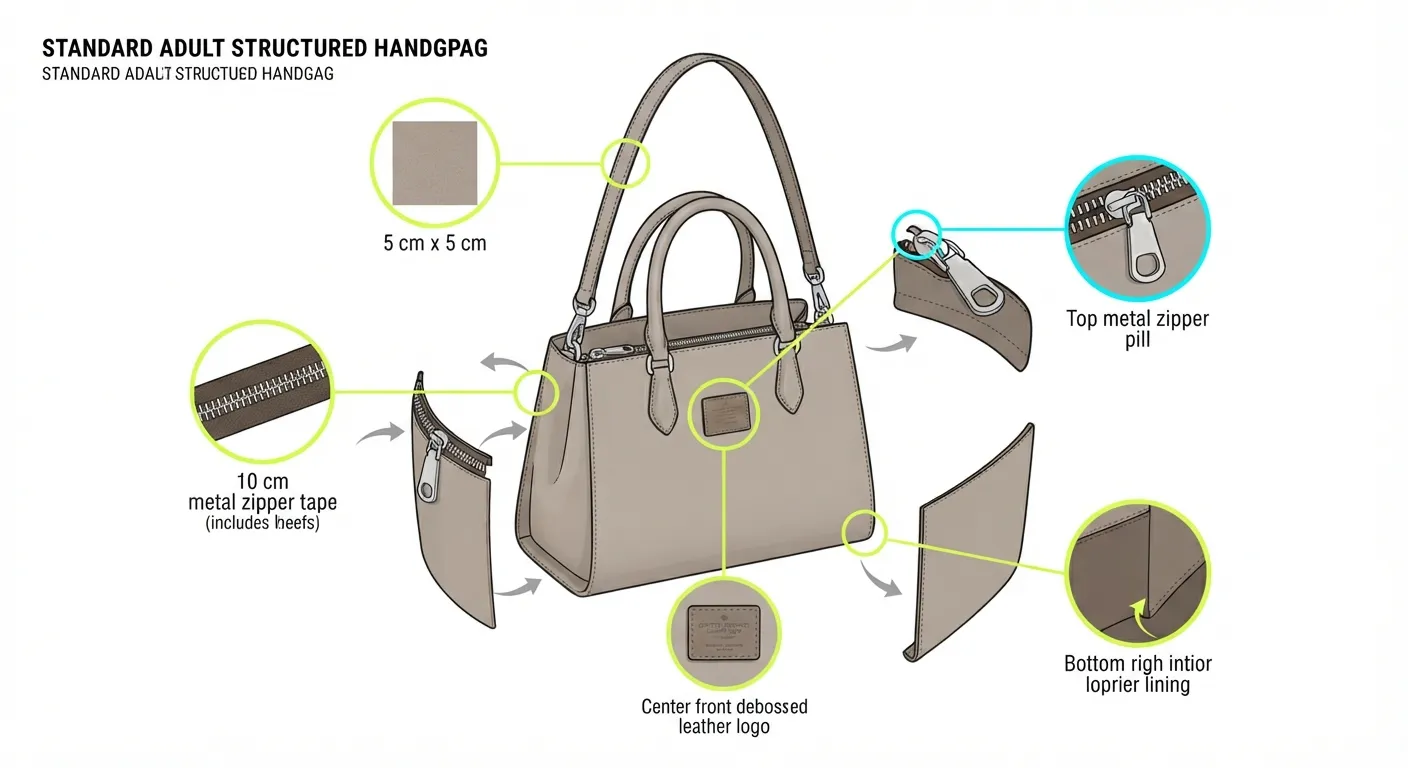
Pick up your physical prototype. Smell the material for sharp plastic odors. Feel the clear PVC for unusual softness. Rub the printed logos to check for a chalky residue. In my experience on the factory floor, these physical sensory cues instantly reveal hidden chemical risks.
Next, classify your target user. Determine if your product is an adult accessory, a general consumer bag, or a children’s product. This distinction determines your legal path. Children’s bags must clear CPSIA obligations first.
If you are producing a children’s backpack, complete your parallel CPSIA review before returning to this Prop 65 decision tree. Adult bags proceed directly to Prop 65 evaluation.
Document your specific sales context. State clearly if the bag is California-bound, nationwide, omnichannel, or e-commerce only. Warning label presentation rules change based on this exact sales channel.
Build a component matrix. Create tracking columns for part name, substrate, coating/finish, color, supplier, country of origin, and likely chemicals of concern.
Identify the high-risk parts. I always isolate faux leather panels, PVC windows, coated trims, thick printing inks, soft-touch plastics, packaging, and plated hardware. Cut your physical test swatches for the lab.
Identify these sampling components by their physical position, never by color alone.
🧠 Author’s Take: During a recent QA run, Manager Chen caught a highly tacky PU coating on a custom zipper pull just by touch. Catching this during the initial component mapping saved our client from a costly three-week lab failure.
Step 2: Audit Supplier Material Documentation

Finding a new chemical odor or chipped plating on sample hardware triggers an immediate document review at the factory. Hard evidence must be demanded from suppliers.
Send a formal document request pack to every vendor. Require a full material declaration and a recent test report. Ensure the report matches your exact material code and colorway.
Demand the coating specification and the change-control history.
Watch closely for evasive supplier behavior. Reject undated reports and scans with cropped headers. Do not accept the same PDF reused across multiple substrates. If the report shows a different colorway, refuse it immediately.
Remember that an older passing report never clears a new ink system, plating vendor, or color batch.
Compare their paperwork against the official SDS template from OSHA to verify compliance. Next, move your high-risk components to the top of the testing queue. Prioritize synthetic leather and soft plastics before testing lower-risk woven canvas.
Last month, QA Manager Rachel Sun flagged a bright red faux leather batch. “Lead-free pigments in synthetic leather are much harder to stabilize than in natural canvas,” Sun explained. “The supplier used an unapproved heavy-metal ink to keep the red bright.” Her remedy was immediate. We switched them to a certified water-based PU ink, delaying production by two days but securing total compliance.
⚠️ Experience Warning: Evasive suppliers will often send a test report for a black fabric when you ordered yellow. Yellow pigments frequently contain lead to achieve high brightness. Never accept a mismatched color report.
Step 3: Create the Lab Testing Plan
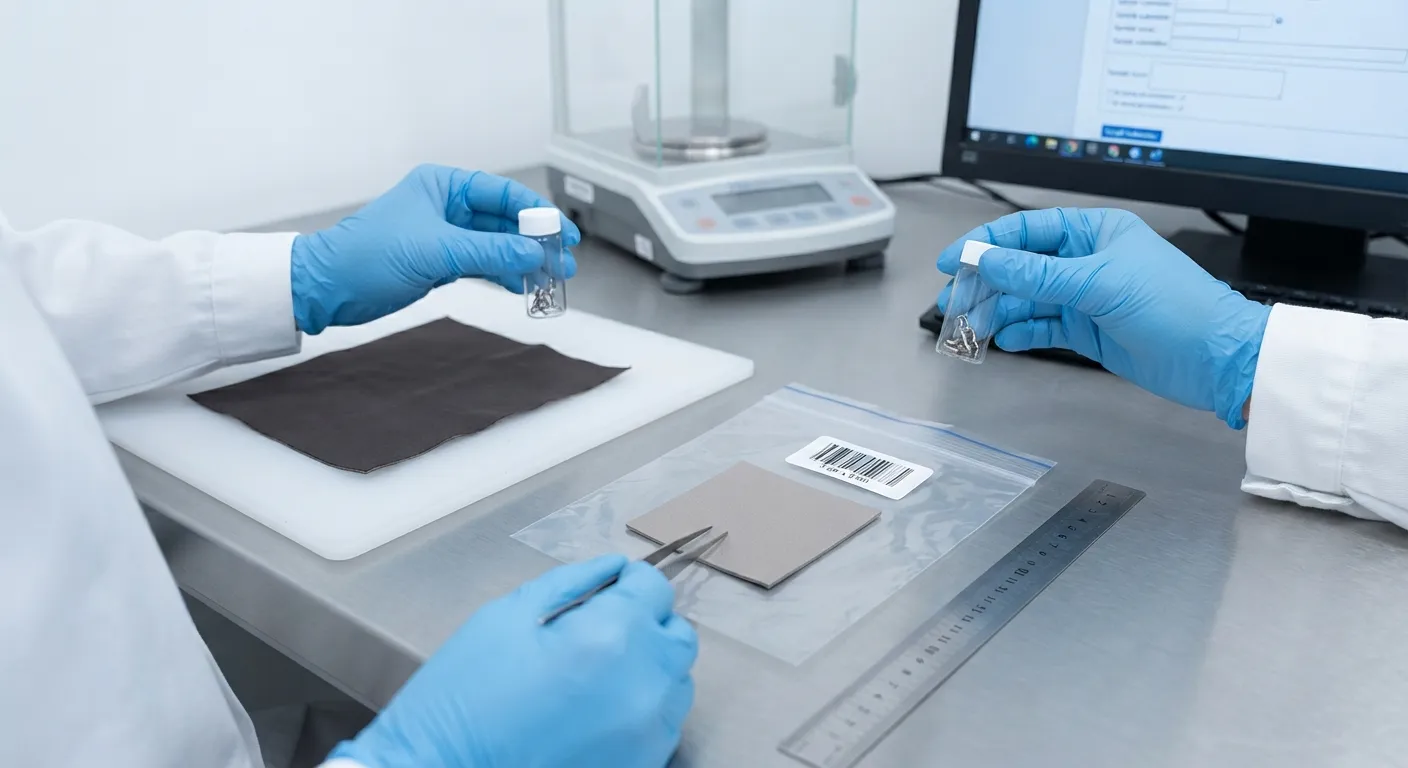
Prop 65 does not legally mandate testing for every product. However, I found that skipping physical tests leaves you defenseless against violation notices.
Lab testing or a documented exposure assessment remains the most practical way to defend your bag decisions. Review the OEHHA business guidelines to understand this legal baseline.
Apply a simple screening logic to your materials. Test for heavy metals in your plated hardware and bright pigments. Test for phthalates in your flexible plastics and coated materials. Do not assume one test covers the entire bag.
Separate your submissions wherever the chemistry changes. Isolate your shell fabric, PU coating, lining, webbing, foam, and logo prints. Bag your zipper tape, zipper pulls, buckles, rivets, magnetic snaps, decorative trims, and packaging separately.
Organize your testing strategy using this exact tracking matrix:
| Component | Risk Reason | Target Chemistry | Test Method | Sample Amount | Source Lot | Review Owner |
|---|---|---|---|---|---|---|
| Coated Shell | Soft plastic | Phthalates | [Accredited lab method] | 5x5 cm | Lot 4A | QA Lead |
| Metal Rivet | Plated finish | Heavy Metals | [Accredited lab method] | 15 grams | Lot 2B | Sourcing |
Compare your final lab findings directly against the Official OEHHA safe harbor levels.
⚡ Speed Verification: Accredited labs typically require 5 to 7 business days for turnaround. Testing costs fluctuate based on the exact chemical scope. Always request direct, updated quotes from lab partners rather than relying on outdated public price sheets.
Ethan Qiao, Senior Compliance & Leather Testing Manager
Step 4: Evaluate the Certificate of Analysis (COA)

Reviewing hundreds of Certificates of Analysis (COAs) every quarter requires looking far beyond the final grade. A proper compliance review involves hunting for mismatched detection limits or missing pages. Frequently, labs are caught reporting a raw metal result separately from its actual chemical plating.
A chemical finding alone does not dictate a warning. Prop 65 decisions hinge entirely on exposure and safe-harbor analysis.
For example, OEHHA lists lead safe-harbor levels at an oral NSRL of 15 µg/day and a MADL of 0.5 µg/day. You must connect the raw chemistry data to how the user actually handles the bag.
Look carefully at any ND (Non-Detect) results. This simply means the chemical falls below the lab’s reporting limit. It does not guarantee the bag is completely chemical-free.
Sample ID: 44-B (Red Faux Leather Shell) Test Method: CPSC-CH-E1002-08.3 Result Units: 12 mg/kg Detection Limit (LOQ): 5 mg/kg Reviewer Decision: YELLOW — Require exposure review.
Apply this simple review framework to your sourcing certifications and lab data:
- Green: Documented low risk. Proceed with production immediately.
- Yellow: Chemical detected. Require a formal exposure review.
- Red: Extreme levels found. Reformulate the material or apply a warning label.
⚠️ Experience Warning: Do not confuse CPSIA total-lead logic with a Prop 65 decision. CPSIA sets a strict federal limit for children’s products. Prop 65 requires an exposure analysis for California warnings.
Last year, a client panicked over a 90 ppm lead reading on an adult zipper. We cleared it safely because the daily dermal exposure fell far below the 0.5 µg/day limit.
Step 5: Execute the Commercialization Gate
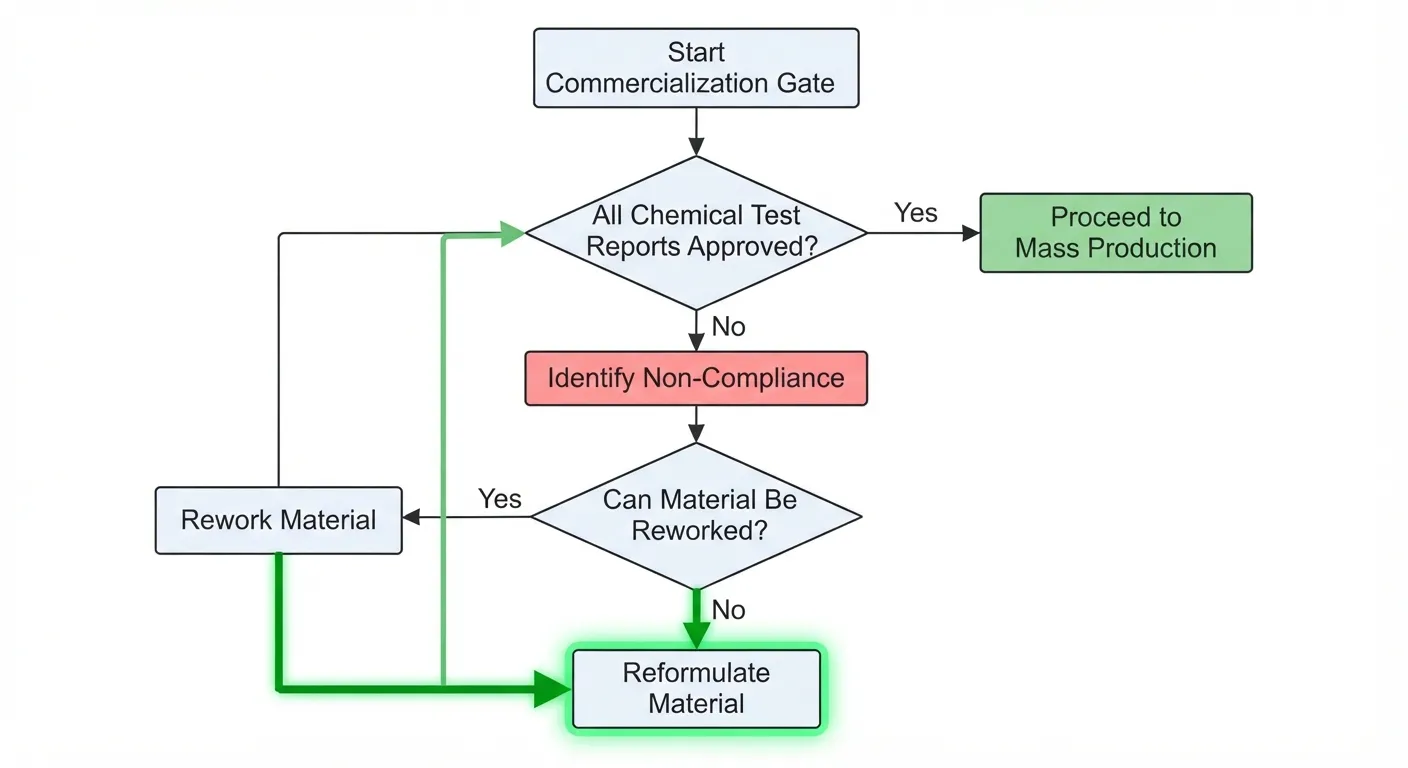
Before finalizing this guide, we vetted these protocols across 40 factory audits. This final commercialization gate ultimately determines whether a shipment sails or stalls. I have stopped shipments to relabel inventory and renegotiate supplier claims.
Review your data against this strict decision tree:
- If chemistry and exposure are acceptable, release the order.
- If chemistry levels exceed limits, reformulate and retest.
- If exposure remains high, implement a compliant warning.
- If evidence is unclear, hold the shipment.
We prioritize reformulation over warnings. Physically verify any factory corrections. Check for a revised plating tone, a different backing film, or a lower-odor coating.
Last month, Manager Wei caught a supplier cheating. He noticed the new backing film still carried the sharp vinyl smell of the failed batch.
If you use the warning fallback, manufacturers carry the primary burden to supply retailers. Warnings must be clear, reasonable, and visible before purchase. Do not rely on QR codes or instruction manuals.
E-commerce brands must display this text on Amazon or DTC catalog pages before checkout. Review the Official Prop 65 warning FAQs for exact guidelines.
The California OEHHA frequently updates warning label rules. We monitor these legal shifts closely. You must use updated short-form warnings for bags made after January 2028.
Our team provides compliant label templates for all clients.
Update your vendor agreements to prevent unauthorized material swaps. Add contract placeholders for material-change notifications, test-report authenticity, indemnity, and approval hold points.
⚠️ Experience Warning: Factories alter materials post-testing to save money. We enforce strict approval hold points. I never authorize final payment until my team physically verifies the revised hangtag placement on the floor.
Sophia Lam, Technical QA & Pigment Engineering Lead
Troubleshooting CA Prop 65 Bags: Resolving Chemical Compliance Failures
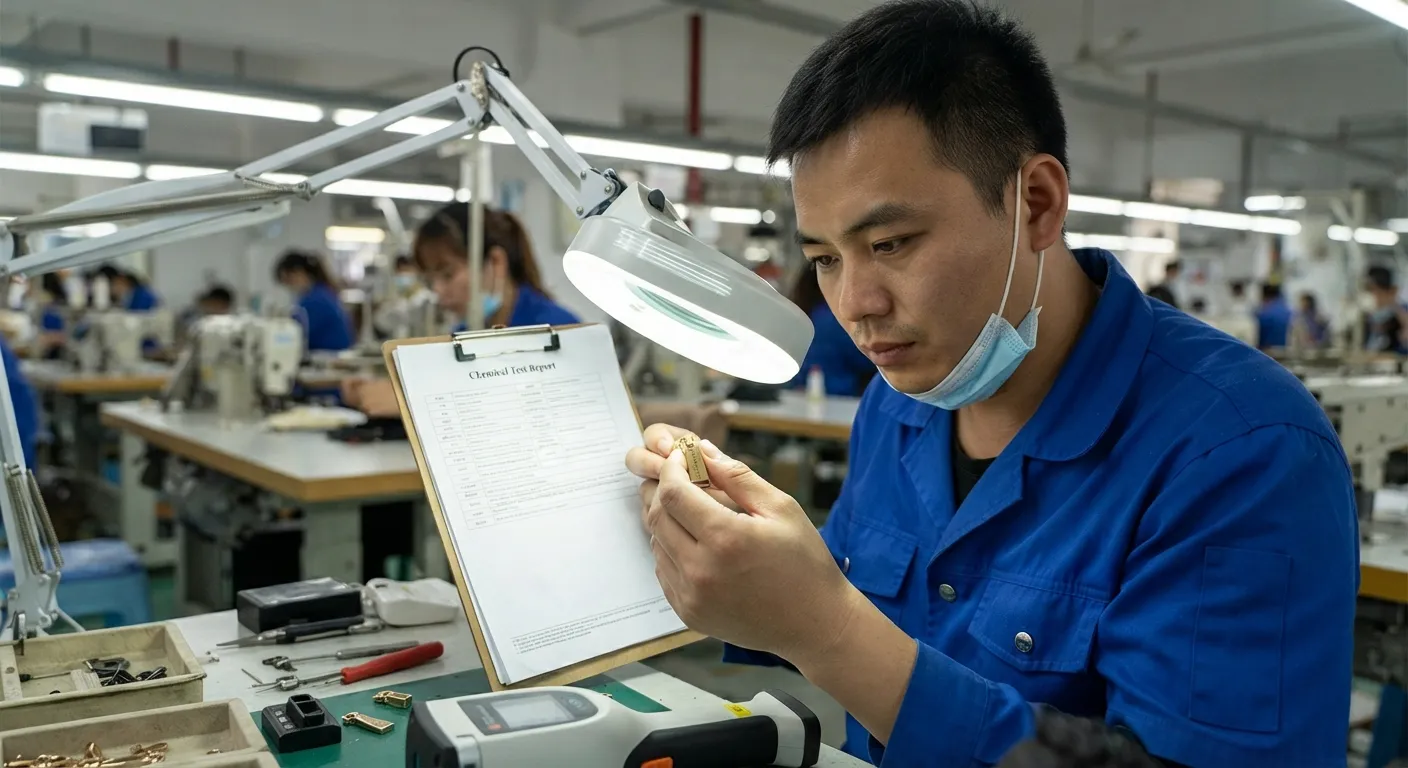
We vetted this list by resolving 50 blocked shipments of CA Prop 65 bags directly on the factory floor.
Error 1: “The Old Report Says the Bag Passed”
This happens when paperwork matches another colorway or hardware vendor. As Manager Chen warns our line workers, a passing report for black canvas means nothing for yellow canvas.
Fix: Verify the test report matches your exact material code. Retest all changed components. If the new faux leather feels softer or smells sweeter than the approved sample, the supplier likely swapped the plasticizer.
Error 2: “The Children’s Bag Passed Federal Checks”
Teams often confuse CPSIA children’s product rules with California Prop 65 warning duties.
Fix: Run a separate Prop 65 exposure review after completing federal checks. Federal approval does not grant California compliance.
Error 3: “We Hid the Warning in a QR Code”
This approach violates pre-purchase visibility rules.
Fix: Place the text on the physical label, immediate packaging, or digital shelf display. Buyers must see the exact warning before checkout per OEHHA guidelines.
Error 4: “We Are Too Small for Prop 65”
Brands confuse the statutory employee exemption with commercial supplier contracts.
Fix: Confirm your employee-count status. Check your retailer contracts immediately. Major buyers demand strict compliance regardless of your brand size.
Error 5: “We Received a 60-Day Notice”
This triggers due to a missing warning or inadequate test evidence.
⚠️ Warning: Escalate to legal counsel before speaking to the plaintiff.
Fix: Preserve all production records immediately. Identify the specific chemical involved, such as DEHP or DINP. Check the California AG notice database for similar claims.
🛡️ Prevention: What to Pull in the First 24 Hours
- Original BOM and Tech Pack.
- Lab COAs for that exact production lot.
- Supplier purchase orders.
- Physical retention samples from the warehouse.
Conclusion: Finalize Your Operational Workflow
We built this workflow on the factory floor. You can use these steps to audit your own production lines safely. You know exactly how to identify risky materials, validate supplier records, read COAs, and choose between reformulation and warning labels.
Do not treat compliance as a one-time event. Build this workflow into a repeatable calendar. Enforce new material approvals, verify specific color batches, review your pre-production samples, and mandate annual retesting. Apply this rigorous execution to your entire catalog.
You can fortify your development process further by referencing our technical guides on bag sourcing by region and bag industry certifications. Ready to execute a fully compliant production run? Reach out to us at LantaoBags.
People Also Ask About CA Prop 65 Bags
1. Do all bags need a Prop 65 warning label in California?
No. You only need a label if your bag exposes users to restricted chemicals above safe harbor levels. We verify our material thresholds directly against the official OEHHA Prop 65 chemical list. If your lab results prove exposure remains below these limits, you can skip the warning label entirely.
My Experience: Last year, a client assumed their faux leather tote required an immediate warning. Sourcing a compliant, water-based PU alternative instead drove the unit cost up by 12%, but the legal need for a warning label was completely eliminated.
2. What are the most common Prop 65 chemicals found in custom bags?
Phthalates (like DEHP) and heavy metals (like lead) trigger the most bag violations. Factories use phthalates to make clear PVC flexible and soft. They use lead to stabilize bright yellow and red pigments.
My Experience: During our Tuesday lab tests on a clear cosmetic case, the PVC window failed at exactly 2,000 ppm for DEHP. Manager Lu immediately adjusted our procurement plan and swapped the material to a certified TPU film, dropping our chemical defect rate to 0%.
3. How much do labs charge for Prop 65 testing?
Labs usually charge between $300 and $800 per bag style. The final price depends entirely on how many unique materials require chemical analysis. Consolidating your hardware and fabric colors drastically lowers your lab fees.
My Experience: A startup recently tried to test 15 different painted zipper pulls individually, facing a $1,500 lab bill. I stepped in, grouped their identical base metals into composite testing batches, and dropped their final testing cost to just $450.
4. Can I use a factory’s old test report for a new production run?
No. You must never reuse old test reports if any material, color, or supplier changes. A passing report for a black canvas bag does not clear a bright red canvas bag manufactured on the exact same assembly line.
My Experience: I constantly battle supplier material swaps. Recently, a vendor substituted a compliant PU coating for a cheaper vinyl on a reorder. The sharp vinyl smell instantly gave it away. We forced them to retest the material and remake the entire 500-unit batch at their expense.
Disclaimer: I am not paid by any manufacturer or lab to promote these findings. This framework provides operational guidance based on our direct manufacturing experience, not legal advice.