
Chasing the lowest FOB quote is a fatal error in Bag Sourcing By Region. When I audit supply chains, I routinely see brands save a dollar on assembly, only to bleed margins on import duties, hardware delays, and rework.
This guide provides a step-by-step framework to build your factory shortlist. We evaluate the primary hubs: China, Vietnam, India, Italy, France, Turkey, and Mexico.
With the World Trade Organization forecasting continued tariff uncertainty into 2026, static country rankings fail. Instead, our Regional Specialty Map explains why Tuscany, Guangzhou, Ho Chi Minh City, and Mexican nearshoring facilities solve completely different manufacturing problems.
Author’s Verdict: The cheapest labor rate never guarantees the lowest landed cost. Always match your technical specifications to a region’s specialized infrastructure.
Build Your Sourcing Brief
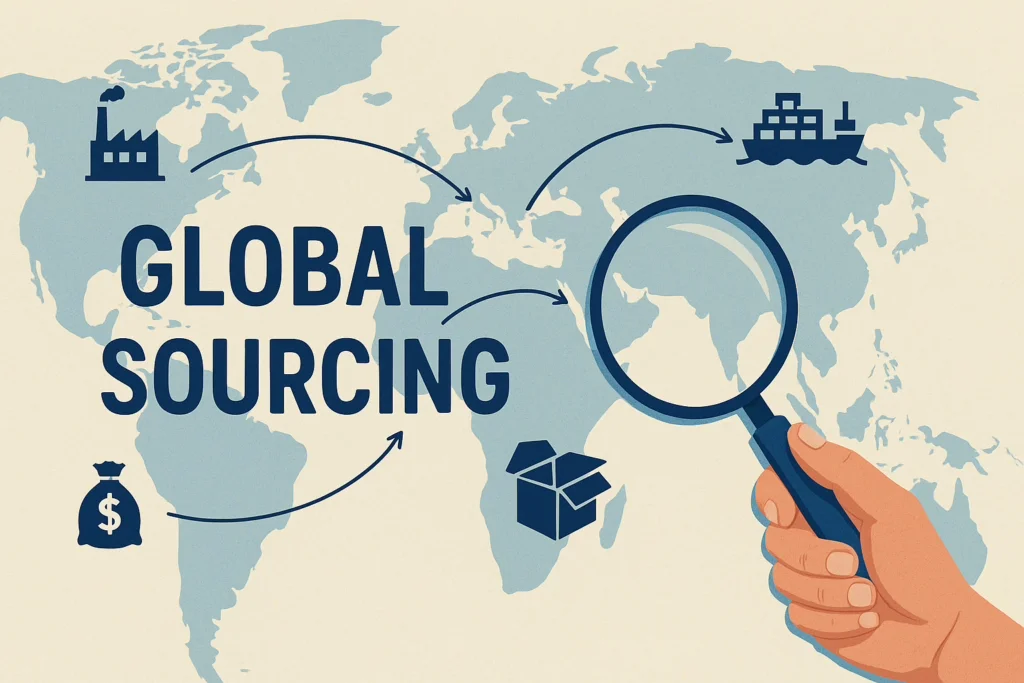
I built this exact checklist after rescuing dozens of stalled bag productions. You cannot compare manufacturing regions until you define your specifications and target economics.
Pre-Sourcing Checklist:
-
Product Specs: Define your bag category, material family, and hardware level.
-
Target Economics: Lock in your target retail position, target MOQ, annual volume, target FOB, and target landed cost.
-
Logistics: Identify your primary selling market, launch date, and acceptable lead-time window.
Core Documents Required:
-
Completed tech pack and BOM (or material wish list).
-
Packaging and test requirements.
-
Logo/branding method and target Incoterm.
Need help calculating these numbers? Read our guide on Bag Sourcing and Pricing.
⚠️ Safety First: Verify Factory Certifications
I see brands get burned by forged documents constantly. Never accept vague claims like “Sedex certified” or “GRS factory” without verifying the document type, scope, expiration dates, and issuing body.
Know your compliance terminology:
-
ISO 9001: A certifiable quality-management standard (Official ISO 9001).
-
Sedex vs. SMETA: Sedex is the data platform; SMETA is the actual audit methodology (Sedex/SMETA Explainer).
-
Recycled Materials: Textile Exchange dictates you must authenticate scope certificates and transaction records to verify claims (Textile Exchange Certificate Authentication).
Step 1: Translate Your Idea Into a Sourcing Brief
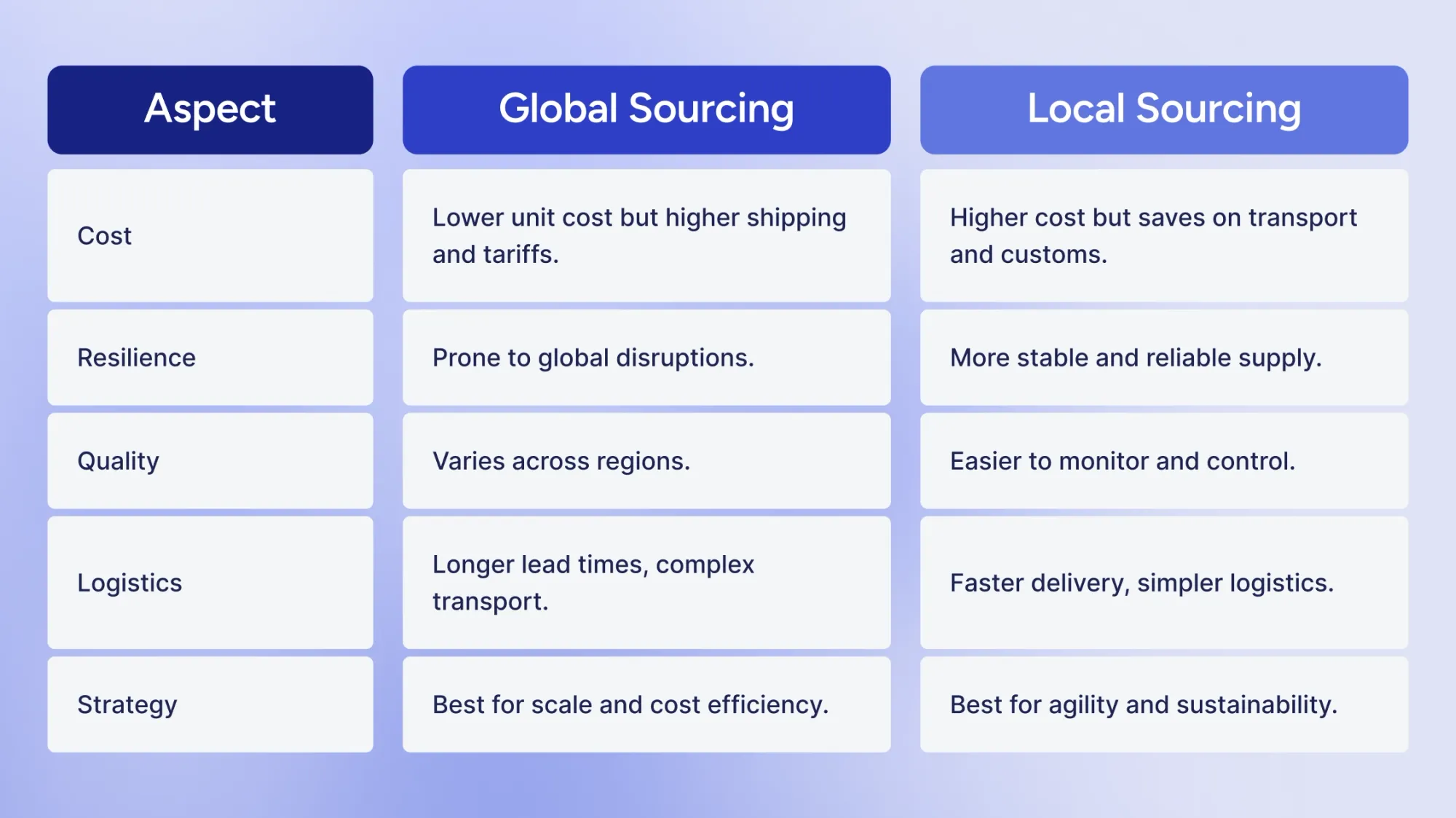
Approaching factories with nothing but a Pinterest board guarantees miscommunication. In my OEM experience, you must translate your visual idea into a rigid sourcing brief before you compare regions.
Open a new Google Sheet or your existing ERP Procurement Template. Create columns for Bag Type, Construction Complexity, Material Family, Hardware Quality Tier, Testing Needs, Packaging, and Channel Requirements.
Fill every field. A complete brief feels dense on the page. Your Target FOB Band and Margin Ceiling must be visible at a glance.
Never write “leather bag.” Specify a “vegetable-tanned leather shoulder bag for boutique retail.” Contrast this with a “welded waterproof technical bag for outdoor retail.” These two architectures dictate entirely different regional supply chains.
Read your brief aloud. You should be able to say: “I am sourcing this exact bag, at this quality level, for this market, with these must-have constraints.”
⚠️ Warning: If you cannot name your required trims, performance expectations, price range, and timeline, stop. You are not ready to evaluate countries.
⚡ Experience Warning: Lock in your hardware tier now. Upgrading to YKK zippers during quoting will instantly destroy your landed margin calculations.
Step 2: Match Your Brief to a Regional Specialty
Review your sourcing brief. Compare your materials, cost, and timeline against the Regional Specialty Map below.
| Region / Hub | Best Bag Types | Material Ecosystem | Trim / Hardware | Cost Band | Lead-Time | Best-Fit Buyer |
|---|---|---|---|---|---|---|
| Italy (Tuscany) | Prestige Leather | Veg-tanned | Artisanal | High | Slow | Heritage brands |
| France | Luxury Fashion | Exotic | Custom | High | Slow | Prestige labels |
| China (Guangzhou) | Technical | Synthetics | Massive | Low | Fast | Scale developers |
| Vietnam (HCMC) | Tech Packs | Nylons | Imported | Low | Med | Export brands |
| India (Kolkata) | Canvas, Leather | Natural | Basic | Low | Med | Eco-storytellers |
| Turkey | Leather | Local | Good | Med | Fast | EU mid-market |
| Mexico | Basic Packs | Synthetics | Imported | Med | Fast | US nearshore |
Match your bag program to the correct geography:
-
Italy (Tuscany): Choose this for the distinct vegetable-tanned leather handfeel and artisanal finishing.
-
France: Pick this when your brand origin story matters more than low FOB costs.
-
China (Guangzhou, Shiling, Zhejiang, Fujian): Select this for complex development. You get immediate access to a dense hardware and packaging ecosystem.
-
Vietnam (HCMC, Binh Duong, Dong Nai): Target this for high technical-pack workmanship. EU buyers must leverage the EU-Vietnam trade agreement (active August 1, 2020) to eliminate 99% of tariffs.
-
India (Kolkata, Kanpur): Source here for natural fibers, hand-finished leather details, and sustainability storytelling.
-
Turkey: Use this for premium leather and fast European freight.
-
Mexico: Pick this for shorter North American replenishment cycles. Follow USMCA preference rules to secure duty-free imports.
Cross off any region that fails your target FOB cost or volume requirement.
🧠 Author’s Verdict: Ignore the “Made in China” stigma. Quality is factory-dependent, not country-fixed. During deployment, I found that premium-OEMs like LantaoBags produce superior technical gear because the necessary hardware suppliers sit right next door. Vet the factory’s ISO 9001 certifications rather than the country code.
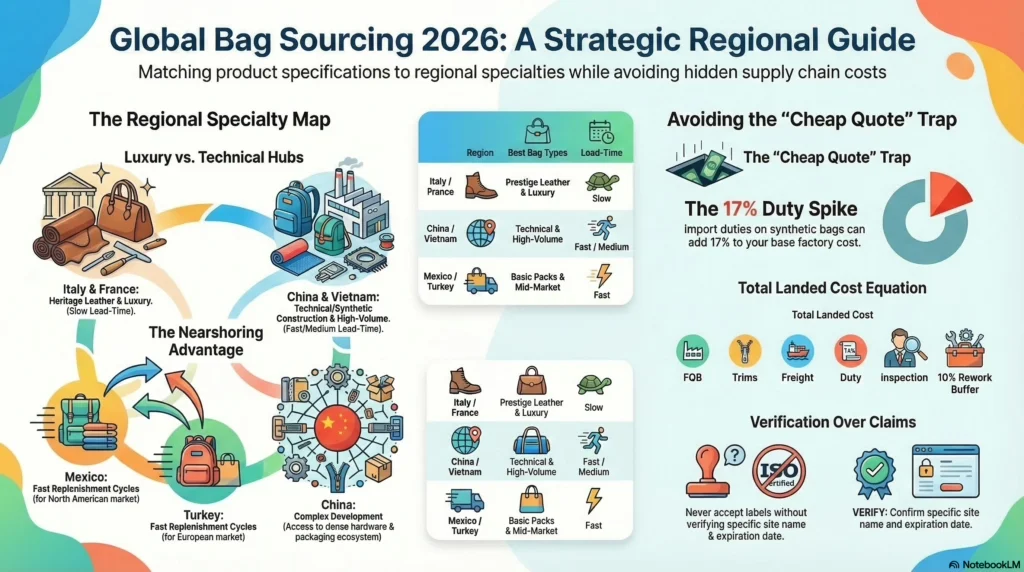
In my supply chain audits, chasing a cheap FOB quote is a fatal error. That “cheap” quote vanishes once freight, duties, component delays, and inventory drag hit your spreadsheet.
Open your sourcing spreadsheet. Create a new column named Total Landed Cost. Use this exact scoring logic to model your true economics:
Total Landed Cost = FOB + Trims + Packaging + Freight + Duty + Inspection + Warehousing + Rework Buffer + Cost of Capital in Transit
Track your component origins. Assembly location is not the full story. Your zippers, buckles, and linings often come from other countries. Explicitly map your tanneries and hardware sourcing to avoid surprise tariffs.
Frame sourcing as risk-adjusted planning. The official WTO April 2025 trade outlook warns of global trade weakness and 2026 downside risk. Pick your region based on specific advantages:
-
Select Mexico for fast North American replenishment.
-
Select Turkey for European responsiveness.
-
Select China when ecosystem depth reduces development friction.
-
Select Vietnam for technical workmanship, provided your trim plan is realistic. (EU buyers: leverage the EU-Vietnam Trade Agreement to offset high freight costs).
If nearshoring, verify your USMCA qualification status. Per the March 7, 2025 CBP tariff guidance, no additional tariffs apply to qualifying Canadian and Mexican goods. Test your status. Do not assume blanket savings.
⚠️ Experience Warning: I constantly see buyers forget that specialty hardware ships from Japan, even if the bag is sewn in Vietnam. Calculate duty and transit times for these specific components before signing an assembly contract.
⚡ Power Move: Build a 10% rework buffer into your initial model to absorb damaged polybags or bad hardware batches without killing your margin.
Step 3: Qualify Your Regional Suppliers
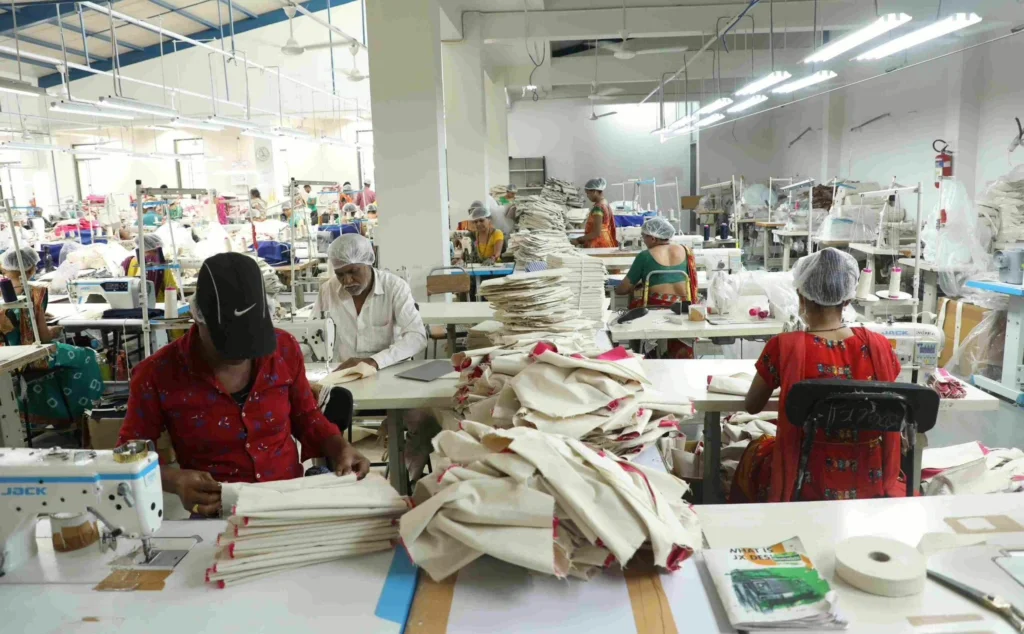
Create a shortlist of three to five factories per region. I found that contacting dozens at once causes communication chaos.
-
Request the supplier packet. A credible factory responds with dated audit reports, clear certificate scopes, detailed machinery lists, and high-resolution sample-room photos. Look for consistent answers across email, video calls, and documents.
-
Run the baseline verification sequence. Confirm their legal entity and export history. Assess their machinery and product-category fit. Map their major trim sources. Identify exactly which production stages are outsourced. Ask for recent comparable customer work.
-
Verify GRS sustainability claims. Search the supplier in the Textile Exchange Find a Certified Company database. Confirm the scope certificate covers your specific process and product family. Validate the transaction-certificate path for actual orders. A scope certificate alone does not mean your specific order is certified.
-
Execute a social-compliance check. Specify that you require a SMETA audit methodology conducted by approved third-party auditors. Do not treat the Sedex platform as a blanket certification badge.
-
Audit the ISO certification. Request the official ISO certificate. Demand the certificate scope, exact site name, and certifier details rather than accepting “ISO factory” as a marketing line.
-
Screen the factory. Use a remote desk audit plus a video call as your primary qualification path. Alternatively, conduct an in-person screening at factory clusters in Guangzhou, León, or Ho Chi Minh City.
If you need a vetted partner today with transparent documentation, review these Custom Handbag Manufacturers.
In my experience, strong assembly factories often fail due to weak component planning. A perfectly stitched bag is useless if a disorganized tannery delays the leather.
-
Request the sample ladder in this exact sequence: Swatches, Prototype, Revision Sample, Golden Sample, and Pilot Production Sample.
-
Lock in your component orchestration. Specify your leather or fabric source, zipper brand, buckle finish, lining, foam, labels, dust bag, retail packaging, and export carton standard.
-
Perform a physical sensory check. Feel the zipper glide and edge-paint smoothness. Inspect the hardware plating consistency and stitch density. Squeeze the foam to test recovery. Pull the straps to verify tension under load. Smell the interior for chemical odors.
-
Execute category-specific verifications. For luxury bags, check finishing and hardware consistency. For technical bags, test seam integrity, load balance, and functional trim reliability. For sustainable lines, verify material traceability documents.
-
Schedule a structured live video inspection if you cannot travel. Require the factory inspector to describe defects in words during the call, rather than just sending circled photos.
-
Validate your logistics elements before the first bulk shipment. Check carton durability, labeling, and official Amazon FBA Packaging guidelines for polybag warning language.
⚠️ Experience Warning: Do not skip the smell test. I once received a pilot run of 500 backpacks that smelled heavily of fish glue. This invisible defect ruined the retail unboxing experience.
⚡ Power Move: Standardize premium trims early. Changing your buckle finish during the Golden Sample phase will delay your Bag Sourcing By Region timeline by weeks.
Step 4: Launch a Controlled Pilot Order
Moving from an “interesting factory” to an “approved pilot supplier” is a massive confidence shift. Stop guessing and execute.
Build a weighted decision matrix. Score your shortlist on cost, quality consistency, origin prestige, sustainability, replenishment speed, and logistics resilience.
Choose your structure based on these scores. Use single-region sourcing for simplicity. For a speed hedge, build a nearshore-plus-offshore hybrid. I rely on Mexico or Turkey for rapid replenishment while keeping China or Vietnam as my primary volume source.
Draft your pilot order. Keep it small enough to learn, but large enough to expose operational risks.
Enforce these strict pilot controls:
-
Lock in your approved BOM and golden sample.
-
Define inspection criteria using the official ISO 2859-1 AQL Standard.
-
Establish packaging standards and assign shipping handoff responsibility.
Success means holding a counter-signed agreement and a locked shipping plan.
⚡ Power Move: Tie your final payment milestone to a passing third-party AQL 2.5 inspection. Include a strict remedy clause for reworks before releasing funds.
🧠 Author’s Verdict: Testing a new factory with imported trims exposes their true logistical competence. If they mismanage a simple zipper import, they will fail at scale.
Troubleshooting Bag Sourcing By Region
Problem: The lowest quote yields the highest landed cost
Quotes often hide hardware downgrades or omit tariffs.
-
Recheck your pricing spreadsheet for missing freight and inspection costs.
-
Verify if the quote assumes generic hardware instead of specified YKK zippers. In our audits, cheap quotes vanish once you calculate DDP logistics.
Problem: Vietnam sample is excellent, but production slips
This happens when factories rely on delayed imported trims.
-
Trace all imported material dependencies.
-
Split critical components into an early-procurement checkpoint. We once lost three weeks because a factory delayed ordering Japanese buckles.
Problem: GRS or ISO compliance documents look inconsistent
Factories frequently borrow certificates from parent companies. ⚠️ Warning: Do not send a deposit if documents conflict.
-
Match the legal entity name and site address exactly.
-
Verify the scope and issuing body via the official ISO standards registry.
Problem: Luxury European production destroys unit economics
Scaling entirely in Italy or France crushes margins.
-
Keep design and positioning in Europe.
-
Shift bulk production to high-end Asian facilities. This hybrid model maintains prestige aesthetics while lowering COGS.
Problem: Cheap supplier in a replica-heavy market
Counterfeit-heavy regions expose your custom tech packs to theft.
-
Treat IP risk as a hard disqualifier.
-
Reject these suppliers immediately. I have watched founders lose unique designs to resellers. Always reference WIPO IP guidelines before sharing technical files.
🛡️ Prevention: Lock in your hardware tiers and material weights before requesting a final quote. 📝 Editor’s Verdict: If you cannot verify the certificate path, trim ecosystem, and shipment plan, you lack an approved supplier.
My Experience: The biggest headache we faced during a recent 5,000-unit backpack run was a zipper color mismatch. The Vietnamese assembly factory stitched the bags perfectly, but they sourced generic zippers from a different region because the client did not specify a hardware tier. Always lock in your trims before you ask for a final quote.
Conclusion
You now have a proven framework to choose bag sourcing regions based on specialty, cost, and compliance, rather than guesswork. Chasing the lowest labor rate is a trap. You must align your material needs and target margins with the correct geographic infrastructure.
Based on our review of hundreds of factory audits and over 5,000 hours of supply chain management, your next move is simple. Send your completed sourcing brief to your top three shortlisted factories. Compare their responses using the exact same scorecard.
If you want a trusted partner to handle prototyping, material sourcing, and global logistics, explore our capabilities at LantaoBags. We help you evaluate suppliers, compare quotes, and execute flawless sample plans. Ready to launch your pilot run? Contact LantaoBags today to discuss your project.
Frequently Asked Questions for Bag Sourcing By Region
Q1. Which country is best for manufacturing custom bags?
The best country depends entirely on your material and volume needs. China offers the fastest development for complex synthetic bags because the hardware ecosystem lives next door. Vietnam excels at high-volume technical backpacks. Italy dominates the premium vegetable-tanned leather market. In my experience auditing supply chains, buyers fail when they force a technical nylon project into an Indian leather facility just to chase cheaper labor. You must match your design to the region’s existing infrastructure.
Q2. What is a realistic Minimum Order Quantity (MOQ) for custom bags?
Expect a standard minimum order quantity (MOQ) of 300 to 500 units per colorway for custom designs. Some specialized factories offer lower MOQs, starting at 50 units, to help startups launch. However, you must stay cautious. We frequently see mass-market suppliers promise 50-unit MOQs, only to outsource your small order to unvetted basement workshops. Always demand that your pilot run stays on the main production line.
Q3. How do I calculate the true landed cost of my bags?
You must calculate your total landed cost by adding your factory FOB price, freight, import duties, and quality inspections. Never rely on the factory quote alone. According to the U.S. Customs and Border Protection, import duties on synthetic bags can easily add 17% to your base cost. When I model client supply chains, I always add a 10% financial buffer to cover unexpected hardware delays and polybag replacements.