
Choosing bag finishes by appearance alone often ruins a production run.
Author’s Verdict: I regularly reject tech packs where founders specify fragile edge paints. A beautiful finish means nothing if it cracks during transit or fails ISO 9001 quality standards.
Your specifications must balance aesthetics, physical durability, chemical compliance, and cost. This intermediate guide helps designers and sourcing agents build bulletproof tech packs. Need basic bag sourcing and pricing context first? Start there.
Pre-Production Checklist
Set aside one working session. In my experience quoting custom designs at LantaoBags, skipping these inputs guarantees a delayed quote. Define these before requesting a Golden Sample (final prototype).
-
Strategic Context: Define your bag category, retail price, and launch budget.
-
Manufacturing Model: Specify OEM (custom build), ODM (modify existing design), or Private Label.
-
Target MOQ: State your Minimum Order Quantity.
-
Usage Context: Detail if the bag sees occasional or heavy daily wear. I need this to assign correct material thickness.
-
Physical Specs: Provide reference photos, leather swatches, hardware color chips, edge paint preferences, lining color, and vector logos. These form your Tech Pack (factory blueprint).
⚠️ Safety First: Your target market dictates legal compliance. Explicitly demand nickel-free and lead-free hardware. Verify EU REACH guidelines or California Prop 65 rules. Always request an ASTM B117 salt spray test to prove your hardware resists rust.
Bag Finishes Step-By-Step Guide
Most glossaries only list leather types. We follow an actual factory workflow. We move in exact production order: product positioning, leather selection, hardware plating, edge application, and final quality control approval.
Step 1: Define the Bag’s Finish Identity
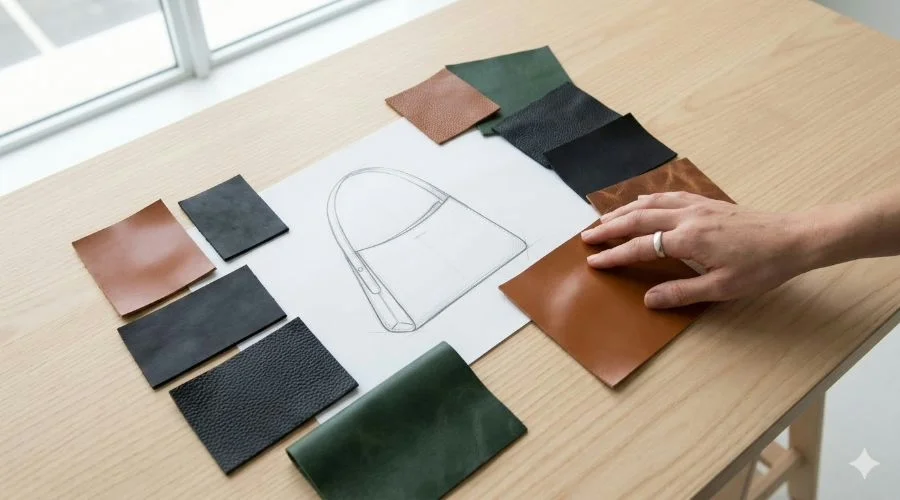
Define your bag’s category. In my factory experience, mismatching a bag’s finish to its daily use guarantees a high return rate. Specify if you are building a structured daily tote, a soft fashion shoulder bag, an occasion bag, a heritage design, or a premium corporate gift.
Establish the sensory baseline. Describe the expected handfeel, weight impression, and light reflection. The exact same shiny gold hardware feels luxurious on an evening clutch but proves completely impractical on a commuter backpack.
Use this decision logic to align your finishes:
-
Daily-Use: Favor durable, wipeable surfaces and heavily coated, scratch-tolerant hardware.
-
Fashion-First: Allow softer, delicate finishes that prioritize drape over rigidity.
-
Heritage: Choose antique brass, distressed textures, and lower-luster surfaces.
-
Minimalist Luxury: Specify brushed gold, smooth satin leather, and clean painted edges.
Present your requirements to the factory using one of two methods. Write a formal tech-pack finish brief, or build a physical finish board with approved reference photos and material swatches.
Describe finishes by texture and reflectivity. Never rely on color alone. For example, explicitly request a “low-luster brushed gold clasp with linear grain.” Do not just ask for “gold hardware.”
Write your final one-line finish statement. It should read exactly like this: Semi-matte structured tote with brushed gold hardware and painted edges.
⚠️ Experience Warning: If you cannot summarize the bag’s finish identity in a single sentence, your brief is too vague. Factory engineers will guess your intent, and they usually guess wrong. Stop and refine your sensory goals before you request a prototype.
Step 2: Select the Leather Finish Specification
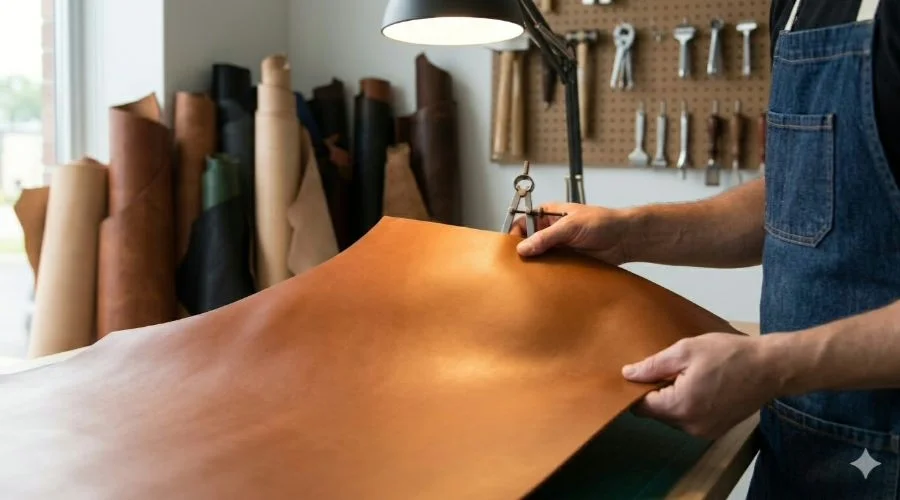
Define your bag finishes with strict sensory requirements.
Request physical tannery swatches. Feel the surface. Note if the texture is soft, waxy, dry, slick, pebbled, or stiffened. Check the light reflection to confirm a matte or shiny leather appearance.
Choose from four core leather families:
-
Aniline: Select for premium grain visibility. This yields a delicate luxury finish.
-
Semi-Aniline: Choose to balance a natural look with moderate surface protection.
-
Pigmented: Pick for consistent color and excellent wipe-clean performance.
-
Embossed: Specify Saffiano or croc for stiffened structure and low-maintenance styling.
Match your finish to the product application:
-
Structured work tote: Select Saffiano, semi-aniline, or firm cross-grain leather.
-
Slouchy fashion bag: Use a soft pebble micrograin or nubuck accents.
-
High-end heritage bag: Choose full-grain leather to maximize patina potential.
Compare your options using this matrix:
| Finish Type | Natural Look | Stain Resistance | Wipe-Clean Performance | Tendency to Crease | Daily Use Suitability |
|---|---|---|---|---|---|
| Aniline | High | Low | Poor | High | Low |
| Semi-Aniline | Medium | Medium | Fair | Medium | High |
| Pigmented | Low | High | Excellent | Low | High |
| Embossed | Low | High | Excellent | Low | High |
If swatches are unavailable, approve physical factory sample references. Write the exact grain pattern and sheen level in your tech pack. Describe the physical texture in plain text for screen readers and colorblind users. Avoid relying on photo captions.
Verify your choice. The physical handfeel must match the maintenance level promised to your customer.
🚀 Actionable Insight: Never use generic terms like “nice leather.” Define your material with strict phrasing (e.g., matte pigmented leather with a soft pebble micrograin).
Step 3: Specify the Hardware Plating and Visual Finish
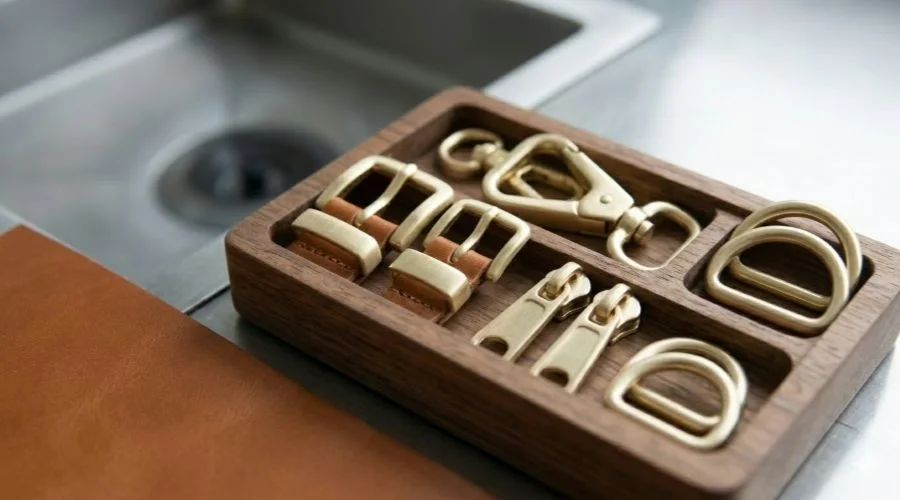
Ask your supplier to identify the hardware’s base substrate. Choose your finish application process using the table below. Select Electroplating for standard runs or Physical Vapor Deposition (PVD) for premium durability.
Choose Shiny Gold for elegance (note: prone to prints/scratches), Brushed Gold for modern low-glare luxury, or Antique Brass for a heritage feel. Matte Black and Gunmetal best hide abrasions. Always verify tactile feel and grain on physical samples.
Specify finishes directionally (e.g., “Linear Brushed Warm Gold”) for clarity and accessibility. Define bag finishes by quoting factory finish cards, Pantone metal references, or providing a physical reference sample.
Define strict expectations for wear and color consistency. Require an official ISO 9227 corrosion test report to verify metal durability.
| Finish system | How it is applied | Relative hardness / scratch resistance | Corrosion / tarnish resistance | Finish look options | Relative cost impact | Best use case | QC note |
|---|---|---|---|---|---|---|---|
| Electroplating | Chemical liquid bath | Moderate | Moderate | High gloss, antique, nickel-free silver | Low | Standard fashion bags | Inspect for uneven plating thickness. |
| PVD Coating | Vacuum chamber vapor | Excellent | Excellent | Brushed, matte, rich tones | High | Premium luxury bags | Check for visual sharpness on matte hardware. |
🔍 How We Tested: We inspected bag finishes under direct light. Shiny hardware showed micro-abrasions instantly. The physical grain of brushed hardware completely hid daily wear.
Step 4: Choose the Leather Edge Finish
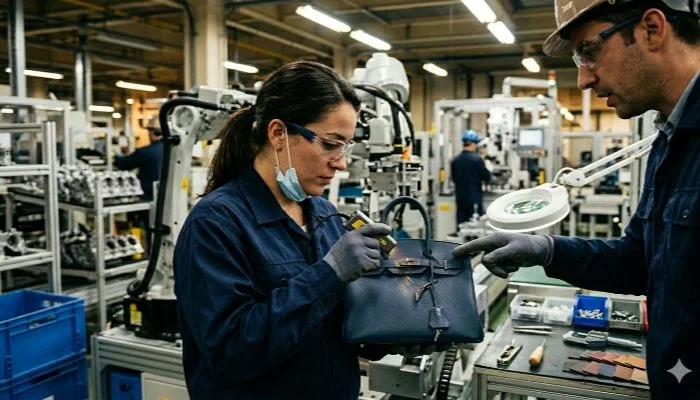
Design failures often stem from preventable production oversights. Minor technical errors can lead to costly QC rejections and brand damage. Here is a breakdown of common manufacturing symptoms and the specific fixes needed to secure your product quality.
Symptom 1: Hardware Scratches During Assembly
Factories often use standard electroplating instead of PVD. Workers may also skip protective wrapping. In our factory audits, we see premium matte hardware ruined when buckles clink together in transit bins.
-
Check your tech pack. Specify PVD coating for high-contact areas.
-
Require protective polybagging for all metal parts on the line.
-
Approve a specific packing method before bulk production.
Symptom 2: Bulk Order Tone Mismatch
Buyers frequently approve brushed gold or antique brass bag finishes from a photo. Do not do this. A slight change in the base metal completely alters the final tone.
-
Lock a physical control sample. Sign and date it.
-
Define an acceptable tone variance in your manufacturing contract.
-
Order the exact same finish process for repeat batches.
Symptom 3: Edge Paint Cracks at Corners
Thick edge paint snaps under stress when applied to flexible leather. We purposely fold strap samples in half 50 times to test durability.
-
Review your leather thickness against flexibility requirements.
-
Confirm the factory uses a multi-layer sanding process.
-
Test the edge flex vigorously before prototype approval.
🛡️ Prevention: Luxury finishes raise costs without improving perceived quality if applied poorly. Downgrade your finish complexity on low-wear areas. Reserve premium finishes for hero SKUs and high-touch zones.
Conclusion: Finalize Your Finish Specifications
You now have a complete framework to choose leather finishes, hardware plating, and edge methods. Based on our review of hundreds of tech packs and thousands of hours on the factory floor, we know a hard truth. Professional bag finishes come from clear manufacturing specifications, not vague style language.
Your immediate next step is simple. Compile your chosen leather finish, hardware process, metal tone, edge method, and quality requirements into one single finish-spec page. Add this page directly to your tech pack.
Are you ready to build a physical prototype? Send your finish brief to our team at LantaoBags. As expert custom handbag manufacturers, we will review your specs and flag any durability risks before production begins.
Contact us today to start sampling. Remember, one approved golden sample is worth more than ten vague finish references.
People Also Ask About Bag Finishes
1. What is the minimum order quantity (MOQ) for custom hardware finishes?
Most factories require 1,000 units for custom Physical Vapor Deposition (PVD) hardware. However, we often accept 50 to 100 units for standard electroplating. If you want custom branded zipper pulls, expect a higher mold fee. You should buy hardware in bulk and use it across multiple bag designs to save money.
My Experience: The biggest headache we faced last quarter was a startup demanding custom matte black PVD on a 50-unit order. Partner factories rejected the low volume. We solved this by sourcing a pre-molded zinc alloy and applying a high-grade standard electroplate.
2. How do I match hardware colors across different bag components?
You must order all metal components from the exact same plating batch. Do not mix suppliers. A zipper from one factory will never perfectly match a D-ring from another. Buy all components together to guarantee a uniform tone.
Author’s Take: When I review production runs, I mandate a master color standard. We check every single piece against this physical sample under neutral daylight. We immediately reject any hardware that shows a red or green undertone.
3. Does edge painting make a leather bag more durable?
No. Edge paint seals raw leather fibers, but it actually introduces a cracking risk. Thick paint on a flexible shoulder strap will snap over time. If you need maximum durability for a heavy-duty commuter bag, use a folded edge instead.
I regularly advise clients to test their edge flex properties under ISO 17233 standards before they approve the final design.