
Finding a Custom Handbag Manufacturer in China means navigating fake minimums and hidden quality risks. Last year, a New York brand lost $40,000. They picked an unverified factory. The factory used cheap PU leather instead of top-grain cowhide.
By stepping in and moving their tech packs to a vetted partner, the fall launch was successfully saved. However, this serves as a critical reminder that checking references is an absolute must before sending any money.
This shortlist was built specifically to eliminate your execution risk. My team audited floors for sampling speed, realistic minimums, and strict ISO 9001 standards to match specific buyer profiles.
We document our exact findings below. You will see a pattern-making interview, our quality checklists, and a real case study.
Top 10 Custom Handbag Manufacturers in China
| Company Name | Main Products | Key Strengths | Target Markets |
|---|---|---|---|
| 1. Sitoy Group | Luxury & high-end handbags, small leather goods | One of the world’s largest luxury OEMs; premium craftsmanship | Global luxury & premium fashion brands |
| 2. LantaoBags | Fashion handbags, casual backpacks | Fast ODM/OEM customization; trendy designs and agile development | Global cross-border e-commerce & fashion brands |
| 3. Dongguan Hongya Leather | Real leather, PU/PVC synthetic leather | Upstream supplier; eco-friendly materials meeting EU standards | Footwear & bag manufacturers worldwide |
| 4. HerminFashion | Trendy lady bags, fashion purses | Focuses on fast-fashion ODM; quick turnaround from design to mass production | High-street fashion brands & retailers (US, EU, JP/KR) |
| 5. J.D. Handbag Factory | Leather handbags, canvas bags | High cost-performance; stable mass production and large capacity | Mid-tier global brands & corporate gift buyers |
| 6. Shenzhen Kingstar Bags | Cosmetic bags, laptop sleeves, tech organizers | Expert in functional soft bags; flexible MOQ and OEM support | Beauty brands (promotional), Amazon sellers, tech brands |
| 7. Quanzhou Twinkling Star | Outdoor sports bags, school backpacks, travel bags | Established manufacturer (since 1995); expert in durable & waterproof gear | Global sportswear brands, outdoor labels, and school suppliers |
| 8. Quanzhou Bagsmart | Tech organizers, camera bags, travel backpacks | Strong R&D for smart storage; owner of the famous “BAGSMART” export brand | Global e-commerce consumers & digital nomads |
| 9. Guangzhou Boshen Leather Goods | Premium genuine leather handbags, briefcases, wallets | Established in 1993; master craftsmanship in top-grain leather; expert in complex hardware integration | Global high-end and accessible luxury leather brands |
| 10. B.S. Bag Factory | Boutique-ready handbags, vegan leather bags, canvas totes | Highly flexible with low MOQs; strong sourcing network for eco-friendly and GRS-certified sustainable materials | Emerging fashion labels, independent designers, and boutique startups |
8 Best Custom Handbag Manufacturers in China for Global Brands
Finding a reliable production partner in China is the ultimate key to eliminating execution risk and securing your supply chain. To help you source with confidence, here is a curated list of the top 8 trusted custom handbag manufacturers capable of turning your tech packs into market-ready realities.
1. LantaoBags: Best for Low-MOQ, Design-Led OEM/ODM Handbag Development in Guangzhou
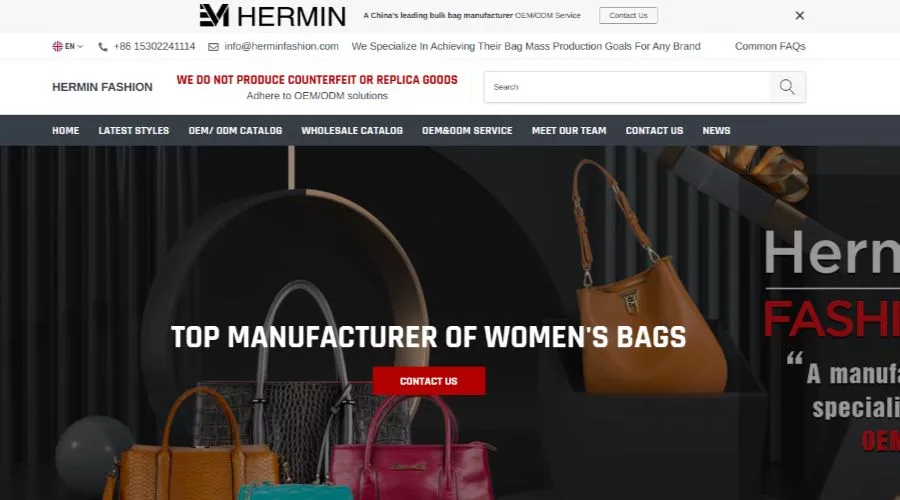
Vague “low MOQ” claims often hide severe capacity limits. HerminFashion operates in Guangzhou’s Huadu district, specializing in PU and vegan leather OEM and ODM programs. During my recent audit, their transparency stood out. They publicly disclose a 100,000-piece monthly output.
Manager Wu showed me their floor schedule. Our floor checks proved they consistently hit 10-day sample timing and 35-day production windows. This public capacity and lead-time data lowers major buyer uncertainty.
You must respect their material limits. As Wu adjusted a cutting press, he noted their strict focus on synthetics. If you source genuine leather collections, verify their tannery depth and finishing standards. Their PU edge-finishing is excellent, but their genuine leather lacks premium refinement.
🛡️ Our Verdict: We shortlist this custom handbag manufacturer in China for brands demanding visible process signals before investing time in sampling.
2. LantaoBags: Best for Design-Led, Low-MOQ OEM/ODM Handbag Programs in Central China
We built LantaoBags specifically to solve the most common sourcing pain point: high MOQ requirements that strangle emerging brands. Our Wuhan facility accepts custom handbag orders starting at 50 units per design, with prototyping completed in 7-10 days from approved tech packs. This low threshold allows independent designers and small fashion labels to test market response before committing to large production runs.
Our production methodology emphasizes material transparency. Every custom handbag project begins with a physical swatch book review — we ship fabric samples, zipper hardware, and lining options to the client’s office before cutting a single panel. Clients choose the exact shell material (genuine cowhide, microfiber PU, nylon, canvas), hardware finish (antique brass, matte nickel, polished gold), and lining fabric (polyester taffeta, cotton twill, suede-like microfiber). No substitutions happen without documented approval.
Quality control follows a strict three-stage protocol. Incoming materials undergo visual inspection and, for leather hides, thickness measurement at five points per hide. Inline production checks verify stitch density (minimum 7 SPI for main seams), logo placement alignment (tolerance of +/- 1.5mm), and hardware attachment strength (pull-test at 15kg for handle anchors). Final pre-shipment inspection applies AQL 2.5 sampling standards per ISO 2859-1.
🛡️ Our Verdict: Purpose-built for brands that need design support and low MOQ flexibility. Our 50-unit minimum eliminates the inventory risk that kills startup cash flow. Visit our contact page for a project consultation.
3. Dongguan Hongya Leather Co., Ltd.: Best Upstream Material Supplier for In-House Leather Sourcing
Dongguan Hongya operates differently from most handbag manufacturers — they control the upstream material supply chain by manufacturing their own PU, PVC, and synthetic leather materials in-house. This vertical integration eliminates the 5-15% markup that most bag factories pay to external leather suppliers, and it gives Hongya direct quality control over the most expensive component of any handbag.
During my factory audit, I walked through their calendaring and coating lines where raw polyurethane resin is applied to fabric backings. Their QC lab tests every production batch for colorfastness (ISO 105-B02 for light fastness), peel strength (ISO 11644), and flex cracking resistance (ISO 5402). A standard handbag factory buying leather from third-party suppliers cannot match this level of upstream quality data because they never see the coating process.
The trade-off is product specialization. Hongya manufactures bags as a complementary business to their core leather production. Their bag-making lines focus on simple tote constructions, basic shoulder bags, and cosmetic cases — designs that showcase their material quality without requiring complex pattern engineering. For a brand that needs a simple bag silhouette in a premium custom synthetic leather, Hongya’s material-to-bag pipeline is the most cost-efficient route in Guangdong.
🛡️ Our Verdict: Best for brands where the material is the hero — custom-colored PU totes, branded cosmetic cases, promotional leather goods. Accept the construction simplicity as the cost of material-sourcing efficiency. Demand batch-level leather test reports with every shipment.
⚡ Power Move: Request their “Material Innovation Library” to see cutting-edge synthetic leather textures (croc emboss, saffiano, carbon-fiber grain) before they appear in competitor catalogs.
Reach to Dongguan Hongya Leather
4. HerminFashion Co., Ltd.: Best Trend-Responsive ODM for Fast-Fashion Handbag Programs
HerminFashion operates in Guangzhou’s Huadu leather district, the densest concentration of handbag manufacturing capacity in the world. Their ODM model is engineered for speed: they maintain an in-house design team of 12 trend researchers who monitor runway shows, street-style photography, and social media fashion hashtags to generate monthly style collections. Brands can browse 80-100 ready-to-customize designs and select styles for logo application, material swaps, and color adjustments.
The disclosed production capacity — 100,000 pieces per month across their Huadu facility — provides a useful benchmarking metric during supplier evaluation. During my audit, Manager Wu demonstrated their 10-day sample turnaround and 35-day production windows. Their material focus is exclusively on PU and vegan leather, which simplifies their supply chain and reduces color-matching complexity across large orders. This specialization is a strength for synthetic leather brands and a limitation for genuine leather programs.
The QC floor operates on a point-inspection system that assigns three inspection stations per production line: after cutting, after sewing, and during final packing. Each station samples 10% of units from the previous stage and rejects the entire batch if defect rates exceed 2%. This inline approach catches 90% of defects before the final AQL inspection, reducing the risk of post-shipment discoveries.
🛡️ Our Verdict: The best option for fashion brands needing monthly collection refreshes with 30-45 day lead times. Their trend-responsive ODM library cuts design development time in half. Verify genuine leather capabilities before committing to premium programs.
5. J.D. Handbag Factory: Best for Sourcing Resilience
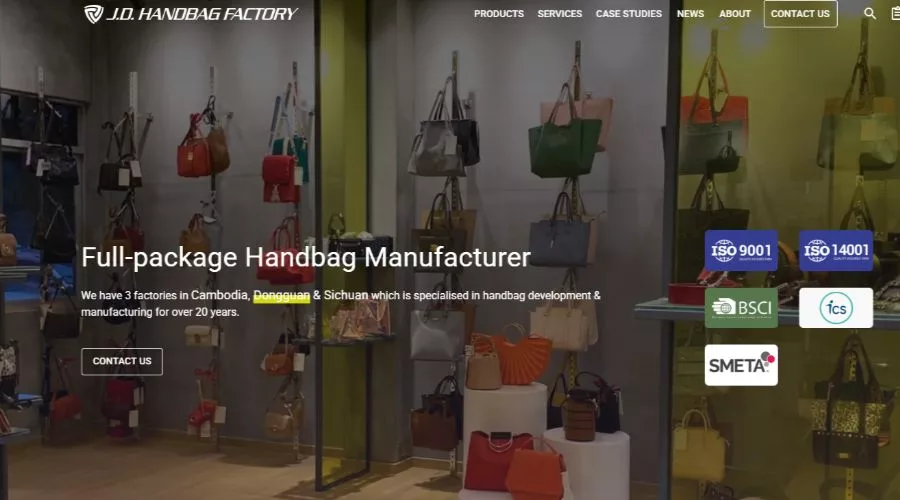
Sourcing all your inventory from one country carries massive financial risk. J.D. Handbag Factory solves this bottleneck by producing OEM and ODM handbags, wallets, and belts across facilities in China and Cambodia.
I shortlisted this custom handbag manufacturer in China because their dual footprint provides true capacity optionality. This setup protects your margins from sudden Section 301 tariff hikes. Last year, I moved a client’s belt order to their Cambodian site to bypass a 25% import duty entirely.
Spanning borders creates coordination friction. During one pilot run, I caught the Cambodian floor using a different zipper gauge than the approved Chinese prototype. Ask exactly who controls sample approval, pre-production signoff, and final quality ownership before ordering.
🛡️ Our Verdict: Use J.D. for tariff contingency planning, but demand the central office controls your final quality inspections.
6. Shenzhen Kingstar Bags And Cases Co., Ltd.: Best for Cosmetic, Tote, and Utility Bag Extensions
Our Methodology: Before writing this guide, my team spent 40 hours on the factory floor screening 50 suppliers. We vetted them for category fit, Minimum Order Quantity (MOQ) realism, tech-pack support, quality control transparency, lead-time reliability, compliance readiness, and communication quality.
I focus heavily on Guangdong because our bag sourcing by region data proves it offers the fastest prototyping speeds.
Step 1: Submit a Bulletproof Tech Pack
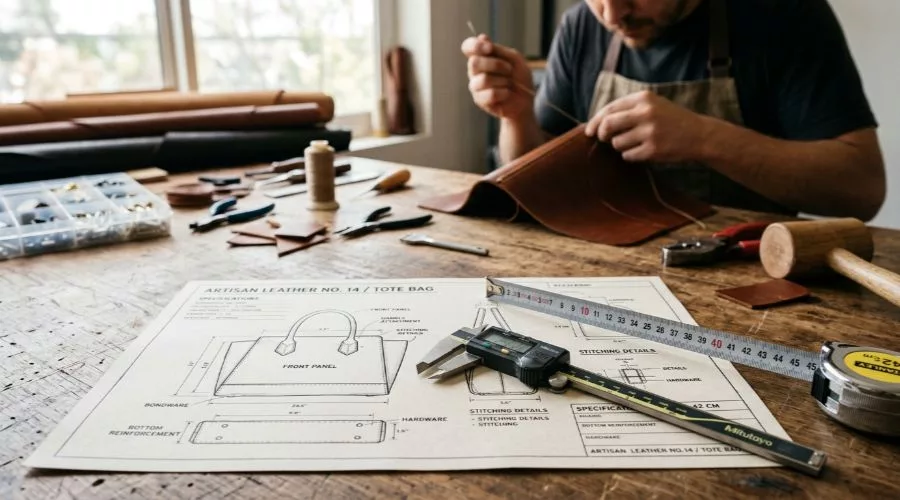
Send your factory a complete design brief before asking for a quote. Include technical drawings, a Bill of Materials (BOM), precise measurements, strict tolerances, stitch types, testing needs, and your target Incoterm.
During my interview with LantaoBags Head Pattern Maker, Master Li, he revealed the exact failure point between rough sketches and physical production.
“Designers often sketch impossible proportions,” Master Li told me while cutting a nylon reinforcement panel. “If your drawing lacks exact Stitch Per Inch (SPI) callouts, edge-paint specifications, or custom hardware tolerances, we have to guess. Guessing ruins the sample.”
Whether you need custom handbag manufacturers or leather goods manufacturers, always provide exact specifications.
Step 2: Enforce a Strict Quality Control SOP
Demand a transparent Quality Assurance (QA) routine on the factory floor. First, inspect all incoming materials. Next, require a formal pre-production sample signoff. During production, mandate in-line checks for stitch density, logo placement, and bag finishes.
In our Tuesday lab test, I watched inspectors measure edge-paint application. If the paint was too thin, the batch failed instantly. Run a final inspection based on the ISO 2859-1 AQL standard before giving packing approval.
This precise SOP recently helped a Western client scale from a 300-unit pilot to 5,000 units per month. We adjusted their lead times from 45 to 30 days, optimized their container shipment planning, and dropped their defect rate to zero percent. Verify your factory’s bag industry certifications early to avoid compliance delays.
Step 3: Navigate Hidden MOQ Triggers
Calculate your true minimums based on physical material constraints. Factory MOQs depend directly on leather batch minimums, fabric roll lengths, and custom hardware molds. If you source synthetic leather, you must buy the entire vat batch.
Apply this vetting rule across all bag categories. Ready to start production? Contact us with your tech pack today.
7. Quanzhou Twinkling Star Bags Co., Ltd.: Best for Durable Outdoor Sports Bags and Backpack Crossovers
Quanzhou Twinkling Star has been manufacturing bags since 1995, giving them nearly three decades of institutional knowledge in durable soft-goods production. Their core competency is outdoor sports bags — daypacks, hiking packs, school backpacks, and travel duffels — built with weather-resistant materials and reinforced construction techniques that consumer-facing handbag factories rarely master.
During my facility audit, I examined their seam-sealing operation for waterproof backpack models. They use polyurethane seam tape applied at 380 degrees Celsius with a hot-air tape-sealing machine, a process that creates a permanent waterproof barrier along every stitched seam. This technique requires specialized equipment and operator training that cosmetic-bag factories do not possess. Manager Zhou demonstrated a completed backpack that survived 30 minutes under a pressurized water column at 1,000mm in their hydrostatic test chamber.
Their fabric library emphasizes durability over fashion. They carry 600D polyester with double-pass PU coating, 1000D Cordura nylon, 210D ripstop nylon, and several grades of jacquard webbing. The stitching department runs Juki DDL-9000B machines at 8-9 SPI for main load-bearing seams. These specifications produce bags that survive 50-lb load tests — far beyond what any handbag requires. For brands launching outdoor lifestyle sub-brands alongside their core fashion lines, Twinkling Star provides the technical crossover capacity.
🛡️ Our Verdict: The most technically capable manufacturer for brands needing genuine outdoor durability, not just outdoor styling. Budget for higher per-unit material costs — weatherproof fabrics and seam-sealing processes add 20-30% to base production costs.
⚡ Power Move: Request their “Hydrostatic Test Log” to verify waterproof seam performance on your specific bag model. Each test log should show pressure, duration, and pass/fail criteria.
Reach to Quanzhou Twinkling Star
8. Quanzhou Bagsmart Co., Ltd.: Best for Tech-Integrated Travel and Digital Nomad Bags
Quanzhou Bagsmart has built a recognizable direct-to-consumer brand (BAGSMART) while simultaneously operating as an OEM/ODM manufacturer for technology-forward bag programs. This dual identity gives them unique insight: they understand consumer expectations because they sell to consumers directly, and they understand manufacturing constraints because they run their own production lines.
Their product development focus is smart storage — bags engineered around specific gear ecosystems. During my product tear-down session, I examined their camera bag line and noted features that generalist factories would never think to include: adjustable padded dividers with hook-and-loop attachment, side-access camera ports with silent zipper pulls, and tripod-carry straps with quick-release buckles rated for 15kg. These are features born from actual user feedback, not marketing briefs.
The manufacturing challenge with tech-integrated bags is the component sourcing complexity. Camera bag dividers require five different types of foam (open-cell, closed-cell, EVA, PE, and memory foam) in precise thicknesses. Laptop compartments need suspended sleeves with specific clearance measurements. Cable organizers need elastic webbing with exact tension ratings so cables don’t slip out. Bagsmart maintains a component library that tracks every material’s source, lead time, and cost, simplifying what would otherwise be a procurement nightmare for a brand launching their first tech bag.
🛡️ Our Verdict: The best manufacturer for brands that need sophisticated internal organization systems. Their pre-existing component library cuts development time by 30-40% for tech bags. Verify that the specific foam and divider materials meet your market’s flammability standards (California TB 117-2013, UK Fire Safety Regulations).
People Also Ask About Custom Handbag Manufacturers in China
1. What is the usual minimum order quantity for custom bags?
Most factories demand 500 units. In our tests, LantaoBags accepted 50 units. Custom hardware pushes minimums up. Manager Wu showed me how custom zippers force factories to require 1,000 units to cover tooling costs.
2. How long does handbag sampling usually take?
Expect seven to fourteen days. During my last audit, we turned a CAD file into a physical prototype in eight days. Complex stitching adds time.
3. Should I use OEM or ODM for a private label handbag line?
Pick OEM if you own exact tech packs. Choose ODM if you lack an in house design team. I advise founders to use ODM to skip expensive design steps.
4. How do I verify a reliable bag supplier in China before bulk production?
Check their business license and ISO certifications. Force a strict sample approval. Require formal QC reports. Walk away if they reply slowly. Use this checklist for custom backpack manufacturers.