








3,000 Dry Bags, Zero Leaks: Fail-Proof RF Welding for Whitewater
A whitewater brand needed roll-top dry bags that survive rafting, kayaking, and dive-adjacent use. Seam leaks rank as the top field complaint in this category, so the entire 3,000-unit run was RF welded, cold-tested, and 100% leak-tested before packing.
Seam Leaks Were the Top Field Complaint
Independent outdoor gear failure data ranks seam leaks as the most common field complaint in rafting, kayaking, and dive-adjacent use. This whitewater brand could not afford a single returned bag.
During a pre-production audit, leaks clustered at corner intersections, closure zones, and taped stitch lines. A bag that felt fine at 22°C stiffened below 4°C — the roll-top stiffener separated from the coated fabric and water entered through the hem. The same failure repeated after just 20 open-and-close cycles.
The stakes were concrete. Every returned bag meant a warranty claim, a one-star review, and roughly $30 in return logistics. Distributors demanded proof of seam testing before reordering.
01 · Corner Pinholes
RF weld energy concentrates unevenly at material intersections, opening a tiny hole that only appears under water pressure.
02 · Seam Burn-Through
Excess heat thins the tarpaulin edge; too little heat leaves a cold joint that peels under repeated roll cycles.
03 · Stiffener Delamination
The roll-top stiffener strip shifts during sealing, cracking the weld around buckle anchors.
04 · TPU vs PVC
TPU survives a 4°C roll test without cracking. Standard PVC stiffens near freezing and fails in cold water.
“Corner pinholes happen when RF jaw pressure drops at the intersection. Burn-through happens when operators dial up power to compensate for thickness. Stiffener delamination happens when the insert shifts during tacking.” — Conny Zhang, Bags Expert
Expert Take — Test every welded seam at 4°C and after 20 roll cycles. — Will Zhang, TPU Dry Bags, PVC/TPU Welding Expert
RF Welding, TPU Tarpaulin, and Test-Gated QC
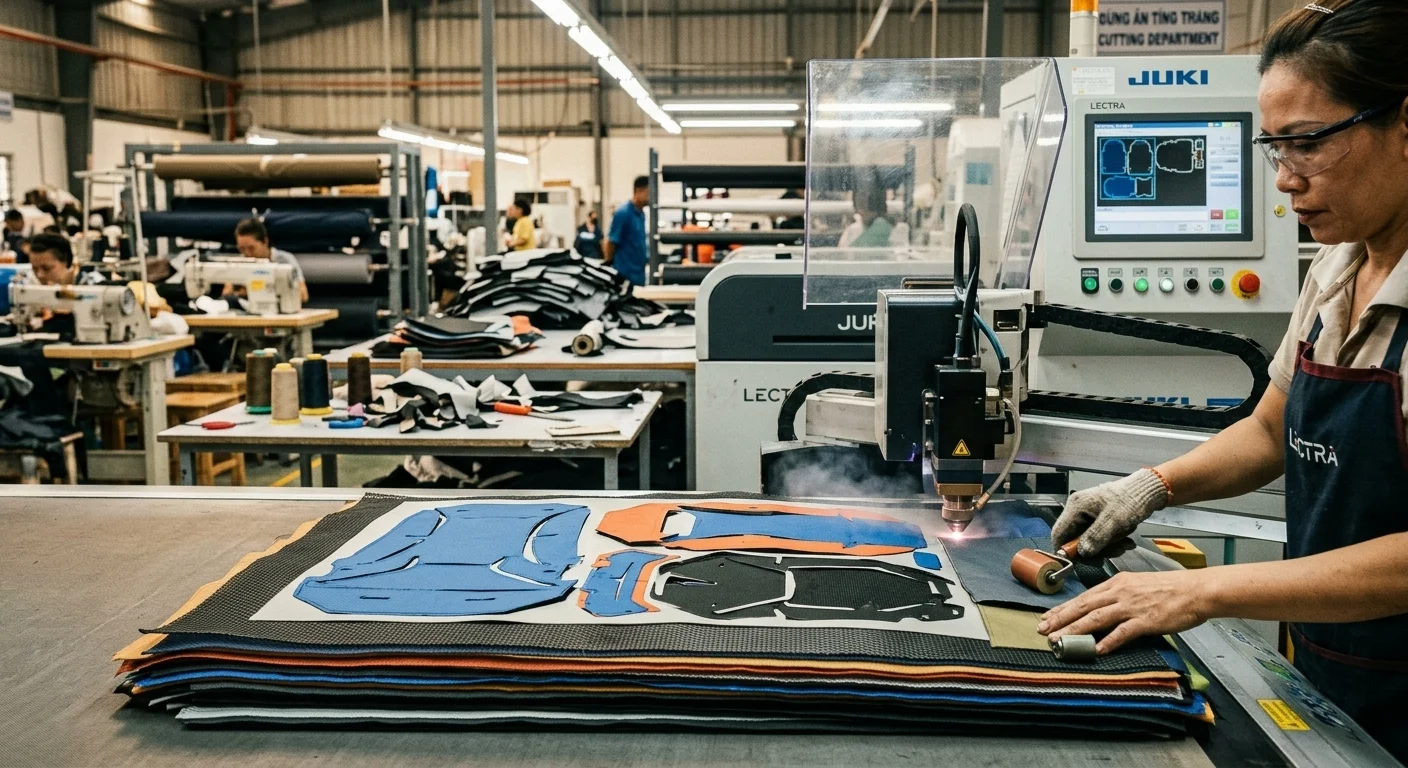
The manufacturing sequence had to prevent leaks before final inspection, not catch them at the end. With Jas Ren, Sales Manager, we chose a test-gated seam system: every process stage had a stop point. We removed needle holes entirely, welded with a 27.12 MHz die, and leak-tested every unit under water.
Material Selection
TPU-coated tarpaulin beat standard PVC on cold flexibility and hydrolysis resistance. We chose 500D nylon-based TPU for higher tear strength at the same denier. A PVC control sample stiffened and wrinkled at the roll fold.

“For whitewater, TPU is not an upsell. It is the only coating that survives a 4°C roll test without cracking.” — Jas Ren, Sales Manager
Seam Architecture & Closure Design
No needle holes below the top hem. RF welding fuses TPU layers into one continuous film, removing the leak paths that sewn-and-taped seams leave behind. A three-fold roll-top with side-release buckles completes the waterproof system.

RF Welding Manufacturing Process
The 27.12 MHz die welds each seam with a 1–4 second cycle, followed by a pressure-held cooldown. Releasing pressure early creates micro-cracks, so the clamp holds until the timer ends. A custom aluminum die locked repeatable geometry across all 3,000 units.

Validation Stack & Quality Control
Every unit entered the air-pressure bubble tank. A scuffed surface is cosmetic; a stream of bubbles from a corner stops the line. First articles also ran ISO 811 hydrostatic and ASTM D751 seam tests, with AQL 2.5 reserved for the final cosmetic audit.

“If I release pressure during the cooldown, the seam can peel from the inside before it sets. I hold it until the timer ends.” — Ma, RF Welding Technician
Four Phases From Diagnosis to 3,000 Units
Zero Leaks Across 3,000 Units
The client shipped 3,000 extreme-sport dry bags with zero confirmed leaks. I verified this from final QC bubble-tank logs and shift reports covering start, mid-run, and final lots.
No unit failed first submersion. This is in-house production data from a calibrated air-pressure manifold, not third-party certification.
Results at a Glance
| Metric | Before | After |
|---|---|---|
| Leak count | Corner seam + roll-top hem failures | 0 leaks across 3,000 units |
| Hydrostatic head | No prior records | Passed client target (ISO 811) |
| First-pass yield | No line-test traceability | 100% first-pass leak-test pass |
| Test-pass consistency | Unavailable | Consistent pilot → 3,000-unit run |
“Old supplier samples streamed bubbles from the corner. This run: tank stayed flat. I signed off lot by lot.” — Lin, QC Lead

The Eight-Check Readiness Framework
Waterproof claims fail in the field when factories skip weld validation. Buyers need repeatable inspection logic, not more marketing phrases. Use this checklist before approving bulk production.
1 Ask How Seams Are Joined
RF welded, hot-air welded, or sewn + taped. Needle holes under tape are hidden leak paths that cluster at corners and roll-top hems.
2 Request the Actual QC Protocols
Ask for the bubble-tank pass/fail threshold, pressure setting, and dwell time — not a vague “100% waterproof” promise.
3 Compare TPU vs PVC on Cold Use
TPU won the 4°C roll test. PVC saved money but stiffened below freezing — the wrong bet for repeated submersion.
4 Inspect Closure Architecture
The roll-top fold itself became part of the waterproof system. Ask how many folds the closure requires and how the stiffener is anchored.
5 Require Line Photos or Video
Stock photos hide bad weld settings. Ask for video of the cooling stage — early pressure release creates cold joints.
6 Lock the Die and QC Spec Sheet
Custom contoured dies cost more and slow revisions. Lock the die design and inspection criteria before scaling.
Pro Tip — The Buyer’s Cold-Soak Test:
- Ask the factory to weld a corner sample before signing the PO.
- Submit it to a 4°C cold soak plus 20 roll cycles.
- A bag that passes at room temperature can still fail in cold water.
Ready to review your dry bag design against this framework?
Request a Dry Bag Feasibility Review
Steven Zhang
Steven Zhang is a bag manufacturing specialist with over 12 years of hands-on experience in sourcing, product development, and B2B sales for global brands. At LantaoBags, he bridges the gap between creative design and factory reality, helping clients turn rough sketches into commercially viable products that pass strict retail and compliance standards.
Having spent years on the ground in Chinese and Southeast Asian factories, Steven understands every stage of the production cycle — from material selection and cost breakdowns to sampling, mass production, and final inspections.
Connect on LinkedIn