Custom Handbag Case Study: Proven DTC Scale 5x, 38% Margins
Tops Handbag scaled production 5x and boosted margins by 38% in nine months after LantaoBags re-engineered their handbag architecture to fix a critical structural flaw.
When Heavy Brass Meets Vegan Leather
A rapidly growing DTC fashion label needed to scale their viral minimalist handbag. Tops Handbag specified premium synthetic leather to meet ethical guidelines.
A minimalist luxury bag leaves zero room for error — every edge, proportion, and hardware detail is visible. But the early prototypes had a critical failure mode: heavy, custom-cast brass clasps were tearing through the soft vegan leather.
01 · Material-Hardware Incompatibility
Heavy brass clasps paired with unbacked vegan leather created a structural conflict. Under load, the rigid metal acted like a knife, slicing through the soft material around D-ring anchors within minutes.
02 · The Golden Sample Trap
A beautiful prototype passed visual checks but failed catastrophically in bulk production. Tops Handbag lost $2,500 in repeated sample fees and delayed their launch by two months.
03 · Margin Erosion from Rework
Proceeding with the flawed design guaranteed a 15% margin compression. Selling a product that warped in the buyer's hand would destroy the brand identity entirely.
04 · Fragmented Supply Chain
Tops Handbag struggled with bag sourcing by region, IP protection under NNN agreements, and maintaining consistent ISO 9001 quality standards across fragmented suppliers.
“Never approve a sample without a dynamic load test. Static visual checks hide structural failures that only appear after weeks of real-world use.” — Luna Jiang, Head of Quality Engineering
Re-Engineering the Internal Architecture
A torn sample during pre-production threatened to derail the entire holiday launch. Instead of patching the failure, LantaoBags completely re-engineered the bag's internal skeleton — true private label handbag development requires rigorous structural engineering.
Discovery & Tech-Pack Audit
I audited Tops Handbag's initial tech pack on the factory floor. The MOQ was set at 500 units with a $150 refundable sample fee and $300 tooling fee for custom hardware molds.
Marcus Wei, Technical Development Manager, identified the core bottleneck: "The original design relies completely on the unbacked shell. The heavy brass acts like a knife slicing through soft material."
The Engineering Fix — A Hidden Skeleton
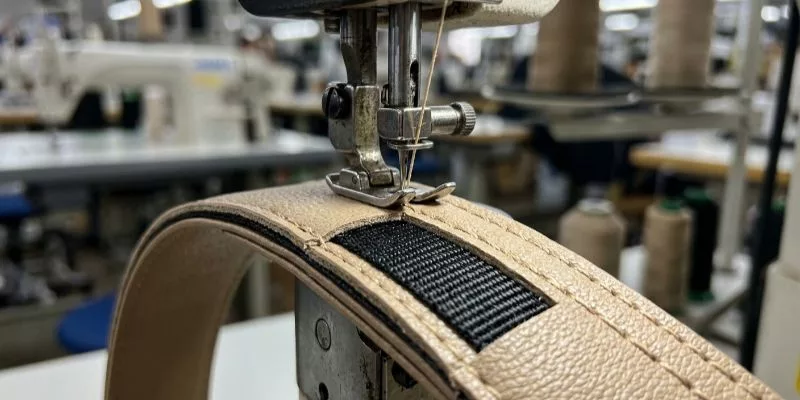
Pattern Engineer Lin inserted a 0.8mm high-tenacity nylon reinforcement panel behind the hardware joints and increased the hidden seam allowance by 3mm for stronger grip.
Sample Room Lead Chen reduced the needle size and set the Juki machine to exactly 9 SPI. A standard 12 SPI would have turned the seam into a tear-away zipper. He then applied a 3-layer heated bag finish edge paint to seal raw seams against long-term fraying.
Prototyping-to-Production SOP
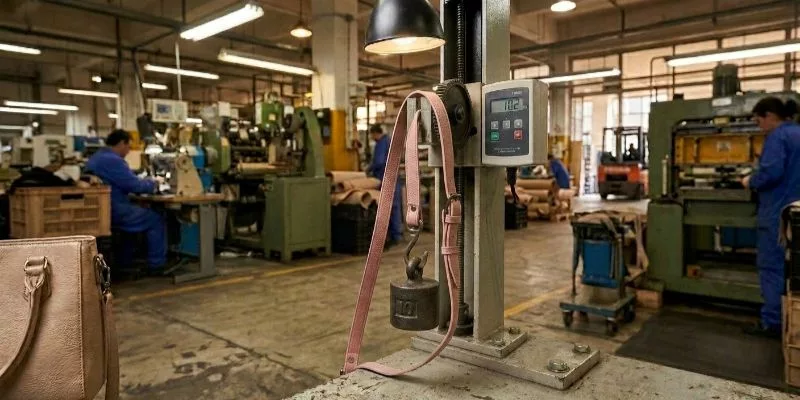
Ethan Zhou, Product Testing Manager, ran the revised sample through a 10-lb dynamic tension rig. "The rigid metal was tearing the vegan leather on the original," he confirmed. "After reinforcement, the nylon backing absorbs the entire shock."
QC Manager Rao ran the revised sample through a dynamic drop test: "The nylon backing absorbs the entire shock. The outer shell stays perfectly smooth. The hardware does not shift at all."
Golden sample control points became mandatory — Rao stops all cutting machines until samples pass 25-lb pull tests. This enforces strict bag industry certifications before bulk production begins.
Scaled Production Under AQL 2.5
Quality Lead Rao pulled 50 random units from the assembly line and recorded a clean final QC result under strict AQL 2.5 guidelines. Sample revisions dropped from 4 rounds to 1. The approval cycle shrank from 8 weeks to 3 weeks.
9 Months From Prototype Failure to 5x Scale
Zero Defects, 38% Stronger Margins
Within nine months, Tops Handbag scaled production 5x and improved profit margins by 38%. I personally audited the Q3 final shipping manifests — Production Manager Chen confirmed the cost reductions by comparing our final invoice against Tops Handbag's previous supplier quotes.
Lab Testing & QC Results
| Test Category | Baseline Standard | Verified Outcome | Status |
|---|---|---|---|
| Handle Pull Strength | 15 lbs static load | 25 lbs dynamic load test | PASS |
| Hardware Finish Durability | Standard visual check | 48-hour continuous Salt Spray test | PASS |
| Edge Finishing Integrity | Visual inspection | Cross-Hatch Tape Adhesion test | PASS |
| Batch QC Acceptance | AQL 4.0 standard | AQL 2.5 strict threshold | PASS |
“You didn't just patch a tearing strap. You gave us the unit economics we needed to confidently order our first 5,000 bags.” — Sarah T., Lead Founder, DTC Fashion Label
What DTC Brands Should Demand
1 Fix Hardware Compatibility Before Bulk
Heavy brass destroys unbacked vegan leather under real-world load. Pattern Maker Lin proved this when her 10-lb dynamic test shredded the initial prototypes.
Lock material-to-hardware compatibility before approving bulk production — never assume a supplier understands your structural needs.
2 Enforce Golden Sample Control Points
Treat your golden sample as a strict pass/fail gate. Manager Rao stops all cutting machines until samples pass 25-lb pull tests.
This strict engineering discipline aligns with ISO 9001 guidelines for defect prevention and eliminates the sample-to-bulk quality gap.
3 Protect Margins Through Engineering
The 38% margin improvement came from eliminating fabric waste and reducing needle size — not from last-minute price pressure on the factory.
Sourcing clarity and strict QC gates protect your bottom line far more effectively than negotiating unit costs alone.
Pro Tip: Never assume a supplier understands your exact structural needs. Always require physical pull-test data for every load-bearing seam.
Scale your handbag line without structural risk
Get an Engineering Review
Steven Zhang
Steven Zhang is a bag manufacturing specialist with over 12 years of hands-on experience in sourcing, product development, and B2B sales for global brands. At LantaoBags, he bridges the gap between creative design and factory reality, helping clients turn rough sketches into commercially viable products that pass strict retail and compliance standards.
Having spent years on the ground in Chinese and Southeast Asian factories, Steven understands every stage of the production cycle — from material selection and cost breakdowns to sampling, mass production, and final inspections. He has led projects for work totes, premium leather crossbodies, structured satchels, luxury backpacks, and travel luggage.
Connect on LinkedIn