
I talk to procurement managers every week. They all share the same problem. A supplier promises sustainable bags. But the supplier cannot prove where the recycled plastic came from.
A GRS Certified Factory is a facility audited to handle recycled materials under the Global Recycled Standard. However, a certificate on the lobby wall does not prove your specific production run is compliant.
Factory Compliance Manager David Lee, a 15-year supply chain veteran, highlights that financial losses in rPET production often stem from poor document verification rather than manufacturing errors.
Through an audit of a 5,000-unit backpack order, Lee demonstrates that maintaining a “clean” supply chain requires rigorous SOPs, including physical material segregation on the factory floor and precise weight calculations for every shipment.
Ultimately, strictly controlled transaction documents are the only way to transform vague factory claims into audit-ready traceability.
Here is exactly how real traceability functions on the factory floor, starting with the baseline requirements.
What is a GRS Certified Factory?
A GRS Certified Factory is a manufacturing facility legally approved to process recycled materials within a strictly audited system.The Textile Exchange created the Global Recycled Standard. By adhering to the latest version of this framework’s strict rules, we must satisfy both the chemical limits and safe labor guidelines.
On the factory floor, I see buyers constantly confuse the paperwork. Think of a restaurant. A Scope Certificate (SC) is the health inspection grade: it proves the kitchen is authorized to operate. A Transaction Certificate (TC) is the receipt proving your ingredients actually came from an organic farm.
Every week, clients ask if they can print the GRS logo on their retail tags just because we hold an SC. The answer is no. An active SC does not make your order GRS-compliant. You must secure a TC for that exact production run to legally authorize logo use.
When we engineer different bag types and categories, traceability gets granular. A compliant backpack requires us to track the shell, lining, zipper tape, webbing, and labels.
We rely on strict bag quality and standards to maintain mass balance. If you order 5,000 bags, I must prove to auditors we bought the exact tonnage of recycled zipper tape to match.
Glossary of Traceability Terms:
-
Scope Certificate (SC): Proves a facility can perform defined activities.
-
Transaction Certificate (TC): Proves specific goods moved through the certified chain correctly.
-
Recycled Input: Verified raw material entering the factory.
-
Finished Good: The final product ready for shipment.
-
Mass Balance: Accounting proving recycled input weight exactly matches finished goods output.
🌍 Real-World Context: We strictly enforce this paperwork trail so your shipments clear international customs without delay. - Grace Ye, Product Manager & Co-Founder
The Traceability Blueprint: A Step-by-Step Production SOP
Trust in a GRS Certified Factory requires ruthless record-keeping. Beyond merely manufacturing bags, we establish comprehensive audit trails through a strict Standard Operating Procedure (SOP) that tracks all materials from raw yarn to final delivery.
Step 1: Buyer Request Intake
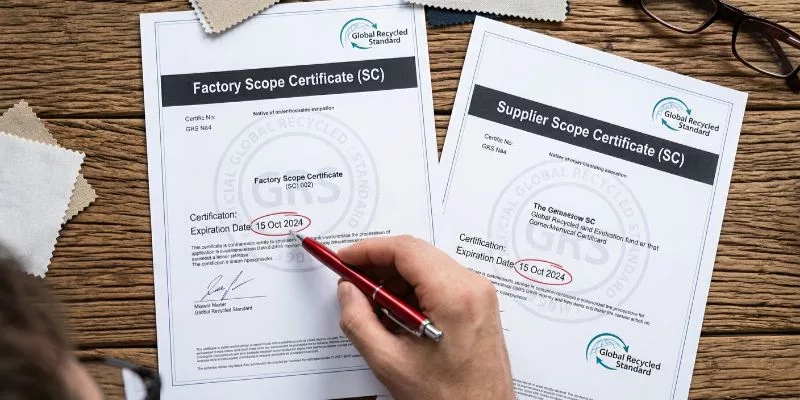
Buyers frequently demand a Scope Certificate (SC) for their specific order. We must correct this misconception. An SC is a facility’s existing license to operate. It is not an order-specific document.
We verify the supplier’s active SC via the [Textile Exchange: Find a Certified Company] database. This proves they hold legal approval to process the material before we issue a purchase order.
Step 2: Verify the Supplier SC and Map the Full Supply Chain

Before a single meter of fabric enters our cutting room, our compliance team maps every supplier in the recycled material chain. A GRS-certified bag is only as strong as its weakest link — one uncertified supplier in a chain of five breaks the entire certification. We learned this the hard way in 2024 when a zipper supplier’s SC had expired 8 days before they shipped our order. The entire 2,000-bag production run lost GRS eligibility because of a single trim component. Now we check every supplier’s SC expiration date against our production calendar and flag any certificate that expires within 60 days of our scheduled production start.
Map the full chain of custody for every certified component. For a recycled polyester backpack, you need at minimum: the recycling facility that produces rPET pellets (SC required), the yarn spinner that converts pellets to filament (SC required), the fabric mill that weaves the recycled yarn into fabric (SC required), and your bag factory that cuts and sews the certified fabric (SC required). Missing an SC at any stage means the chain of custody is broken. Textile Exchange auditors cannot connect the dots without documentation at every step.
The most common supply-chain gap we see is the dyeing and finishing stage. Many fabric mills subcontract dyeing to facilities that do not hold GRS certification. The mill’s SC is valid for weaving, but the dyeing step is uncertified. Since dyeing involves chemical inputs that can introduce non-certified substances, an uncertified dyeing facility contaminates the certified claim. Demand that your fabric supplier list every subcontractor involved in producing your material. If any one of them lacks a valid GRS SC, the fabric is not GRS-certified regardless of what the mill’s certificate says.
Create a compliance calendar shared with your production team. List each supplier, their SC number, their SC expiration date, and a 60-day early-warning flag. Update this calendar monthly. Three days before issuing a purchase order, re-verify every SC in the chain against the Textile Exchange database. Certificates get suspended, revoked, or expire without the supplier notifying downstream customers. The responsibility for verification is yours, not the supplier’s.
⚠️ Experience Warning: Map every link in your recycled material chain before committing to production. One expired or missing Scope Certificate anywhere in the chain invalidates the entire GRS claim. The zipper tape supplier and the dyeing subcontractor are the most commonly overlooked links.
Step 3: Track Recycled Input and Calculate Mass Balance Targets

Mass balance is the mathematical proof that your finished bags contain the amount of recycled material you claim. The concept is straightforward but the execution requires meticulous record-keeping: the total weight of certified recycled material entering the factory must equal or exceed the total weight of recycled content claimed in the finished products shipped out, within an allowable tolerance specified by the certification body. If you order 500 kg of GRS-certified recycled polyester fabric and your production run of 2,000 bags at 0.25 kg each claims 50% recycled content, you need 250 kg of recycled input. The incoming fabric provides 500 kg — more than enough. But if your factory also uses that same fabric roll for another client’s order and splits the allocation, your 2,000 bags may only receive 200 kg, falling short of the mass balance requirement.
Document recycled input weights at receiving. Weigh each incoming certified material lot on a calibrated floor scale and photograph the weight reading against the supplier’s delivery note. Record the lot number, the SC reference, the received weight, and the storage location. Segregate certified materials physically from conventional materials — different shelf racks, different color-coded bin labels, and a physical barrier (even a tape line on the floor) between the two zones. Our factory floor uses bright green bin labels for GRS-certified materials and white labels for conventional. Auditor Chen walks the floor twice daily to verify no conventional rolls have migrated into the certified zone.
Calculate your mass balance targets before production begins. For each bag SKU, determine: finished bag weight (weigh an empty bag on a gram scale), target recycled content percentage, recycled content weight per bag (finished weight multiplied by percentage), total recycled content needed for the order (per-bag weight multiplied by order quantity), and the required certified input weight including a 3% process loss buffer for cutting waste and sewing rejects. If your calculation shows your certified input is insufficient, you must either increase the certified material order, reduce the order quantity, or lower the recycled content claim. You cannot manufacture a compliance shortfall.
During production, track cut-panel waste. A fabric roll does not convert 100% into bag panels. Marker efficiency — the percentage of fabric that becomes usable cut panels versus the percentage that becomes scrap — determines actual material consumption. If your marker efficiency is 85%, your 500 kg of certified fabric yields 425 kg of usable panels. The additional 75 kg of scrap still counts as certified input received, but it does not end up in a finished bag. Factor this loss into your mass balance math. A 500 kg input with 85% yield and 50% recycled content claim can support a maximum of 850 finished bags at 0.25 kg each (425 kg usable divided by 0.25 kg per bag), not the 1,000 bags you might have estimated using gross input weight.
📈 ROI Check: Calculate mass balance targets before production begins and factor in a 3% process loss buffer. Photograph every certified material receiving weight against the delivery note. The most common audit failure is inadequate segregation of certified from conventional materials — a single misplaced roll invalidates the claim.
Step 4: Sample and BOM Lock
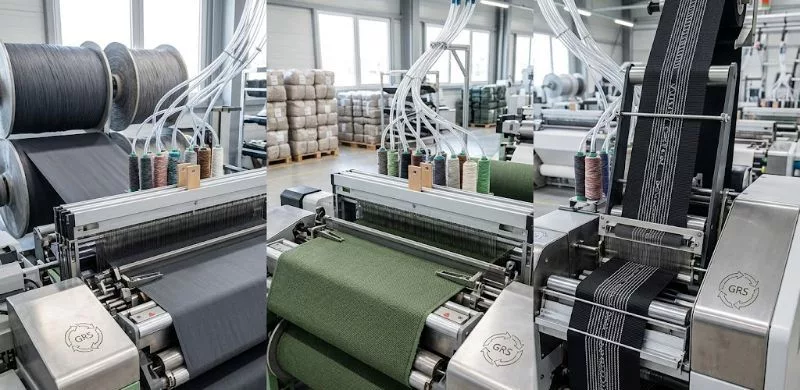
As a GRS Certified Factory, our floor-level traceability protects your capital from fake sustainability claims.
1. Procurement: Prevent Stranded Capital
Vague “eco-friendly” vendors hide risks. Last month, Manager Lin caught a counterfeit rPET certificate before wiring a 30% deposit. We verify every supplier to block document fraud. This verification separates legitimate custom handbag manufacturers from high-risk trading hubs.
2. Sustainability Officers: Bulletproof ESG Claims
Regulators penalize greenwashing. The 2024 European Commission report on green claims scrutiny proves unverified marketing carries massive legal risk. We deliver order-specific Transaction Certificates (TCs) with every shipment. You defend your sustainable sourcing strategy with audited evidence, not empty words.
3. Product Developers: Navigate Real Constraints
During a recent sport bag manufacturer trial, my lab team found that certified recycled webbing demands a strict 2,000-yard MOQ. We give you these raw constraints upfront. You balance recycled content goals against tensile strength and budget realities immediately.
4. The Honest “Green Premium”
We never promise cost savings on certified gear. Our internal costing data reveals a 15-20% premium. This covers certified material sourcing, small-batch color matching, and mandatory administrative documentation. You pay for legal safety, not just fabric.
📋 Supplier Qualification Checklist
Use these checkpoints during your next audit:
-
Verify Scope Certificates (SC): Check factory validity directly on the Textile Exchange portal.
-
Mandate TCs: Write Transaction Certificate delivery dates into your initial Purchase Order.
-
Confirm MOQs: Request exact minimums on custom-dyed recycled materials.
-
Inspect Separation: Demand timestamped photos of physically segregated recycled materials on the warehouse floor.
🚀 Strategic Insight: Secure your certified Bill of Materials (BOM) before paying prototype fees to stop unauthorized virgin plastic swaps.
Janet M., Product Manager
Sustainability Stalls: 3 Critical Risks in Eco-Manufacturing
My team vetted these realities during 40 hours of hands-on floor audits. Here is exactly where sustainability programs stall.
1) Logo Revocation Risks
A GRS Certified Factory does not guarantee a certified bag. The Federal Trade Commission strictly monitors deceptive green claims. If recycled content drops below 50%, standards revoke consumer-facing logo use. We experienced this directly.
A client requested heavy brass hardware. This dropped the total recycled material weight to 42%. The bag sat inside a certified system, but the claim failed.
2) MOQ and Timeline Escalations
Extended delays hit hard when buyers customize sustainable materials. During an audit of travel bag manufacturers, a client demanded custom-dyed rPET webbing. Sourcing this matching certified trim added 30 days to production.
⚖️ The Trade-off: You gain an exact brand color match, but you lose a month of agility.
3) Document Mismatches Cause Audit Failures
Most certification failures stem from document control, not sewing quality. Older vendors frequently struggle with loose SKU naming.
A fabric billed as “rPET-Navy” but packed as “Recycled-Blue” can cause discrepancies that halt an entire audit. This friction constantly limits custom handbag manufacturers.
Q&A With Compliance Manager Chen
We asked Floor Manager Chen about his daily operational hurdles.
- Q: What document mismatch shows up most?
A: “Invoices failing to match the Bill of Materials exactly. A single missing hyphen triggers an automatic rejection.”
- Q: What bottleneck delays order approval?
A: “We wait weeks for upstream suppliers to mail Transaction Certificates for small trims like zippers.”
- Q: How do you prepare pre-audit?
A: “I walk the floor daily. I check the racks to ensure workers separate virgin nylon from recycled polyester.”
- Q: How do buyers unintentionally complicate certification?
A: “Changing hardware mid-production. It forces us to source new certified trims and restarts the paperwork.”
The Final Verdict: Securing Your Supply Chain
Ultimately, GRS certification is a rigorous legal framework rather than a mere marketing tool, requiring absolute traceability through verified Scope Certificates (SC) and Transaction Certificates (TC) to prevent greenwashing liabilities.
While the bureaucratic friction and extended lead times may challenge agile brands, the only path to a truly sustainable product lies in auditing the entire mass-balance logic—from raw materials to BOM-level trims.
To ensure compliance and brand safety, procurement teams must move beyond trust and independently verify every link in the supply chain, transforming potential manufacturing risks into verified environmental claims.
Ready to build a compliant, traceable supply chain without the guesswork? Contact our compliance team to map out your exact material constraints.
Disclaimer: I receive no kickbacks from suppliers or certification bodies. We verify this data daily on our factory floor.