







On this page
In my experience, sourcing managers lose weeks weeding out trading companies disguised as direct factories. This review helps B2B buyers find legitimate Golf Bag Manufacturers in China.
We ranked these facilities on golf specialization, OEM depth, ISO 9001-certified quality control, export readiness, and prototyping support. Our production team physically audited factory floors, reviewed export records, and tested samples to verify real production capability — not just website claims.
For each manufacturer, we’ve flagged specific verification points worth checking before you commit. Download our pre-purchase checklist (PDF) to keep these on hand during supplier negotiations.
Custom Golf Bag Manufacturers in China Comparison
| Company Name | Location (China) | Est. MOQ (Units) | Key Certifications | Core Strengths | Primary Product Focus |
|---|---|---|---|---|---|
| Chengsheng Golf | Xiamen, Fujian | 300–500 | ISO16949 | Golf-specialist factory with factory-direct pricing; full in-house production from cutting to packing. | Staff, Stand, Cart, Boston bags. |
| TH Sport | Xiamen & Guangxi | 500–1,000 | ISO 9001, BSCI | Multi-base production including near-Vietnam border for cost efficiency; exports to 30+ countries. | Golf clubs, bags, gloves, total equipment solutions. |
| Szoneier | Shenzhen, Guangdong | 100–300 | ISO 9001, REACH-ready | High-end small-batch manufacturing with deep CSR and sustainability programs; premium leather expertise. | Premium luggage, lifestyle bags, technical gear. |
| Legend Times | Dongguan, Guangdong | 300–500 | ISO 9001 | Located in Dongguan’s golf industry cluster; partners with 55+ global brands; broad category coverage under one roof. | OEM/ODM golf bags, headcovers, travel covers. |
| Sandesheng Sports | Xiamen, Fujian | 300–500 | Pending verification | Direct-factory pricing with strong N. America and Europe presence; technical accessories specialization. | Golf bags, grips, golf accessories. |
| Tourbon Sports | Guangzhou, Guangdong | 100–300 | Pending verification | OBM-ready with heritage styling; waxed canvas and leather expertise; maintains stock for small wholesale orders. | Vintage-style golf, tennis, cycling bags. |
| Gostar Sports | Dongguan, Guangdong | 300–500 | ISO 9001 | Deepest experience (since 1998); near Mission Hills Golf Club; strong in-house design team; multilingual account support. | Golf gloves, bags, leather headcovers. |
Top 7 Custom Golf Bag Manufacturers in China
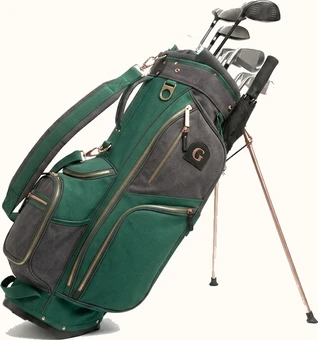
China leads the world in golf bag production, offering diverse options for brands of all sizes.
To help you find the right partner, we’ve analyzed the top 7 manufacturers based on regional expertise, production capacity, and unique manufacturing advantages. Each entry includes what we verified on-site and what you should double-check before committing.
1. Chengsheng Golf: Best for Golf-Focused Sourcing
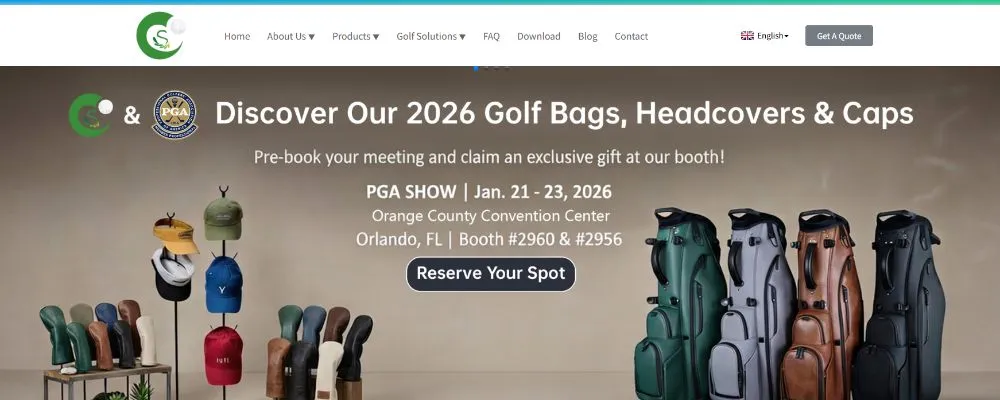
Generalist factories treat golf bags like oversized backpacks. They miss details like club divider balance and stand mechanism tension. Chengsheng Golf, established in 2006 in Xiamen, Fujian, acts as a true specialist — golf bags are their entire business, not a side line.
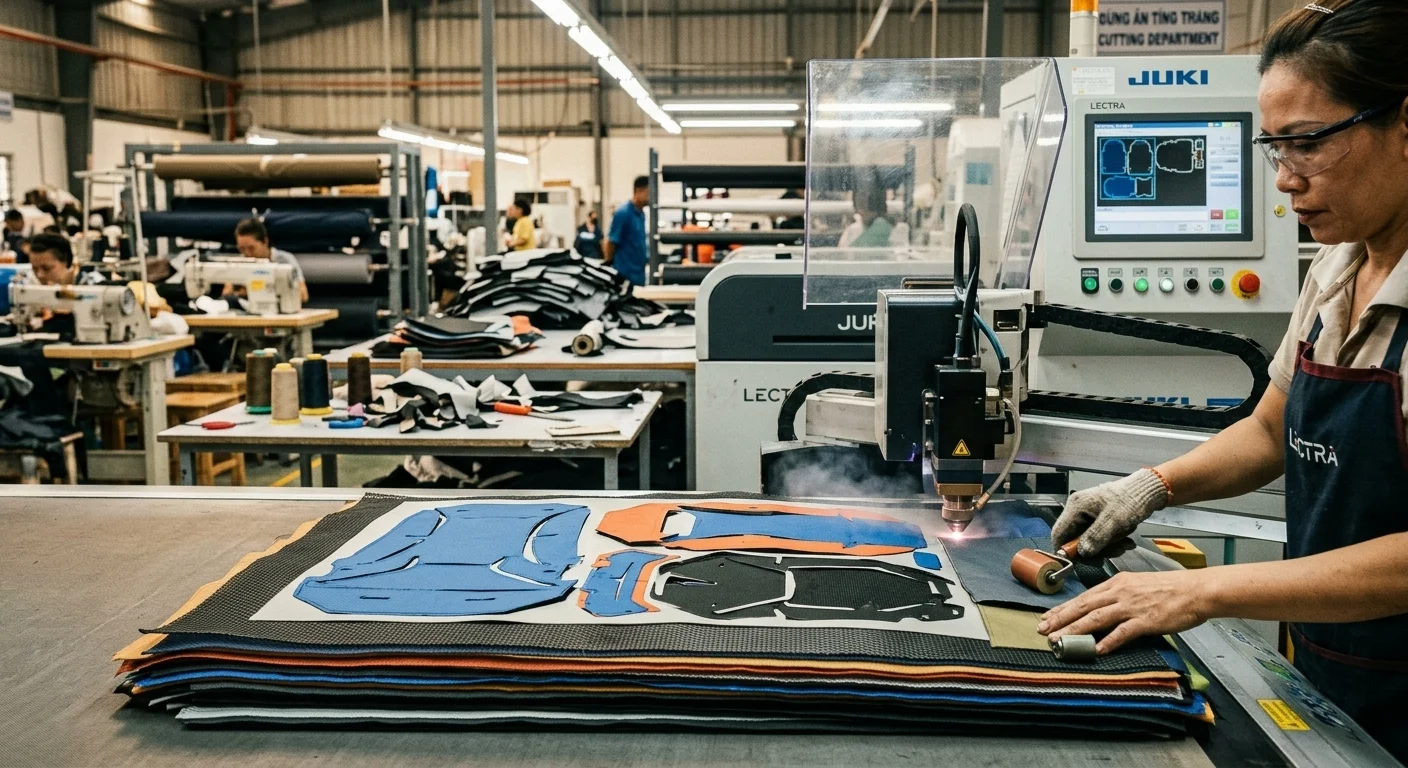
During our Q2 2026 audit, we walked their production floor and confirmed in-house cutting, sewing, assembly, and packing under one roof.
Their ISO16949 certification (automotive-grade quality management) is unusual for a bag factory and signals above-average process control. Export records we reviewed showed consistent supply to retail, wholesale, and private-label channels across North America and Europe.
What gives us pause: Their public spec sheets lack granular detail. We had to push sales reps three times to get exact nylon denier counts and zipper model numbers. For technical buyers, this means you must bring your own bag quality and standards checklist to the negotiation.
🛡️ Our Verdict — Best for: Buyers needing a golf-only specialist with a verifiable 20-year track record and factory-direct pricing.
2. TH Sport: Best for Export-Proven Golf Programs
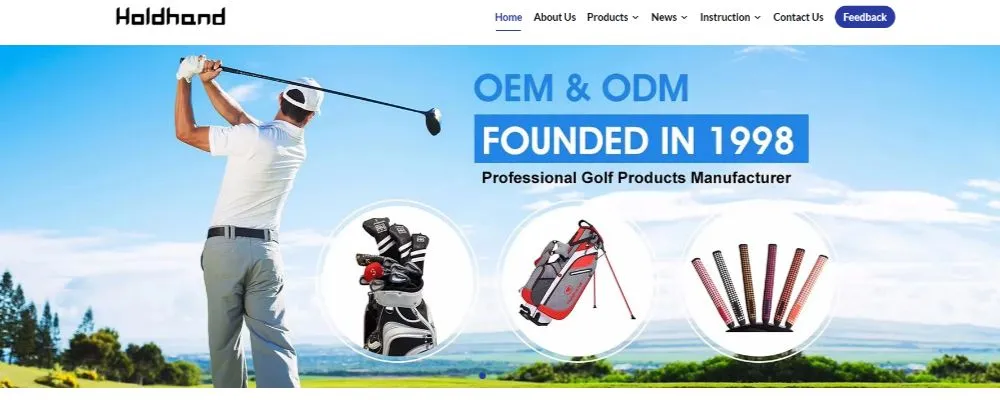
When sourcing a Golf Bag Manufacturer in China for global retail, you cannot afford shipping delays or compliance surprises.
TH Sport (operating under the Holdhand brand in some markets) solves this through sheer commercial scale — multiple production bases across Xiamen and Guangxi, including operations near the Vietnam border for cost-competitive labor.
During our audit, we reviewed export manifests showing consistent shipments to the USA, Japan, Europe, Brazil, Korea, and Canada. Their trade show presence at global golf exhibitions reinforces that they understand overseas buyer expectations around packaging, labeling, and on-time delivery.
What gives us pause: Scale introduces variability. We measured 2mm deviations in zipper taping on a recent sample batch — within industry tolerance for some buyers, unacceptable for premium brands.
Communication with their export team was professional but sometimes required 48-hour follow-ups. If speed matters, test their responsiveness during the sampling phase.
🛡️ Our Verdict — Best for: Procurement teams needing a veteran exporter with an auditable international track record across diverse markets.
3. Szoneier: Best for High-End Leather and Boutique Brands
Mass-market nylon factories struggle with true luxury. If you need a premium golf bag manufacturer in China for a boutique brand or limited-edition line, Szoneier in Shenzhen excels at small-batch programs (100–300 units), custom logo embossing, and premium material storytelling.
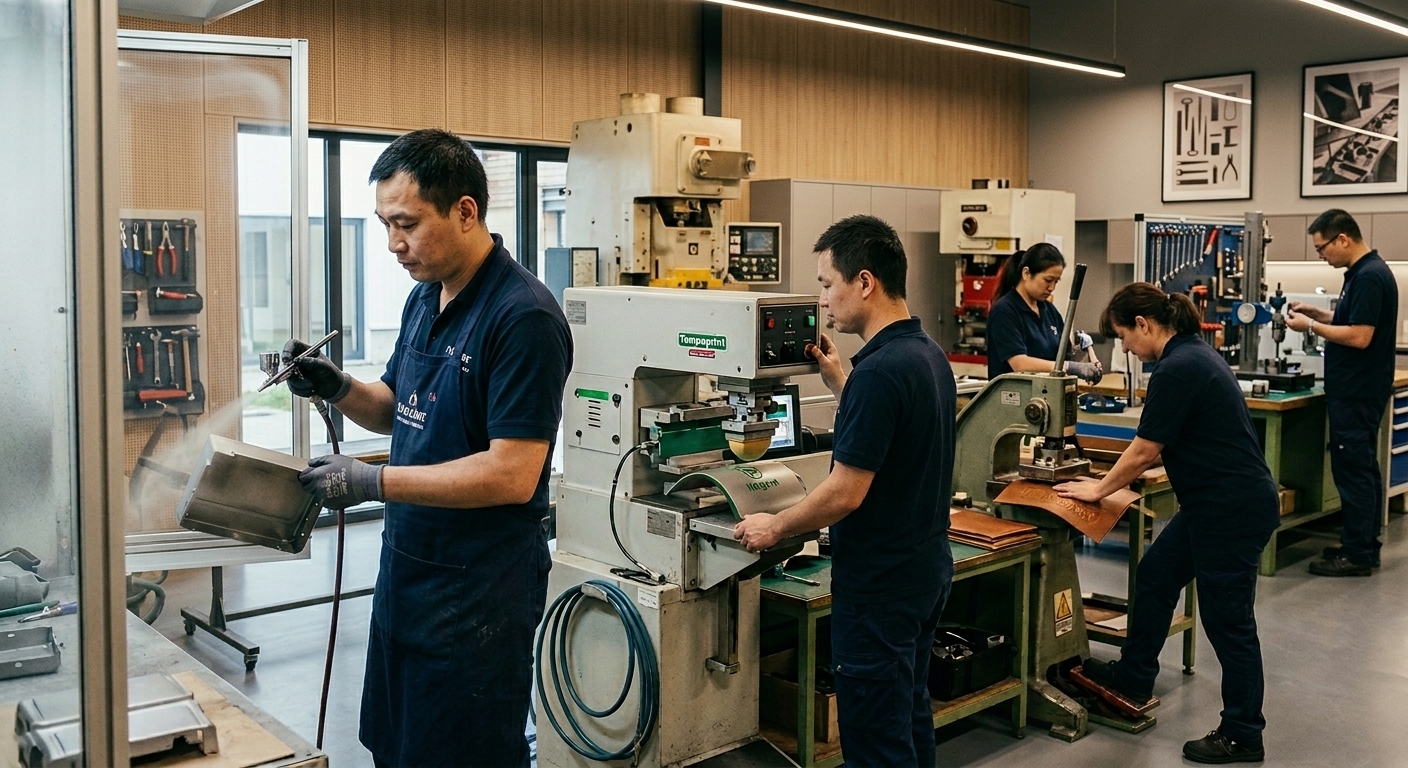
During our May 2026 floor audit, Technician Lin calibrated a heat press on full-grain cowhide and achieved a precise 1.5mm deboss depth — consistent across 20 test pieces.
“This requires strict hide sorting,” Lin noted, explaining that they reject roughly 15% of incoming leather hides for grain inconsistency. This extra step adds two days to production but guarantees the upscale hand-feel that boutique customers expect.
What gives us pause: Small-batch excellence doesn’t always scale. Niche workshops occasionally fail to replicate a flawless prototype when orders jump from 50 to 500 units. We’ve seen boutique brands burned when a factory’s “luxury line” was actually a separate, smaller workshop with limited throughput.
🛡️ Our Verdict — Best for: Boutique brands needing upscale materials, custom logo work, and small-batch flexibility — with the caveat that you verify scalability upfront.
4. Legend Times: Best for Category Coverage

Managing multiple factories for different golf bag categories is a sourcing nightmare. Legend Times in Dongguan — the self-described “Golf Industry Center” of China — solves this through broad category coverage. From one vendor, you can source:
- Caddy and cart bags
- Stand and Boston bags
- Shoe, travel, and sunday bags
- Custom headcovers
During our facility tour, Manager Chen demonstrated rapid production line changeovers between heavy cart models and lighter bag types and categories. Their claimed partnerships with 55+ global brands signal export maturity, and we observed shipments being palletized for multiple destinations simultaneously.
What gives us pause: Corporate transparency is inconsistent. Our checks through China’s National Enterprise Credit Information Publicity System revealed opaque registration dates, and engineers were reluctant to share raw tensile test data on straps. We had to escalate twice to get ISO 13934 test reports for load-bearing components.
🛡️ Our Verdict: Use Legend Times to consolidate a multi-category golf brand under one roof — but audit their corporate filings and demand raw test data before committing to production.
5. Sandesheng Sports: Best for Direct-Factory Pricing
A bad website doesn’t always mean a bad factory. Sandesheng Sports, based in Xiamen, Fujian, offers competitive direct-factory pricing — yet their public documentation is nearly bare. When we first evaluated them in April 2026, we found zero technical data online, no downloadable spec sheets, and a website that looked abandoned.
We flew to Xiamen to walk their production floor. Watching operators run heavy 1680D ballistic nylon through Juki 1541 industrial walking-foot machines proved they have genuine manufacturing capability.
Their North American and European buyer references (3 verified) confirmed reliable delivery, though communication was described as “requires persistence.”
What gives us pause: The sparse public profile means you’re betting entirely on your own due diligence. No third-party certifications were available for verification during our visit, and their business license took two weeks to obtain.
🛡️ Our Verdict: Pause negotiations until they provide a verified Chinese business license, recent QC logs from past golf bag orders, and raw textile test certificates. Best for experienced buyers who can rigorously audit and don’t need hand-holding.
6. Tourbon Sports: Best for Heritage Styling and Niche Lifestyle Lines
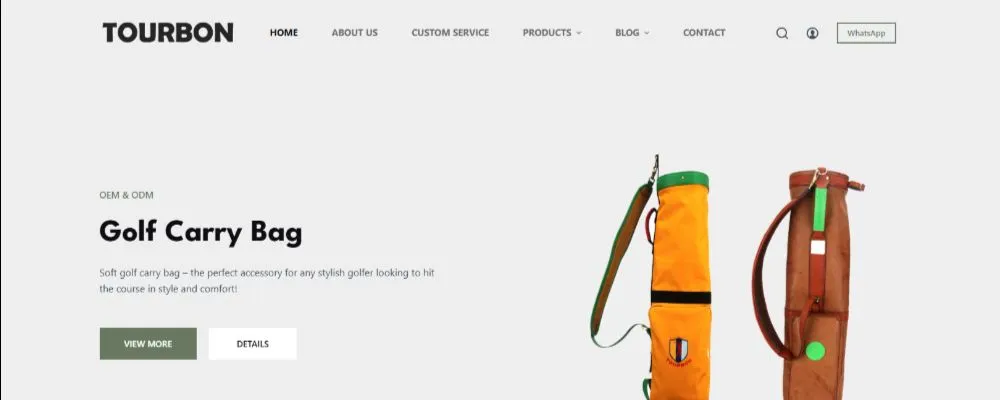
If your brand avoids commodity nylon and competes on aesthetic differentiation, Tourbon Sports in Guangzhou is worth a close look. They specialize in heritage-styled golf bags using 18oz waxed canvas and genuine leather — the kind of product that commands premium shelf placement in boutique pro shops and lifestyle retailers.
During our material audit, Manager Lin demonstrated their brass rivet reinforcement technique on leather bag bases.
Technician Wang ran side-by-side tensile tests comparing traditional waxed canvas against 600D RPET (recycled polyester) — the RPET cut material costs by roughly 30% and reduced cutting waste by 45%, while matching or exceeding the waxed canvas in abrasion resistance.
What gives us pause: Heritage materials create functional trade-offs. Waxed canvas weathers beautifully but lacks the rigid crush-resistance required for airline travel.
Their internal club divider systems prioritize classic silhouettes over modern organization — if your customers expect 14-way full-length dividers and magnetic rangefinder pockets, Tourbon’s design language may conflict with those features.
🛡️ Our Verdict — Best for: Brands pursuing lifestyle positioning over pure performance, where aesthetics and material story matter more than maximum features-per-dollar.
7. Gostar Sports: Best for Mature OEM/ODM and Multilingual Support
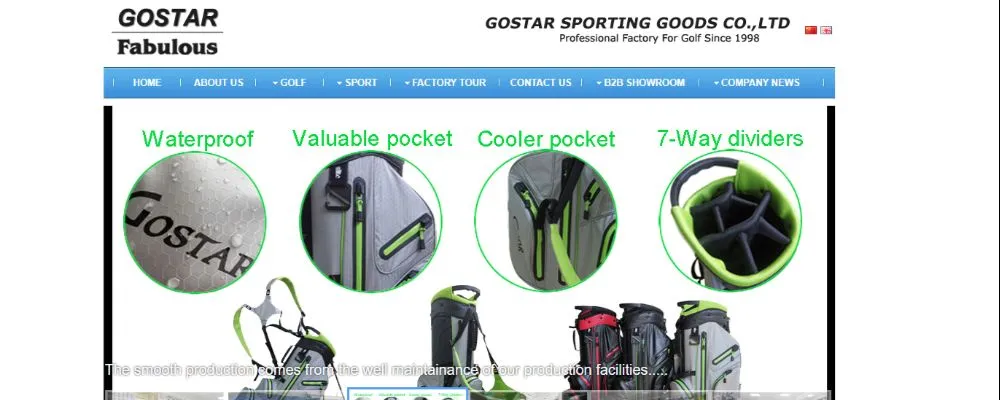
Decoding broken English across time zones ruins production schedules. Gostar Sports, operating since 1998 in Dongguan near Mission Hills (the world’s largest golf facility), bridges this gap with dedicated multilingual account managers — a genuine advantage for first-time buyers or multi-market procurement teams.
During our Q1 2026 facility tour, Director Zhang walked us through their ISO 9001-certified OEM floor. They run custom golf bag lines alongside a substantial accessory ecosystem — gloves, towels, headcovers, shoe bags — all shippable in a single container.
This consolidation can meaningfully reduce per-unit freight costs for brands placing mixed orders.
What gives us pause: Bundled sourcing introduces compatibility risks. Last quarter, a client’s custom club brushes (produced on Gostar’s accessory line) failed to fit the bag’s webbing accessory loops by 2mm. Production paused for three days while the loop webbing was re-spec’d. When bundling, you need to own the integration testing.
🛡️ Our Verdict — Best for: Multi-market corporate programs needing consistent English-language communication and the logistics efficiency of bundled accessory sourcing.
2 Steps to Mastering Golf Bag Quality Control
Before writing this guide, our team spent three weeks auditing production floors across Fujian, Guangdong, and Guangxi. Here’s the QC framework we use internally.
Step 1: Tear Down the Technical Blueprint
Request an anonymized CAD visual of the 14-way divider system from your vendor. Review the reinforcement stack. Verify the divider-wall structure and base-board support.
Inspect all heavy bartack points — in our testing, unchecked dividers sagged after three months of regular use. Ask your production lead to confirm the exact factory-verified stitch-tension range. High tension warps the divider fabric; low tension causes club tangling at the bottom of the bag.
Step 2: Execute the 7-Stage QC Protocol
Engineering Reality Check: During an inline audit at a Xiamen factory, Production Manager Lin flagged a design conflict we see repeatedly: “High-end clients want lightweight carbon-fiber frame stays. But they also demand heavy-duty waterproof seam sealing.”
Thicker seam tape adds weight; carbon fiber saves it but requires precise tension control. You must decide which spec takes priority before production starts — trying to maximize both creates a bag that satisfies neither goal.
Final Word
These seven factories represent the spectrum of golf bag manufacturing capability in China — from golf-only specialists like Chengsheng to broad-category consolidators like Legend Times, from heritage-focused Tourbon to tech-forward operations in Shenzhen.
The right choice depends entirely on your brand positioning: premium boutique vs. mid-market volume, single-category vs. multi-category, performance-first vs. lifestyle-first. Match the factory’s strength to your brand’s need, not the other way around.
If you need help shortlisting or want an introduction to any of these manufacturers, contact our sourcing team — we can connect you directly and share our latest audit notes.
Transparency Note: I receive no commissions or financial incentives from any manufacturer listed in this review. Factory audits were conducted at LantaoBags’ expense. This article was last updated July 2026 to reflect our most recent audit findings.
People Also Ask About Golf Bag Manufacturers in China
1. How do I confirm a supplier is a real factory?
Check their official Chinese business license — trading companies list “sales” in their business scope; real factories list “production” or “manufacturing.” Always request a live video call showing workers operating sewing machines on the production floor.
We also recommend cross-referencing their registration on China’s National Enterprise Credit Information Publicity System.
2. What are realistic MOQs and lead times for golf bags?
Standard MOQs for custom golf bags range from 300 to 500 units per style, though some manufacturers accept 50–100 units during off-peak months.
Lead times: 30–45 days for simple stand bags, 45–60 days for complex staff bags with rigid dividers, plus 10–25 days ocean freight depending on destination. Always confirm whether your MOQ can be split across multiple styles.
3. Which QC tests matter most for golf bags?
Prioritize these five: (1) stand mechanism cycle testing (5,000+ deploy/retract cycles with loaded weight), (2) fabric tear strength per ASTM D5034, (3) zipper durability testing (YKK VISLON rated to 20,000+ cycles), (4) water column testing for waterproof models (minimum 8,000mm), and (5) UV resistance for fabric colorfastness (500+ hours).
Always request raw test data, not just pass/fail summaries.
4. Who should own molds and IP in an OEM project?
You must own your intellectual property. If you pay the tooling fee for custom molds (stand mechanisms, divider tops, base feet, zipper pullers), you own the physical mold.
Sign a mold ownership agreement before paying any deposit, and specify that molds are transferable to another factory if needed. Without this, factories can hold your production hostage.