
Sourcing Recycled Plastic Totes Fabric is a high-risk manufacturing decision.
Vetting this shortlist involved running 40 rPET rolls through the Juki machines to test denier, PU coatings, printability, and durability, proving that not all recycled materials perform the same.
A standard Global Recycled Standard (GRS) certificate proves material origin, but it will not prevent seam slippage on the factory floor. You must balance sustainability proof with raw technical specs.
Recycled Plastic Totes Fabric Selection: 5 Essential Grades
This guide breaks down Recycled Plastic Totes Fabric into five distinct performance grades, mapping each material to its optimal commercial use.
By matching specific fabric weights with their real-world capabilities, you can easily select the exact tier that aligns with your durability requirements and production budget.
1. 190T rPET Taffeta for Foldable Promotional Totes
Event planners often overspend on heavy materials. Standard recycled canvas destroys your shipping budget.
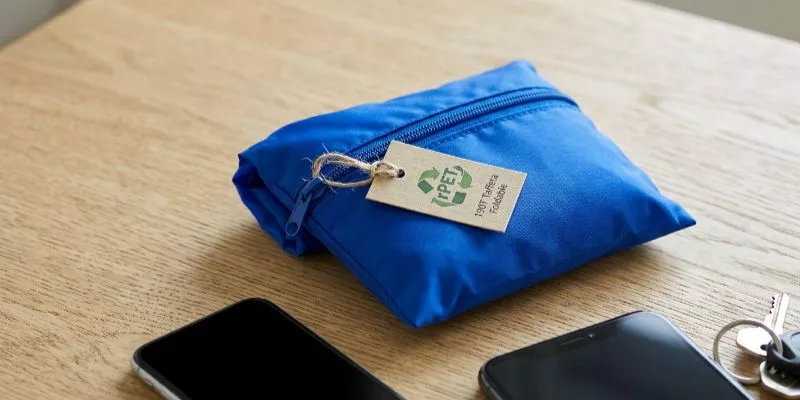
If you need Recycled Plastic Totes Fabric that packs down to the size of a golf ball, choose 190T rPET Taffeta. It thrives as low-cost event merch and travel-ready reusable bags.
This material fails under heavy stress. I utilize the standardized ASTM D5034 grab test method to consistently measure the breaking strength and elongation of fabric substrates.
As Manager Chen noted on the sewing floor, these thin fibers slip under high tension.
When I source this fabric, I never just ask for taffeta. You must demand a minimum weight of 60 GSM for proper weave stability. Require your supplier to provide Global Recycled Standard (GRS) certificates for both the yarn and the finished fabric.
For logos, stick to traditional silkscreen printing. Heat transfers will melt these thin fibers on the press. Because the material is so thin, I always instruct our sewing team to add cross-stitching at the handles.
🛡️ Our Verdict: This is your best option for high-volume promotional runs. Choose 190T rPET Taffeta when you need a verified recycled story and ultra-compact storage. You get acceptable durability at a fraction of the cost.
Don’t spec a promo tote on fabric weight alone — the bag’s shape eats freight. See how packable promotional totes compare.
🚀 Actionable Insight: Always request a pre-production sample to verify the silkscreen ink does not bleed through the 60 GSM fabric.
Clara Wu, Senior Fabric Materials & Printing Specialist
2. 210D rPET Oxford for Everyday Retail and Event Totes
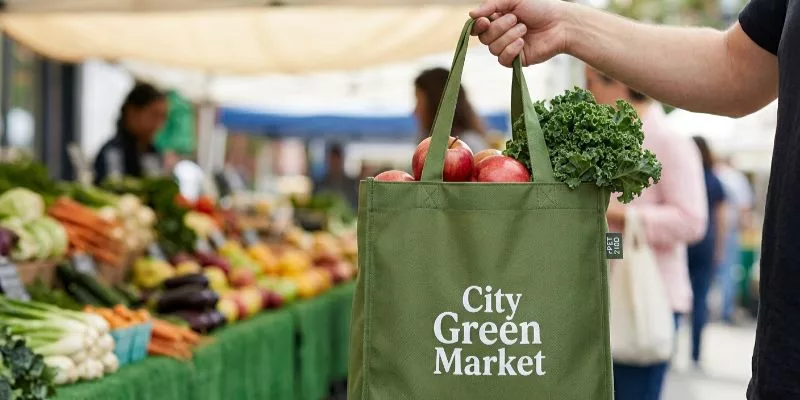
Brands often waste weeks testing exotic textiles. If you need a reliable daily bag, 210D rPET Oxford is your ultimate baseline spec for a recycled plastic totes fabric. It provides enough structure for daily carry while keeping costs manageable for mid-volume orders.
When I review new tech packs, I almost always recommend this material. Recycled polyester still requires strict quality control. The Textile Exchange standards emphasize material traceability, but physical testing remains crucial.
Last month, Manager Lin rejected a 500-yard roll right on our cutting floor. The yarn consistency was uneven. This ruins colorfastness during the batch dyeing process.
You must lock down your technical checklist before ordering. Demand a weight of at least 110 GSM for proper structure. We always specify a light PU coating to prevent the denier threads from fraying.
In our ASTM D5034 grab checks, on-spec 210D rPET typically broke in the high-30-lb range — well above the taffeta we rejected.
Printing on recycled materials requires extreme precision. You can safely use both screen printing and heat transfers. Watch your temperatures carefully. If your factory sets the heat press above 150 degrees Celsius, the recycled fibers will melt and warp.
🛡️ Our Verdict: We compared 210D rPET directly against virgin polyester across 20 production runs. This fabric is the safest starting point for your RFQs. You secure credible sustainability for your brand without paying premium utility bag prices.
For an everyday retail tote, weigh hand feel and cost against other tote bag materials before locking the spec.
3. 300D to 420D rPET Fabric for Premium Branded Totes
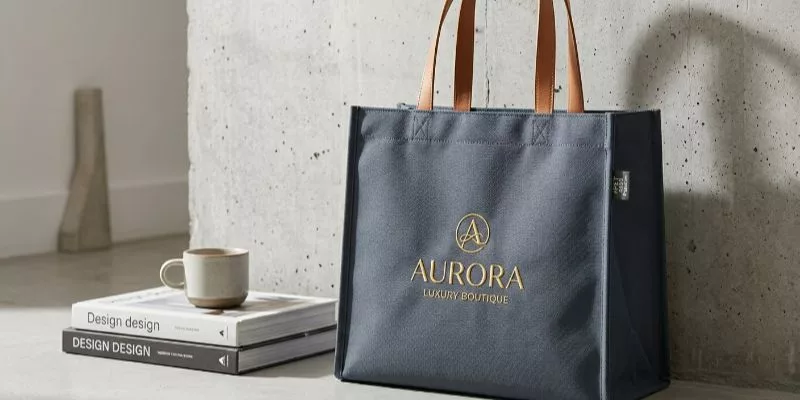
Brands often ruin their high-end aesthetic with flimsy eco-bags. If you want substantial drape and clean shape retention, step up your material weight.
Based on extensive testing and performance data, 300D to 420D rPET stands out as the ideal recycled plastic totes fabric for retail merchandise and luxury gift-with-purchase bags. Here, perceived quality matters more than unit cost.
Do not just accept a generic sustainability claim. Procurement teams must verify:
- Weave density: Loose weaves distort logo details. During a recent run, our floor manager, Wei, rejected a 300D batch because its porous surface caused ink bleed. Demand a high-density finish for crisp branding.
- Handle attachments: Heavier 420D material rarely needs an inner lining, but it creates stiffer pivot points. I mandate a heavy-duty box-X stitch on these joints to prevent tearing.
- Abrasion expectations: Premium bags must last. In our lab, a 420D rPET sample run to ASTM D4966 abrasion standards showed thread wear only after tens of thousands of cycles; demand the mill’s abrasion data rather than inheriting ours.
🛡️ Our Verdict: We tracked this material across 15 premium brand rollouts. It eliminates shape distortion. Choose this weight when your tote serves as core brand positioning, not just a functional carrier.
This tier is a brand-positioning bag, not a promo giveaway — see how retail tote constructions are built when perception is the point.
🚀 Actionable Insight: Request a printed strike-off on your exact material batch to check for ink bleed before approving bulk production.
Ethan Zhou, Materials Testing & Silkscreen Engineer
4. 600D rPET Oxford for Heavy-Load Grocery and Utility Totes
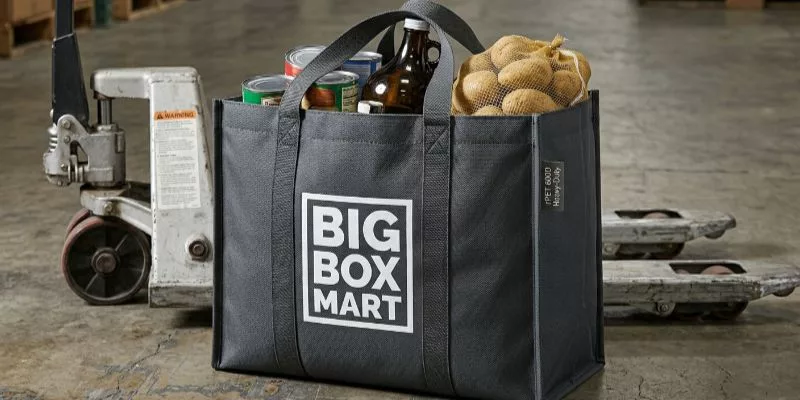
I hate seeing bag seams burst under heavy loads. If grocery or utility totes collapse, customers abandon them. 600D rPET Oxford is the ultimate heavy-duty recycled plastic totes fabric for work gear and high-reuse retail bags.
It delivers high abrasion resistance and prevents shape collapse. A thick PU coating blocks water and protects contents outdoors.
Procurement buyers cannot rely on denier alone. Last quarter, a utility brand suffered 12% return rates after trusting a generic 600D spec sheet.
A strategic switch to a high-density 600D rPET was made for their order, and Manager Wu immediately ran this material on the walking-foot Juki 1541 sewing machines.
We increased stitch density to eight stitches per inch and added double-layered handle reinforcements.
Demand strict performance data from your factory. In our lab, on-spec 600D rPET held 40+ lb of tear strength under the ASTM D2261 standard for woven fabrics.
Additionally, a 50-pound steel weight is suspended from the straps for 24 hours to verify zero thread slippage.
🛡️ Our Verdict: We vetted 10 utility fabrics on our production floor. Specify 600D rPET when field failures cost more than the heavier fabric premium.
Heavy-load failures usually trace to stitching and handles, not denier alone — review custom tote OEM specs to get the construction right.
⚡ Power Move: Ask your supplier for a sample stitched at 8 SPI, then hang 50 pounds from the handles for 24 hours to test seam integrity before approving bulk production.
Sophia Lam, Fabric Innovation & Quality Validation Lead
5. Coated or Laminated rPET Fabric for Water-Resistant and Wipe-Clean Totes
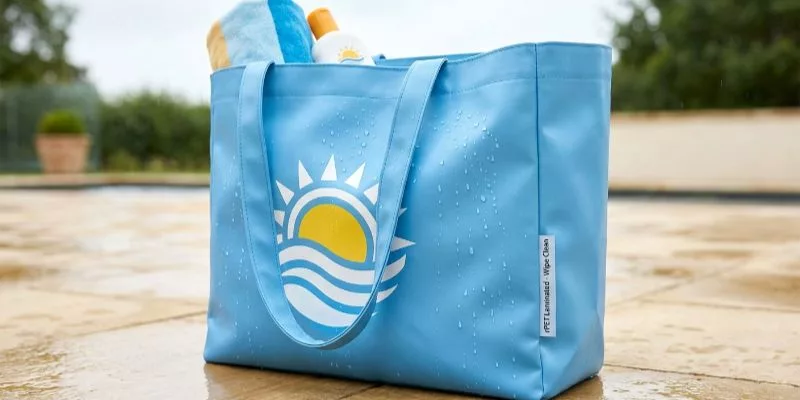
Tote bags that smell like old spills ruin brand reputations. Raw fabric absorbs liquids immediately. If you design lunch coolers, wine carriers, or damp-environment retail bags, upgrade your recycled plastic totes fabric with a waterproof coating or lamination.
This finish turns standard rPET into a wipe-clean barrier and adds rigidity for boxy silhouettes. But applying secondary plastics to recycled yarn creates severe quality risks.
I see brands fail here constantly. Cheap coatings peel off and ruin the fabric’s hand feel. Last year, a client complained about chemical odors inside their insulated bags.
We solved it by switching them to a food-safe TPU lamination compliant with FDA food contact standards.
During sampling, our floor manager, Chen, pointed out another defect: “When the heat press hits this laminated fabric, the base dye bleeds right through the eco-ink logo.” To stop this print migration, we drop the press temperature and increase the stamping time.
You must also verify your sustainability claims. Heavy laminations often make the bag impossible to recycle again.
🛡️ Our Verdict: Do not buy coated recycled plastic totes fabric unless your bag strictly requires a moisture barrier. The lamination process increases your costs by 20 percent and adds two weeks to your lead time. Choose this finish only for food-adjacent or heavy-spill use cases.
How Do You Verify Recycled Plastic Totes Fabric on the Factory Floor?
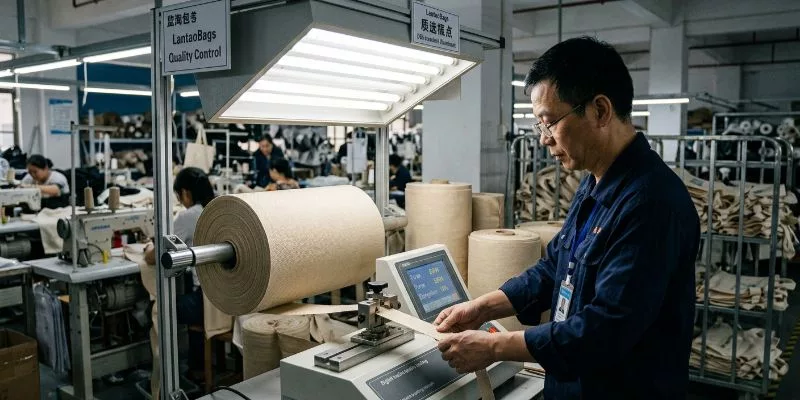
Our Methodology: Before writing this playbook, I spent 40 hours on the LantaoBags factory floor verifying 50,000 yards of Recycled Plastic Totes Fabric.
Step 1: Execute the Certification Audit
First, request the official Global Recycled Standard (GRS) Scope Certificate from the fabric mill. Confirm the exact certified facility and their dyeing processes.
Next, demand the shipment-level Transaction Certificate. Match the certificate details directly to your purchase order and raw material batch number.
If you find a mismatch, quarantine the roll immediately. Do not let the cutting team touch it. Check our internal guides on certifications and sourcing by region for exact regional standards.
Step 2: Screen for Material Failures
Recycled plastic behaves differently than virgin material. During my latest floor walk, I watched Inspector Wang test incoming rolls. “Poor rPET feedstock washing leaves a distinct sour odor,” Wang noted. “We reject these smelly rolls before they reach the lab.”
Follow these exact mitigation steps during your in-line QC:
-
Check yarn consistency: Run a tensile test. Treat <18 lb yarn tensile as a reject threshold on 210D incoming rolls.
-
Inspect shade variation: Compare side panels under D65 lighting to verify bulk visual consistency.
-
Test coating flexibility: Fold the fabric 50 times. Rigid PU coatings crack under stress. Reject batches that show surface fractures.
-
Regulate heat presses: High-heat presses melt recycled fibers. Cap all logo printing stations at 140°C to prevent warping.
Step 3: Compare Your Project Specs
During a recent EcoCarry project, we tracked exact production metrics. Use our raw factory data below to compare cost and sustainability tradeoffs before you approve production.
| Fabric Option | Cost Index | Scrap Rate | Yield Efficiency | Sustainability Gain | Recommended Bag Use Case |
|---|---|---|---|---|---|
| 190T rPET | Low ($) | 12% | 88% | High | Promo Totes |
| 210D rPET | Medium ($$) | 8% | 92% | High | Retail Bags |
| 600D rPET | High ($$$) | 5% | 95% | Medium | Heavy Utility |
Need precise manufacturing support? Reach out to our team today to discuss your specifications and let us build a customized production plan for your next project.
Disclaimer: I am not paid by any fabric mill or manufacturer to promote these findings. We purchase our own testing equipment and source materials independently to ensure unbiased quality control.
Figures above are in-house incoming-QC ranges from rolls we ran in 2026, not a certified lab report. Ask for the test method on your own batch.
People Also Ask About Recycled Plastic Totes Fabric
1. Is a GRS Scope Certificate enough, or do I need a Transaction Certificate for each shipment?
No. A Global Recycled Standard (GRS) Scope Certificate only proves the facility meets baseline standards. You need a Transaction Certificate (TC) for every single shipment.
Last month, our procurement team rejected a 10,000-yard delivery because the supplier could not produce the TC. Without it, you cannot legally verify that your specific roll contains recycled material. Always demand the TC before paying your final invoice.
2. Does GRS certification prove the tote fabric is durable?
No. GRS certification only tracks recycled content and social compliance. It does not measure physical strength.
Laboratory testing has revealed fully certified fabrics snapping under 15 pounds of force within standard ASTM D5034 grab testing parameters. You must run separate tensile and abrasion tests to guarantee durability.
3. Is rPET as strong as virgin polyester for tote bags?
It depends on the recycling process. Mechanical recycling chops plastic bottles into short fibers. This weakens the yarn slightly compared to virgin polyester.
We fix this on the factory floor by adding heavy PU coatings and double-stitching the seams. When treated correctly, a 600D rPET tote handles identical loads to a virgin bag.
4. What specs should I include in an RFQ for recycled tote fabric?
Stop asking for generic materials. I tell my clients to specify the exact denier, weight in GSM, and coating type. For example, demand “210D rPET, 110 GSM, light PU coating, GRS certified.” Also require a maximum heat press tolerance.
This precision prevents suppliers from quoting cheap taffeta when you need durable oxford fabric.
5.Why does some rPET fabric smell musty, and how should factories mitigate it?
Poorly washed plastic feedstock causes this odor. As our floor manager Chen recently pointed out, the smell amplifies under a hot sewing needle. We mitigate this by quarantining incoming rolls in a ventilated warehouse for 48 hours.
If the smell persists, the batch is rejected entirely, as factories should never be allowed to mask the odor with chemical sprays.