
Virgin Polycarbonate wins because it absorbs heavy impacts, resists cold-weather cracking, and lowers lifetime replacement costs. ABS costs less upfront but cracks under stress and turns brittle in the cold — durability defines a high-quality travel bag.
To make this call, my team ran Lantao Lab stress tests, observed factory-floor molding, and audited raw sourcing documents — dropping 50 lb bags onto concrete and chilling shells to −10°C. I cover sourcing and supplier audits, comparing resin documents, not datasheets.
PC flexed and snapped back while ABS shattered at the corners — but it costs more, and its long-run ROI for premium checked bags makes it the clear choice; reserve ABS for low-duty gear. Much “PC” luggage is a PC/ABS blend or a thin PC skin over recycled core — Section 4 shows how to catch it.
Here is a direct comparison, using standard material test methods as reference:
Virgin Polycarbonate generally flexes and survives repeated impacts better than ABS, especially in the cold, but it costs more and must be verified as truly virgin. Exact values depend on resin grade, shell design, and test conditions.
Values above are directional and vary by resin grade, shell design, and test conditions.
| Criterion | Virgin Polycarbonate | ABS | Directional Winner | Why It Matters for Luggage |
|---|---|---|---|---|
| Impact & Cold Resistance | Flexes and snaps back; stays ductile at -10°C | Rigid; cracks at corners and turns brittle in the cold | Virgin PC | Survives baggage handling and freezing cargo holds. |
| Weight | Strong enough to mold thinner walls | Needs thicker walls to pass basic impact tests | Tie | A well-designed PC case can end up lighter. |
| Upfront Resin Cost | Usually noticeably more expensive | Lower resin cost, easier to process | ABS | Lowers first-order COGS. |
| Typical Program Fit | Premium checked luggage | Promotional carry-ons, low-duty gear | Tie | Matches the material to the mission. |
| Main Risk | Must be verified as truly virgin; costlier to buy | Cracks under repeated impact, especially in the cold | Tie | Drives warranty claims if mismatched. |
If your brief requires checked-luggage durability, virgin PC is the default winner.
Quick guide — pick by mission: Checked bags that fly repeatedly → PC. Promotional, single-event, or carry-on use → ABS. Cheapest and lightest, but corner impact and scratch resistance take second place → evaluate PP.
Key takeaway: In our internal comparisons, PC absorbs repeated impacts and stays ductile in the cold, while ABS costs less and is easier to process but cracks under corner impacts in cold conditions. The right choice depends on the duty cycle — not on which plastic sounds more premium.
Virgin PC vs. ABS Main Differences
While Virgin Polycarbonate and ABS are both industry standards, their performance diverge significantly in structural integrity and thermal resilience.
Understanding these technical distinctions is essential for optimizing material selection in high-requirement manufacturing environments.
1. Impact Resistance and Cold-Weather Failure Behavior
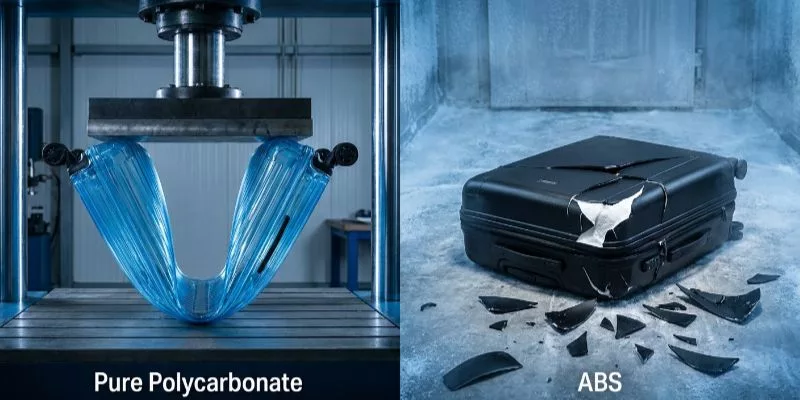
A client recently sent us 50 broken ABS bags from a cold-weather route — one client-reported shipment, not an industry survey, but the pattern was consistent enough to justify a controlled lab comparison.
We tested fresh shells in our lab, ignored the factory marketing materials, and dropped each bag until it broke.
Virgin Polycarbonate (PC) absorbs kinetic energy. It flexes under heavy pressure and snaps back to its original shape. ABS feels entirely rigid. Lacking flexibility, it holds dents and fractures at stress points.
We load each shell with 50 pounds of steel weights and drop it onto concrete from two meters high. These are typical wheeled hard-shell check-in cases from our own runs — we don’t publish specific model numbers.
Virgin PC survived 50 consecutive drops. ABS cracked at the wheel housing on drop number 14. We count a failure as a visible crack or break at a corner or wheel housing.
This was an internal side-by-side comparison, not a third-party certified test, so treat the exact drop counts as directional rather than an industry standard.
Method, in brief: load each shell with 50 lb of steel weights, drop it onto concrete from 2 m, and inspect corners and wheel housings for visible cracks, repeating until failure; cold runs use a −10°C chamber.
This is internal lab testing, and we keep the method notes available to serious buyers on request — our fact-checking process explains how we handle this kind of data. For how we apply ASTM-based impact logic to bags, see our ASTM bag & luggage testing notes.
Next, we simulated a freezing cargo hold. We chilled both shells to −10°C. The physical difference was staggering.
The ABS shattered on the first impact, with severe stress whitening along the zipper line and catastrophic corner fractures. The Virgin PC absorbed the hit, showing minor scuffing but no dent memory.
As our lab technician swept up the broken ABS shards, the pattern was unmistakable: “ABS corners simply snap in the cold. PC actually bends with the blow.”
Demand real impact metrics based on ASTM D256 / impact-testing logic. Reject vague “durable hard shell” marketing.
Winner: Virgin PC
🧠 Expert Take: Cold temperatures expose cheap plastics. If your luggage ships in unheated cargo holds during winter, ABS becomes a massive liability
Joe Yu, OEM/ODM Handbag & Travel Expert
2. Thermal Stability and Manufacturing SOP
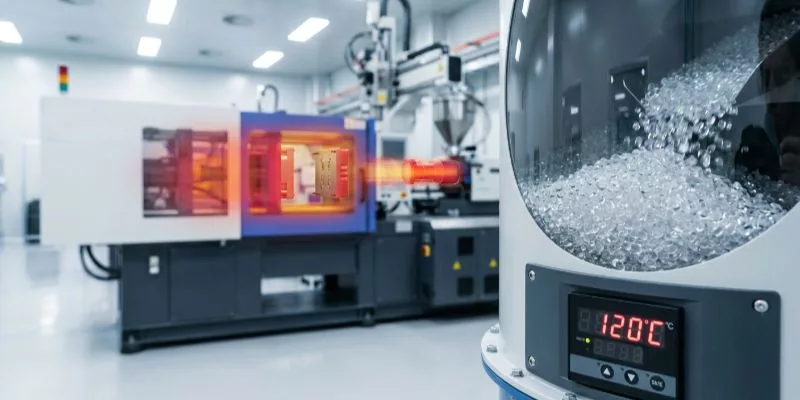
Heat dictates luggage survival. It matters in baking cars and heavily influences the injection molding floor.
Virgin PC typically shows a higher Heat Deflection Temperature (HDT) — common injection-molding grades land around 125–140°C, while ABS sits around 85–100°C under the ASTM D648 test. Exact numbers shift with resin grade, fillers, and test load, so treat these as ranges, not fixed values.
SABIC’s Lexan and Chimei’s PC lines fall in this range; the precise value lives on the specific grade’s datasheet, which is why we always ask which grade a supplier is actually using. The real divide emerges during production.
During my Tuesday audit of our Standard Operating Procedures (SOP), the difference was obvious. Virgin PC requires brutal manufacturing discipline. Pure PC resin requires tight heat control.
We bake the resin at 120 degrees for four hours. This baking removes moisture. It stops silver streaks from forming. It prevents the plastic shell from becoming weak. We push our barrel zones to 280°C and tightly regulate the mold temperature.
ABS flows at lower temperatures and forgives sloppy drying habits. This creates a trap for cheap factories. Overheated ABS degrades fast. It embrittles the shell, causing massive stress concentrations around corners and wheel mounts.
I watched our production manager adjust the large press. He picked up a cracked ABS shell from the scrap bin and showed me the hidden stress marks.
You cannot see this damage until the bag hits the floor. “Overheated ABS structurally degrades invisibly. It looks fine here, but shatters on its first trip.”
We mandate strict resin drying control, barrel-temperature discipline, and lot-level process records to eliminate these defects.
Winner: Virgin PC for thermal headroom; ABS for easier low-cost processing
3. Upfront Resin Cost vs Lifecycle ROI
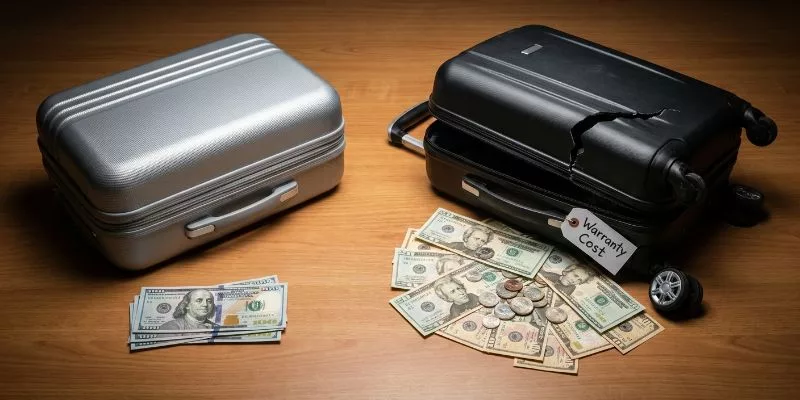
Consider the raw economics. Virgin PC costs materially more than ABS — usually by a noticeable margin. Resin prices move with grade, region, and market conditions, so we don’t quote a single fixed number here. The direction is consistent, though: PC resin is typically the pricier input.
On a 5,000-unit quote, that gap looks intimidating. ABS delivers the lowest upfront COGS. But my team calculates B2B lifecycle ROI.
Upfront savings often trigger backend nightmares for premium brands. Imagine your customer checks an ABS suitcase. It cracks on flight one. You face a furious review, a $50 replacement cost, and $30 in expedited shipping. Your $5 factory saving just burned an $80 hole in your margin.
Lower crack claims and a longer service life offset the higher PC resin cost. Last quarter, a corporate client bled cash from wholesale warranty reserves. For a fuller cost model, see our bag manufacturing cost guide.
In that client’s case, their previous supplier used ABS for a holiday gifting run, and the shipment ran an 8% transit defect rate.
After the switch to Virgin PC, unit cost rose by about $6, but replacement rate fell sharply. That’s a single client-reported example — not an industry average — and it’s the pattern we watch for, not a guarantee.
Winner: ABS for lowest upfront cost; Virgin PC for lower long-run replacement risk
⚡ Power Move: Match the material to the mission. Buy ABS for a cheap promotional bag meant for a single weekend event. Invest in PC for five-star reviews and fewer return headaches
Sarah Zhuo, Sales Manager
4. Virgin Status, Regrind Risk, and Blend/Co-extrusion Opacity
This is the biggest sourcing trap in luggage manufacturing. Buyers think they choose between pure PC and pure ABS. The factory floor reality is darker.
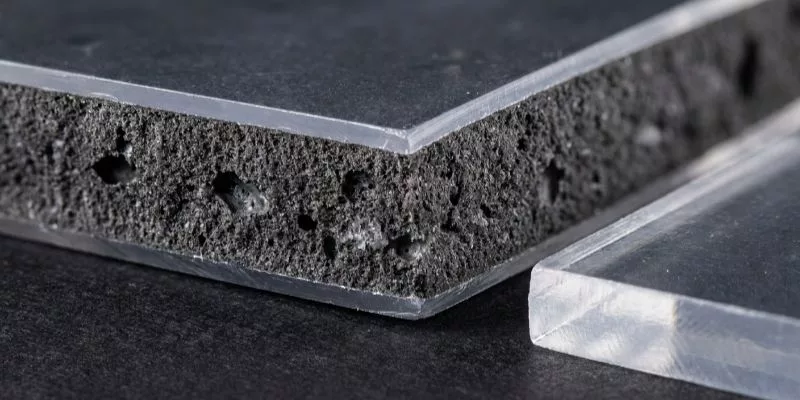
Suppliers frequently quote “Polycarbonate” but deliver a PC/ABS blend. Worse, they use a 3-layer co-extruded shell. They sandwich cheap, brittle recycled ABS in the core and coat the outside with a microscopic skin of PC.
Fake materials look real on the factory floor. I once inspected a batch of bags that looked perfect. We cut them open. We found cheap recycled plastic hidden inside. You must demand the raw resin invoices to prove purity.
Ask point-blank whether a shell is virgin PC, recycled PC, a PC/ABS blend, or a 3-layer co-extrusion — then verify with paperwork. Our sourcing team uses a five-point checklist:
- Resin grade and manufacturer name. Confirm the exact PC grade and the resin producer before production starts.
- COA and COC. Demand the Certificate of Analysis and Certificate of Conformity, and match raw-material purchase invoices to your exact production date.
- Wall thickness. Measure the actual shell wall at several points against the agreed spec — not just the drawing.
- Corners and ribs. Check corner geometry and internal ribbing, because these decide how a shell survives a corner impact.
- Wheel housing and hardware load paths. Confirm reinforcement where wheels and fittings attach — this is where cracked shells fail first.
Also compare the approved golden sample against mass-production shells. Refusal to share lot paperwork, or PC pricing too cheap to be real, almost always signals a blend.
Cross-reference grades against the SABIC Lexan polycarbonate specs and confirm impact-test methods against the ASTM D256 reference or an independent test provider. For a broader sourcing checklist, see our bag sourcing & pricing guide.
Winner: Virgin PC (only when documentation proves it is truly virgin)
⚠️ Safety First: Never approve materials based on samples alone. Co-extruded cores with PC skins lack the integrity of true Virgin PC. Demand the paper trail.
Beyond Kong, Material Sourcing Manager
5. Cosmetic Durability, Weight Myths, and Spec-Sheet Traps
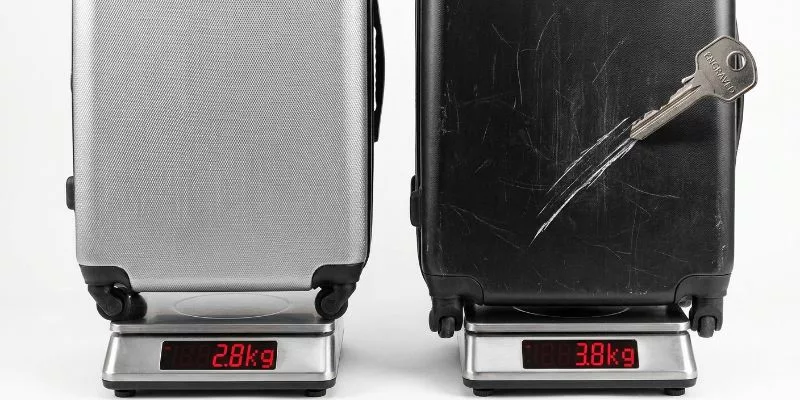
Buyers obsess over resin types and ignore structural design. A poorly engineered PC shell fails faster than a highly reinforced ABS shell. You must inspect wall thickness, corner geometry, internal ribs, and hardware load paths.
Many buyers think ABS bags weigh less. This idea is false. Pure PC is much stronger than ABS. This strength allows factories to mold thinner bag walls. A good PC bag often weighs less than an ABS bag.
In our typical case designs, pure PC is strong enough to inject a thinner ~2.5mm wall. To pass similar impact checks, ABS designs often need to be thickened to ~3.5mm.
The well-engineered PC case can therefore end up lighter — exact wall thicknesses vary with design, hardware, and target impact rating.
We also test cosmetic aging. I dragged a steel key across both samples. Glossy ABS shows wear instantly. It scratches deep and turns cloudy. We apply a micro-diamond texture to our Virgin PC molds.
This texture hides scuffs and handles baggage carousel friction beautifully. Keep in mind, neither plastic is completely scratch-proof.
Both materials show low water absorption in typical grades (under roughly 0.2% depending on grade, per ASTM D570), which helps stability in rain.
These days the comparison also includes polypropylene (PP), especially for wheeled spinners. PP is lighter and cheaper than PC, but its surface scratches more easily and its corner and impact toughness trail PC.
So the material conversation is no longer just PC vs ABS — it’s where each plastic fits the duty cycle.
Winner: Virgin PC
🚀 Actionable Insight: Do not approve a manufacturing run based on the “PC” buzzword alone. Review the full technical specification sheet, including wall thickness metrics and corner ribbing.
Pros & Cons of Virgin Polycarbonate vs. ABS
Here’s the practical trade-off, based on the factory floor checks, lab tests, and material records above.
Virgin Polycarbonate
Pros:
- Total Impact Recovery: The shell flexed inward and snapped back without denting during our 2-meter concrete drop test.
- Cold-Weather Survival: Survived our -10°C freezer test without micro-fracturing, making it ideal for freezing cargo holds.
- Long-Term ROI: Lower defect rates in our corporate trials justify the premium cost. We rely on official Lexan polycarbonate specs for verified tensile strength.
Cons:
- Premium Resin Cost: PC resin is usually noticeably pricier than ABS, which inflates your initial manufacturing invoice.
- Strict Process Control: Our technicians must dry the resin in dedicated hoppers. Poor drying causes moisture streaks and ruins entire batches.
- High Sourcing Risk: Dishonest suppliers substitute cheap regrind material if you lack on-site quality control.
⚡ Power Move: Mandate a lot-level Certificate of Analysis with your purchase order to ensure the factory uses 100% virgin resin.
ABS
Pros:
- Budget-Friendly Base: ABS resin costs less in most grades, slashing initial program costs for entry-level bags.
- Forgiving Processing: The plastic melts and flows with low resistance. This speeds up our injection molding cycles and reduces machine wear.
- Vibrant Aesthetics: Accepts bright finishes with ease, mirroring official Chimei ABS data for excellent dye compatibility.
Cons:
- Brittle Failure Mode: The plastic cracked at corners under repeated impact instead of flexing.
- Weak Cold Performance: Wheel mounts cracked during our winter weather simulations.
- Short Service Life: Clients report higher warranty claims within the first year of heavy checked-baggage use.
🧠 Expert Take: Restrict ABS usage to carry-on sizes or short-duty promotional items where blunt impact risk remains low.
Where Buyers Get Misled
-
Vague Material Claims: Suppliers quote “polycarbonate” but inject a brittle three-layer recycled plastic blend.
-
Confusing Weight Math: Buyers assume ABS is lighter. Strong virgin PC allows thinner, lighter structural walls.
-
The Bait-and-Switch: You approve a pure virgin golden sample, but the factory ships downgraded mass-production resin.
Don’t compromise on structural integrity. Contact our engineering team for full tensile strength reports and ISO testing protocols for our Virgin Polycarbonate vs. ABS materials. Ensure your project meets global standards from the start.
Disclosure: LantaoBags is an OEM/ODM luggage manufacturer with a commercial interest in this comparison; we have not been paid to promote any material, and we recommend buyers verify independently.
People Also Ask About Virgin Polycarbonate vs. ABS
1. What is virgin polycarbonate (PC)?
Virgin polycarbonate is a thermoplastic made from new resin, not recycled or reground material. In luggage, it is valued for absorbing impacts and flexing instead of cracking, especially in cold weather. Because virgin resin costs more than recycled or blended resin, some factories quietly substitute cheaper grades, which is why the paper trail matters.
2. How can I tell if my factory used pure polycarbonate or an ABS blend?
You must demand a Certificate of Analysis (COA) from your supplier. Visual inspection cannot expose a fake. Many factories co-extrude a microscopic polycarbonate skin over a cheap, recycled ABS core to cut costs.
During my factory floor audits, these blended shells look identical to pure virgin material. We physically cut the shells open and match raw material purchase invoices to the exact production date to guarantee purity.
⚠️ Safety First: Never approve a mass production run based solely on how the golden sample looks. Always demand the raw resin paper trail to verify virgin status.
3. Does ABS luggage break easily in the cold?
Yes. ABS turns highly brittle in freezing temperatures, making it a bigger liability for winter travel. Airplane cargo holds get incredibly cold, and that degrades the plastic’s impact resistance.
In our −10°C chamber tests, ABS shells cracked at the corners on early impacts, while PC flexed and recovered. We only recommend ABS for small, carry-on bags that stay inside a temperature-controlled cabin.
4. When should I choose ABS instead of PC?
When the brief is low-duty. ABS is a reasonable fit for promotional giveaways, carry-ons, or single-event use where blunt impacts are rare. It costs less upfront and is easier to process.
For checked luggage that will be handled, stacked, and flown repeatedly, PC’s impact resistance usually wins the lifetime-cost argument.
5. What documents should I request to verify virgin PC?
Ask for the exact resin grade and manufacturer name, plus the COA (Certificate of Analysis) and COC (Certificate of Conformity). Match raw-material purchase invoices to your production date. Refusal to share lot paperwork, or pricing too cheap to be real virgin PC, is a red flag.
6. Can I judge a shell’s quality from the wall-thickness number alone?
No. A spec-sheet number does not tell you how the shell was molded, how thick the corners are, or where the wheel mounts are reinforced. Measure actual wall thickness at several points, inspect corner geometry and internal ribs, and check the wheel-housing load path before approving a run.