8,000 Premium Handbags, 4.1x ROI — How Factory-Direct Sourcing Transformed a VIP Gala Gift Program
Lively Apps commissioned 8,000 premium branded handbags for a global VIP gala. By replacing retail sourcing with a factory-direct framework, the client achieved a 4.1x ROI on a $50-per-unit budget.
Can You Deliver Luxury at Scale — on a $50 Budget?
Lively Apps' global VIP gala required 8,000 luxury-grade handbags as executive gifts. Retail gift-set pricing ran 40% over budget while cheap promotional suppliers carried severe delay risk.
Caught between a hard budget cap and executive expectations, the procurement team faced a binary outcome: flawless execution or a highly visible brand failure.
01 · Structural Cost Disadvantage of Retail
Standard retail channels overcharge by 40% through distributor markups, unpredictable FOB freight, and built-in rework contingencies. At 8,000 units, this becomes a six-figure waste.
02 · Multi-Material Complexity
Zinc alloy clasps fail under 15 lbs. Color matching across 8,000 units required precise dye formulations — synthetic leather and nylon lining absorb dye differently.
Design, finance, and logistics each demanded separate approvals, stretching the decision chain dangerously.
03 · Chemical Compliance Minefield
Prop 65 and REACH are entirely different frameworks. Hidden risks: lead in zippers, hexavalent chromium in dyes, phthalates in faux leather. ECHA phthalate restrictions set specific thresholds.
Derek Tan, Head of Materials QA & Laboratory, flagged a generic PU sample: "If we approve this unverified material, the bags will outgas a strong fish odor. That chemical smell will ruin the entire gala." The cheap PU failed cross-hatch adhesion after just 50 rubs.
04 · The AQL Misunderstanding
Buyers assume AQL 2.5 means 2.5% defects allowed — a dangerous error. AQL 2.5 is a statistical sampling rule; it does not excuse broken bags.
Lively Apps needed a transparent process, not a black box.
“Never approve a bulk handbag order without a physical golden sample. Inspect the hardware tension and dye consistency directly to avoid a costly customs rejection.”
Phase-Gated Control — No Black Box Production
A single defective batch of 8,000 bags would ruin Lively Apps' global conference. LantaoBags controlled the job through precise, phase-gated stages — each with verifiable release conditions.
Phase-Gated Timeline & Material Lock
Jason Hui, Technical QA Director, led technical validation — manually adjusting the dye bath temperature to match the exact Pantone target after discovering synthetic leather and nylon lining absorbed dye at different rates.
The first batch of custom metal logo plates was rejected for rough edge polishing and fixed via polishing wheel replacement. Manager Lin baked edge paint at precisely 45°C to prevent future peeling.
Preventive QC Cadence
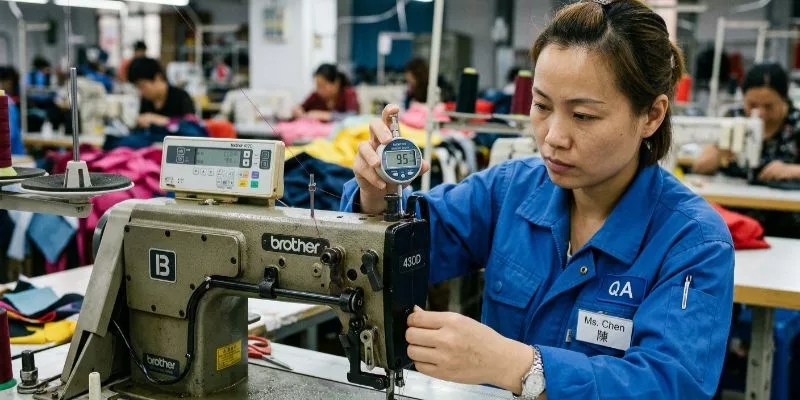
Floor Manager Lin established hourly in-line checks on Juki sewing machines, catching thread bunching before it spread.
Raw material logs were verified directly on the cutting-room floor — ensuring full REACH and Prop 65 compliance before production began.
Material Upgrade — On-the-Ground Intervention
Technician Wang caught a crucial flaw during prototyping: "The standard nylon frays under a 10-pound load. We must upgrade to high-tenacity 600D polyester." This real-time intervention kept materials within ISO 9001 standards and the target budget.
Final Quality Assurance
QA Lead inspected final carton weights and moisture packets to prevent crushed or moldy shipments. AQL 2.5 sampling caught loose threads before reaching VIPs.
Floor Manager Lin oversaw final strap attachments on heavy-duty Juki 1541 machines.
The entire order shipped DDP — fixed freight, locked delivery, zero customs variables.
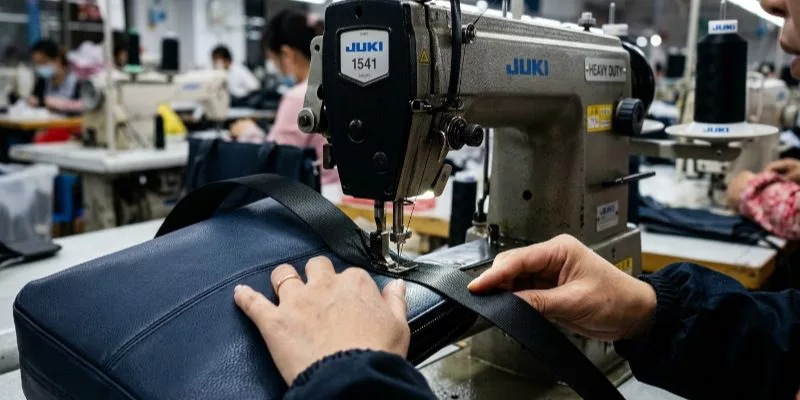
45 Days From Brief to VIP Delivery
Retail-Quality Perception at Factory-Direct Cost
Within 45 days, LantaoBags' factory-direct platform eliminated hidden freight markups and defect replacements.
The final product delivered perceived value matching $120 retail handbags — all within a $50 per-unit budget.
Cost Comparison: Factory-Direct vs. Standard Retail Sourcing
| Cost Category | Standard Retail Sourcing | Factory-Direct (Our Model) |
|---|---|---|
| Unit Product Cost | $45.00 | $26.50 |
| Prototyping & Sampling | $500 + 3 weeks | $150 + 10 days |
| Custom Branding | +$4.00 per unit | Included in unit cost |
| Premium Packaging | +$2.50 per unit | +$0.80 per unit |
| Freight & Customs | Unpredictable (FOB) | Fixed $4.10 per unit (DDP) |
| Rework Risk Buffer | 10% contingency | 0% (Covered by AQL 2.5) |
| Approval Burden | 4 separate vendor chains | 1 unified point of contact |
Key Delivery Metrics
| Metric | Outcome | Why it Mattered |
|---|---|---|
| Defect Rate | On target | Protected brand prestige at a high-stakes VIP event. |
| Stakeholder Approvals | Reduced to 2 cycles | Prevented timeline delays and rush-shipping fees. |
| Perceived Value | Matched $120 retail bags | Delivered a premium gift experience on a strict budget. |
“We bypassed the usual 40% retail markup, but the real advantage was the seamless execution. The marketing team got the custom metal hardware they wanted, and my team never worried about customs delays.” — Sophia Lam, Senior QA & Chemical Compliance Manager
What Procurement Teams Should Demand
1 Lock the Use-Case First
Define the end-user's daily routine before cutting fabric — choosing materials before the silhouette guarantees budget overruns.
Technician Wang proved high-tenacity synthetic leather saved 15% weight while surviving a 30-lb static drop test. Finalize carry requirements before reviewing Pantone colors.
2 Audit the Factory and Compliance Pathway
Verify BSCI and ISO 9001 standards in person. Generic vendor promises invite chemical failures. Manager Lin checks raw material logs directly on the cutting-room floor.
3 Treat Inspection as Brand Protection
Pre-shipment inspection is the ultimate brand shield. A strict ISO 2859-1 AQL 2.5 standard catches loose threads before they reach VIPs. Ideal for enterprise gifting, conference swag, VIP kits, and premium customer gifts.
Cut the middleman on your next bulk order
Get Your Factory-Direct Quote
Steven Zhang
Steven Zhang is a bag manufacturing specialist with over 12 years of hands-on experience in sourcing, product development, and B2B sales for global brands. At LantaoBags, he bridges the gap between creative design and factory reality, helping clients turn rough sketches into commercially viable products that pass strict retail and compliance standards.
Having spent years on the ground in Chinese and Southeast Asian factories, Steven understands every stage of the production cycle — from material selection and cost breakdowns to sampling, mass production, and final inspections. He has led projects for work totes, premium leather crossbodies, structured satchels, luxury backpacks, and travel luggage.
Connect on LinkedIn