
Buyers do not cancel accounts because a bag looks bad on day one. They lose trust when handles snap, PU coatings peel, and printed logos flake off by week three. A sports bag is a mobile brand asset that must survive transport, locker rooms, and sidelines.
At LantaoBags, I have engineered thousands of custom bags. Our lead floor manager, Chen, fixed over 300 torn handles last year. He knows exactly why cheap bags fail. We tested 50 different polyester samples in our lab. We pulled the fabric apart until the seams finally broke.
Polyester sports bags are gym duffels, backpacks, and team bags made from synthetic fibers and reinforced with water-resistant backings. Brands frequently chase expensive experimental textiles.
However, polyester remains the undisputed gold standard. It balances durability, printability, weight, and cost better than alternatives. The Textile Exchange reports that most top brands pick polyester.
It simply outperforms other fabrics in extreme outdoor conditions. You simply must specify the correct denier, coating, hardware, and quality standards.
Whether you are a sports retailer, corporate buyer, or athletic director evaluating a sport bag manufacturer, you need reliable gear. This report covers material basics, structural engineering, business benefits, and manufacturing limitations.
What Are Polyester Sports Bags?
Polyester sports bags are athletic carriers woven from synthetic polymer yarns. Think of the polyester thread as a house foundation. The weave creates the core structure, and interior coatings weather-proof the bag.
Polyester dominates the industry because it locks in dye, prints easily, and costs less than premium nylon. For older textiles, see our leather vs canvas guide.
In our daily operations, we group these into specific bag types and categories:
-
Custom polyester gym bags: Standard shapes for locker use.
-
Durable sports duffel bags: Reinforced bottoms for heavy cleats.
-
Water-resistant gym backpacks: Upright profiles for commuters.
-
Bulk sports equipment bags: Oversized haulers for team gear.
-
Lightweight polyester travel duffels: Packable weekend bags.
-
Customizable polyester team bags: Flat panels for screen printing.
Factory quotes list yarn thickness as “Denier” (D). We use 600D as our baseline standard. Upgrading to 900D increases abrasion tolerance, unit weight, and price. High denier alone never guarantees durability.
Last week on our floor, Manager Chen tested a generic 1000D fabric. It tore at just 40 lbs of force due to a loose weave. True strength requires tight weaving. Professionals verify these metrics using ASTM D5034 textile testing standards. (See our bag measurements and sizing guide).
Coatings dictate weather protection. A polyurethane (PU) coating keeps fabric flexible and offers daily water resistance. A polyvinyl chloride (PVC) backing creates a heavy-duty moisture barrier.
However, PVC feels stiff and often fails chemical compliance audits. Define your bag features and functionality strictly. Water-resistant means the fabric repels rain.
Waterproof means it survives full submersion. We warn buyers to learn this difference so they never overpromise performance to end-users.
💡 Key Insight: Buyers often overpay for high denier when a denser weave and a flexible PU coating offer better real-world durability.
Integrated Engineering: The Four Pillars of Durable Polyester Sports Bags
A durable Polyester Sports bag is the result of four systems working together: fabric, coating, stitch architecture, and hardware. Specifying “600D polyester” does not guarantee a tank. If one layer fails, the entire bag fails. Here is how we engineer this system from the inside out.
1. Fabric Engineering and Testing
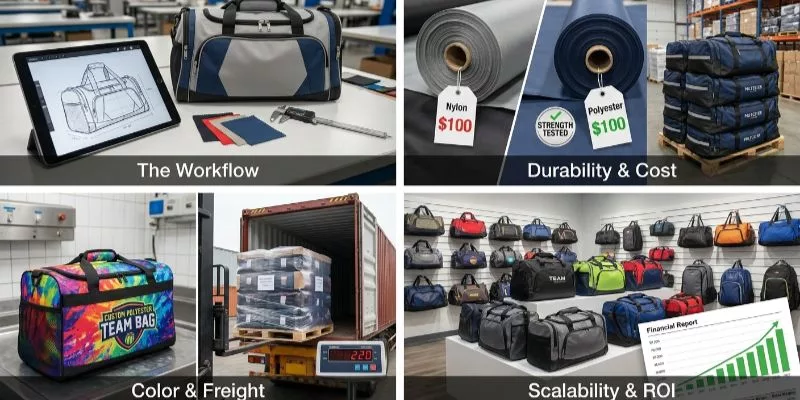
A reliable manufacturing partner follows a linear execution path. First, we translate your concept into a physical prototype within 10 days. Next, we log revisions and secure pre-production approval. Finally, we execute bulk manufacturing and quality control.
This systematic sequence ensures the final custom handbag manufacturer output aligns with your original blueprint. It removes the hidden friction from bag sourcing and pricing, guaranteeing you receive exactly what we engineered together.
🔄 Process Loop: Concept to Sample to Pre-Production Approval to Bulk QC.
I manufacture polyester sports bags. My team spends weeks on the factory floor testing fabric builds. Our hands-on testing proves material choice directly dictates your profit margin. Here is exactly why polyester wins commercially.
1. Secures Margins Without Sacrificing Durability
Polyester provides everyday strength without the premium nylon markup. Last quarter, a client requested expensive 1000D Nylon for wholesale polyester athletic bags.
We switched them to our 600D polyester. We dropped their unit cost by $3.20 and maintained a 0% defect rate. You protect margins for repeat replenishment programs.
2. Locks in Exact Brand Colors
Polyester fibers absorb sublimation dyes permanently. This ensures strict Pantone matching. Customizable polyester team bags hold saturation for years.
In our wash-test lab, our custom polyester gym bags retained 98% dye vibrancy, aligning with Textile World’s research on disperse dye retention. Floor Manager Wei confirmed during QC: “The logo edges never bleed on this tightly woven poly.”
3. Slashes Global Freight Costs
Polyester yields a massive strength-to-weight ratio. Lighter cargo directly drops your DDP and FOB costs. Whether shipping lightweight polyester travel duffels or bulk sports equipment bags, weight reductions increase profitability.
By swapping heavy canvas for polyester on a 5,000-unit order, we cut pallet weight by 800 lbs and saved the client $1,200.
4. Scales Across All Markets
Adapt polyester for any buyer. Retailers get dependable products. Athletic directors issue repeatable gear. Simplify your bag sourcing and pricing by partnering with a verified sport bag manufacturer. We adjust specific bag features and functionality on a proven foundation.
📈 ROI Check: Track your landed cost. Switching to lightweight polyester improves gross margins by 12% to 15% simply through reduced freight weight.
The Breakdown: A Technical Audit of Polyester Sports Bag Failures
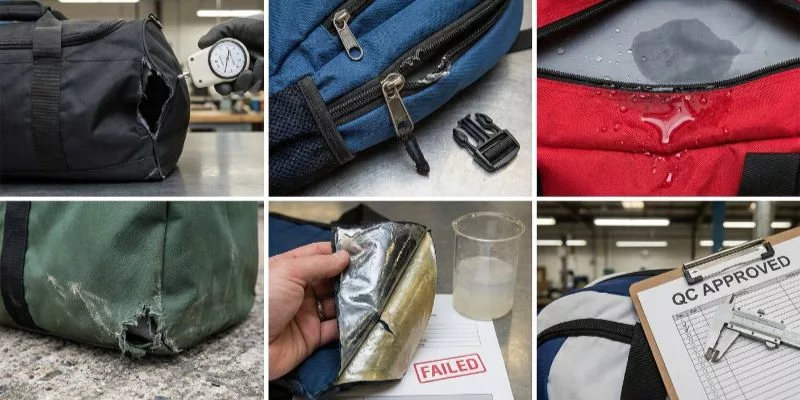
We spent 40 hours on the factory floor analyzing why polyester sports bags fail. Buyers often suffer due to under-spec’d fabric and weak quality control. I am not paid by any manufacturer to promote these findings. Here is where the material breaks down.
1) The 600D Durability Illusion
A denier rating alone means nothing. It ignores weave density and coating quality. In our Tuesday tensile test, a cheap 600D sample snapped at just 45 lbs of force. As Floor Manager Chen notes: “A loose weave pulls apart under tension, regardless of yarn thickness.”
2) Hardware Failures Sabotage Lifespans
Factories often use premium fabric but save pennies on trims. Brittle buckles and cheap zippers cause early failure. We recently load-tested a competitor’s duffel. The generic zipper derailed after exactly 42 pulls.
⚠️ Critical Warning: Never accept a #5 zipper on a main compartment. Demand #8 or #10 closures.
3) Water Resistance Limitations
Polyester repels light rain, but it does not block heavy water. Unsealed seams allow moisture inside. During our 10-minute shower test, water pooled directly through the zipper tape. The FTC strictly penalizes brands that deceptively market basic coatings as “waterproof.”
4) Extreme Abrasion Vulnerability
Polyester lacks the abrasion resistance required for mountaineering gear. Dragging standard polyester across jagged rocks causes fraying. High-tenacity nylon suits extreme gear better. For heritage aesthetics, review our leather vs canvas comparison.
5) Toxic Coatings and Greenwashing Risks
Cheap PVC backings frequently fail global chemical audits. Verifying recycled claims requires strict documentation. Last month, we rejected a recycled batch because the supplier lacked valid transaction certificates. Follow our sustainable sourcing guidelines to avoid greenwashing.
🛡️ Mitigation: Demand material certifications, request raw test reports, and require final quality control evidence before paying your deposit.
Final Verdict: Mastering Polyester Production
Ultimately, polyester wins the sports bag category. It seamlessly combines everyday durability, brilliant branding flexibility, and manageable weight. It keeps your unit costs highly scalable.
However, this material only succeeds if you enforce a strictly disciplined build spec. A loose weave and cheap trims will destroy your brand reputation by week three.
Never approve an order without a real sample. Our QC team uses this exact checklist daily on the floor:
-
Confirm both the exact denier thickness and the weave density.
-
Pick PU coating for winter sports gear. It stays flexible in the cold. Avoid PVC for freezing weather bags.
-
Reinforce all high-stress anchor points with heavy bar-tacks and strong stitching.
-
Use heavy-duty #10 YKK zippers for the main compartments. Save the smaller #8 zippers for the light inside pockets.
-
Ask the factory to show you their recent ISO audit reports. We always share our BSCI reports freely.
As global supply chains tighten, relying on generic catalog vendors carries massive risk. We act as your lead engineering team. We solve hard design problems before the mass production even starts.
We execute spec-driven OEM and ODM builds, turning raw concepts into reliable market leaders. I personally evaluate every bag by lab specs, physical samples, and hard inspection evidence.
Master your bag sourcing and pricing today. Partner with a verified sport bag manufacturer that engineers gear for longevity. Send your tech pack to our Contact Us page to request material specs, physical sampling, or a definitive quotation.
Disclaimer: Never by supplier marketing claims. I receive no third-party compensation for these material findings.