
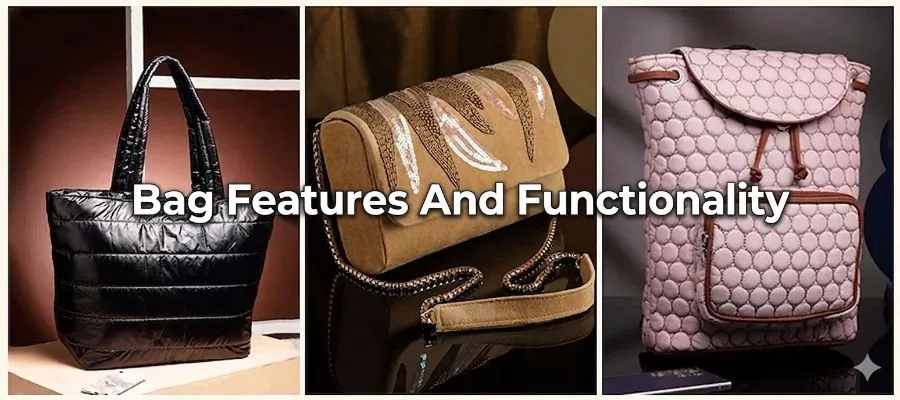
A bag is an engineered system, not just a fashion item. While many look premium in photos, true quality is revealed at stress points like strap anchors and zippers. To avoid costly returns, buyers must evaluate a bag’s structural integrity rather than its outward styling.
Real durability is proven through metrics, not marketing. Professional manufacturing relies on standards like ISO 13934 tensile testing to verify seam and fabric strength. Understanding the “why” behind materials and hardware ensures the product can survive the rigors of its intended environment.
The best bag isn’t the one with the most features, but the one engineered for a specific use case. Whether for commuting or field work, prioritize longevity and functional logic over trends. This technical lens helps you balance manufacturing realities with real-world utility.
What Are Bag Features & Functionality?
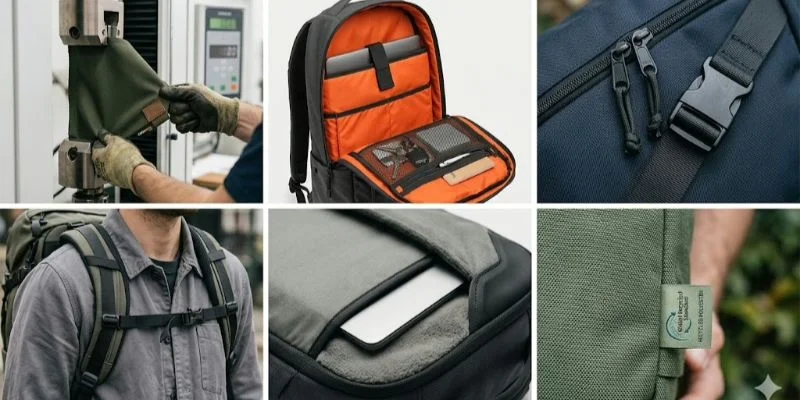
Evaluate a bag as an interconnected system where straps serve as the foundation and fabric acts as the shell. High-end features cannot compensate for a weak structure; if the foundation fails, the entire system collapses under pressure.
Don’t be fooled by the “denier myth”—high yarn thickness does not guarantee strength. True durability is determined by the weave, backing, and overall construction quality rather than just a high numerical rating.
Select materials based on specific needs: 1000D Cordura for scuff resistance, Ballistic nylon for sleek tear-resistance, or RPET for sustainability. Always verify eco-claims through the Global Recycled Standard (GRS) and check material specifications via Textile Exchange.
Quick glossary of common terms:
-
Denier (D): The thickness and weight of fabric yarn.
-
Ballistic nylon: A dense basket-weave nylon designed to stop debris.
-
Cordura: A branded fabric built for extreme abrasion resistance.
-
RPET: Fabric made from recycled plastic bottles.
-
DWR coating: Durable Water Repellent. A treatment that makes water bead up and roll off.
-
Water-resistant vs waterproof: Sheds light rain versus surviving full underwater submersion.
-
Laptop sleeve: A padded pocket suspended above the base to prevent drop damage.
-
MOLLE: A webbing grid used to attach modular pouches.
-
RFID blocking: A lining that prevents digital theft of card data.
💡 Key Insight: High denier means nothing with weak stitching. Always judge the complete system.
To evaluate bag functionality, look beyond marketing. We use industrial testing rigs to dissect and pull apart bags, tracing exactly how fabrics, straps, and seams fail under stress. Quality is a measurable formula, and here is our technical breakdown.
1. Shell Fabrics And Coatings
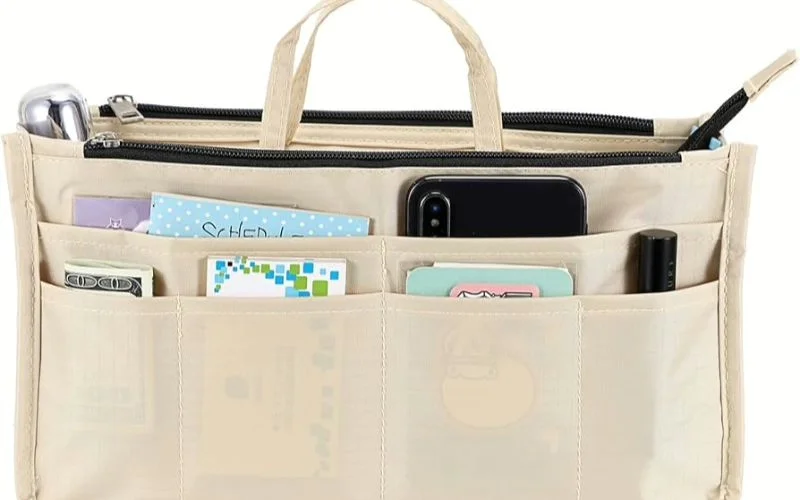
More pockets don’t guarantee better organization. True functionality relies on spatial flow—using zoned packing for bulk, quick-access for keys, and external pockets for liquids. This strategic separation keeps your gear organized while protecting delicate electronics.
When evaluating a laptop sleeve, ignore the 13-inch or 16-inch screen label. The actual device chassis size dictates the fit. More importantly, you must use a suspended sleeve.
⚙️ Technical Detail: A suspended sleeve stops one inch above the bottom of the bag. If you drop the bag, the exterior hits the ground, not your laptop edge.
2. Storage Logic and Internal Organization
A bag with 20 pockets that can’t fit a water bottle is worse than a bag with 3 well-designed compartments. The fundamental principle is zoned packing: bulk storage (main), quick-access (front), protected storage (padded sleeve), and external access (bottle pockets).
Manager Chen evaluates every prototype against a 7-item test: laptop, charger, water bottle, notebook, keys, phone, and sunglasses. If any item requires moving another to access it, the organization fails. This catches 90% of layout problems before the sample leaves the factory.
The most common mistake is pockets that exist but don’t function — a pen slot too narrow for a Sharpie, a phone pocket that works without a case but not with one, a key leash 2 inches too short. We spec all pocket dimensions with a 10% tolerance buffer above the nominal object size.
⚙️ Technical Detail: Pockets anchored only to the bag lining sag inward under load. Anchor all internal pockets to both lining AND shell at minimum two points.
3. Strap Systems and Load Distribution
Strap design determines user comfort more than any other feature, yet receives the least engineering attention in most factory samples. A backpack with perfect materials generates returns if straps dig into shoulders after 20 minutes.
Manager Lin’s protocol: “Strap width below 2.5 inches creates pressure points above 8 lbs load. Padding below 10mm EVA foam bottoms out after 30 minutes. A straight strap that doesn’t follow the natural S-curve will always slip.” We use 3D contoured straps on all backpacks above 15-liter capacity.
For shoulder and messenger bags, the strap attachment angle determines whether the bag hangs flat or twists outward. The attachment point must be positioned at the bag’s center of mass when loaded, not at the geometric center.
🛡️ Our Verdict: 2.5-inch minimum strap width, 10mm EVA foam with air mesh, S-curve geometry for loads above 8 lbs. These three specs cost approximately $1.20 extra per unit and eliminate 80% of comfort returns.
4. Closure Systems and Access Speed
The choice between zipper, magnetic snap, drawstring, flap, or roll-top closure determines access speed, security, and long-term durability. Each type has a specific failure mode.
Zippers are most reliable for high-cycle use but most expensive to repair. Manager Wei’s rule: “The zipper number is not a suggestion. A #5 zipper on a main compartment opened 10 times daily fails within 14 months. Always spec one size up from what ‘should’ work.”
Magnetic snaps dominate handbags for one-handed access, but retention force must match loaded weight. A snap rated for 5 lbs releases when a loaded bag tips over. We spec Fidlock mechanical-magnetic hybrids for bags over 3 lbs.
⚙️ Technical Detail: Roll-top closures require minimum 3-roll fold with side-release buckle. Two rolls leak at corners. Four rolls waste volume. Three is the sweet spot.
5. Hardware Finish and Corrosion Resistance
Hardware is the most under-spec’d component in custom bag manufacturing. Brands obsess over fabric denier but accept “gold-tone metal” as a spec — then wonder why zipper pulls tarnish after 90 days.
Three quality tiers: alloy (corrodes within 6 months, $0.08/unit), zinc (1-2 years, $0.18/unit), and brass with PVD coating (5+ years, $0.35/unit). Manager Zhao: “The brass one passes 96-hour salt spray. The alloy one fails in 24 hours. For a $200 bag, the $0.27 difference is invisible. For a $25 promotional bag, it’s the difference between profit and loss.”
Cross-batch finish consistency is the hidden risk. “Matte black” zippers from Supplier A may read as dark gray next to Supplier B’s “matte black” D-rings. We require all visible hardware from the same finishing batch.
🛡️ Our Verdict: Brass with PVD coating for bags above $80 retail. Zinc for $30-80. Alloy only for single-use promos. Cross-batch matching is non-negotiable.
6. Water Protection And Weather Readiness
Premium bag features & functionality solve specific problems, but they introduce structural compromises. You cannot engineer a product without sacrificing weight, volume, or budget.
1. Reduced Comfort And High Shipping Costs
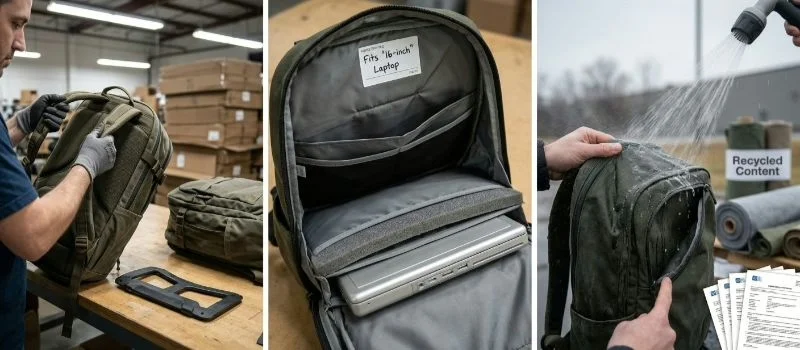
Tougher materials make heavier bags. We stress-tested rugged commuter packs and found that adding a rigid polymer frame increased dry weight by 2.4 pounds. This structure improves lifespan but causes reduced all-day comfort.
Bulky frames also prevent flat-packing in warehouses. This wastes cargo space and raises logistics costs for e-commerce sellers.
During quality control, inspect physical samples closely. Look for visible red flags like skipped stitches, seam slippage on corners, and thin strap foam that collapses under heavy loads.
2. Diminished Usable Volume And Access Friction
More compartments cause reduced usable volume. We packed a heavily organized 30-liter tech backpack. The thick laptop suspension foam and rigid anti-theft layers consumed 40% of the main compartment. Furthermore, laptop compatibility labels frequently mislead buyers.
A printed “16-inch sleeve” tag often fails to fit older devices because it ignores laptop depth. Look inside the prototype for wavy zipper installs, loose thread ends at stress points, and weak lining in high-friction pockets.
⚠️ Critical Warning: Overdone anti-theft features and tactical modularity create awkward daily access and look visually aggressive in professional office settings.
3. Material Failures And Production Hurdles
Marketing frequently overstates waterproof claims. We rain-tested standard stitched bags. Water leaked instantly through the untreated seams. Most consumer bags only offer light urban weather resistance.
Likewise, sustainable fabrics vary wildly. Recycled plastic content does not guarantee high abrasion resistance or longevity.
The Federal Trade Commission strictly monitors deceptive environmental marketing claims. Upgraded components also change your target price, manufacturing complexity, and lead times.
Imported fabrics require strict destination-market safety compliance reviews. To navigate these specific production hurdles and review custom feature feasibility, consult expert custom handbag manufacturers early in your design process.
The Verdict: Execution Over Excess
A premium bag is a unified tool, not a random checklist. While excessive compartments add unnecessary weight and cost, a purpose-built design protects assets and eliminates physical strain. Success lies in prioritizing feature relevance and flawless execution over sheer quantity.
We recommend a strict evaluation hierarchy: first, verify material and build quality; second, test carry comfort under heavy loads; and third, assess internal organization and protection. Finally, review weather resistance and security to ensure the bag matches its specific job.
We help you navigate bag sourcing and pricing without the guesswork. If you want expert input on materials, custom features, or production feasibility, explore our portfolio at LantaoBags. As premier custom handbag manufacturers, we translate your technical specs into a physical reality. Contact us today to start building your next great product.