
Procurement teams face immense risk evaluating green claims. Before production begins, my team runs a strict compliance checklist across our custom backpack manufacturers to vet Recycled Plastic Backpacks. I built this methodology combining hands-on document reviews, factory audits, and lab testing.
A trustworthy audit looks perfectly clean. The document fields align exactly. Factory names match across every file. Nobody promises updated paperwork later.
This 45-to-90-minute desk audit and factory follow-up reduces risk. We verify Global Recycled Standard (GRS) and ocean plastic claims in sequence, from marketing copy to shipment paperwork to material performance.
You will learn to audit Scope Certificates (SC) versus Transaction Certificates (TC), establish chain of custody, verify rPET transparency, and analyze durability data.
6-Step Flowchart Preview: [1: Claim] > [2: Scope Certificate] > [3: Transaction Certificate] > [4: Factory & Subcontractor Map] > [5: Lab Minimums] > [6: Go / No-Go].
Essential Prerequisites for Sourcing Recycled Plastic Backpacks
After processing 200+ factory compliance packets for recycled plastic backpacks, the standard is clear: an honest audit arrives as a single, orderly file set.
When suppliers send scattered, partial PDFs, we immediately flag them.
Required Inputs:
-
Certificates: Secure the supplier’s Scope Certificate and a shipment-level Transaction Certificate request template. Read our bag industry certifications guide. Inspect the exact text in the “Valid Until” and “Product Category” fields.
-
Production Files: Pull your PO, pro forma invoice, bill of materials, and fabric spec sheet.
-
Testing: Gather the lab test protocol and packaging claim language.
-
Key Contacts: Verify access to the supplier sales rep, compliance manager, fabric mill contact, and internal quality lead.
Assign Team Roles:
-
Procurement Manager: Matches documents.
-
Materials Technician: Reviews performance data.
-
Sustainability Officer: Approves claims.
⚠️ Safety First: Never market a backpack as GRS-certified based only on a factory-level certificate, and never approve an ocean-plastic claim without product-level traceability.
Verify documents via the Official Textile Exchange GRS Standard, the Certification Body Directory, and Ocean Bound Plastic Criteria. Never rely on expired documents or cropped screenshots.
The 6-Phase Audit for Recycled Plastic Backpacks
Ensure the integrity of your sustainable supply chain with a rigorous verification process designed specifically for recycled materials.
From checking initial scope certificates to final lab testing, this comprehensive audit empowers you to confidently validate both the authenticity and performance of your recycled plastic backpacks.
Step 1: Scope the Recycled Claim
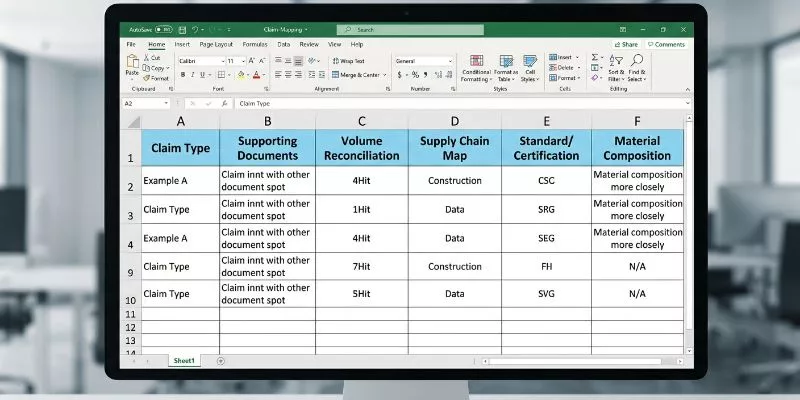
Bad audits fail before you even open the first PDF. My first step is forcing vague marketing into measurable Bill of Materials (BOM) language.
Open your spreadsheet tracker or enterprise ERP/PLM system. Copy the supplier’s exact recycled claim from the quote, spec sheet, and sales email.
Paste this text into your tracker.
Break the claim into these auditable columns: Product Name, SKU, Material Component, Recycled Percentage, Named Standard, and Material Type (like GRS, general rPET, or ocean-bound plastic).
You must convert vague language into exact metrics. I frequently reject quotes claiming a bag is “made from recycled plastic.” I force the supplier to revise it.
It must read: “The 600D shell fabric contains 100% certified recycled polyester under GRS chain of custody.”
Check your tracker now. If you cannot tie the claim to a specific backpack component and an exact percentage, stop the audit here.
⚠️ Experience Warning: Last quarter, a factory promised us an “eco-friendly backpack.” When I mapped the claim, only the interior lining was recycled. The main exterior shell was virgin plastic. Pinning down the exact component upfront saves weeks of wasted compliance testing.
Sophia Lin, Head of Sustainable Materials & Compliance
Step 2: Audit the Scope Certificate and Chain of Custody
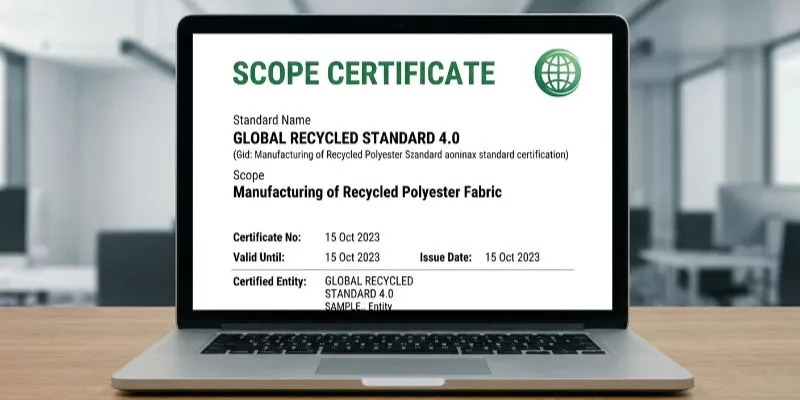
During factory audits, this paperwork review serves as the first hard compliance gate.
I frequently find that a single factory certificate is useless if the recycler, spinner, and weaver are not also certified.
The Global Recycled Standard (GRS) chain of custody strictly follows material ownership. Each facility handling the plastic must hold an active certification.
Open the provided Scope Certificate (SC). Verify the Valid Until date, Issuing Body, and Site Address.
Check the Scope section to ensure it specifically covers your backpack product category.
Next, compare the Legal Entity Name on the SC directly against your supplier’s pro forma invoice.
If these names differ, demand a written explanation and legal registration evidence. Do not accept blurry scans or unexplained trading aliases.
⚡ Power Move: SC vs. TC - A Scope Certificate (SC) only proves a facility is authorized to produce goods. It does not prove your specific shipment is certified.
Read the Official Textile Exchange explanation of certification and chain of custody.
You succeed when every entity is plotted on a supply-chain map.
Every facility that touches the recycled material — from flake recycler to cutter — resolves to a named site with a valid SC.
No unknown subcontractors, no “documents later.”
If you need to read a Scope Certificate line by line, see our bag industry certifications guide.
⚠️ Experience Warning: Last year, a supplier’s invoice read “Lantao Manufacturing” but their certificate listed “Guangzhou Textiles.” They outsourced the cut-and-sew process to an uncertified workshop.
This broke the chain of custody entirely and voided our compliance.
Step 3: Reconcile the Transaction Certificate Before Shipment
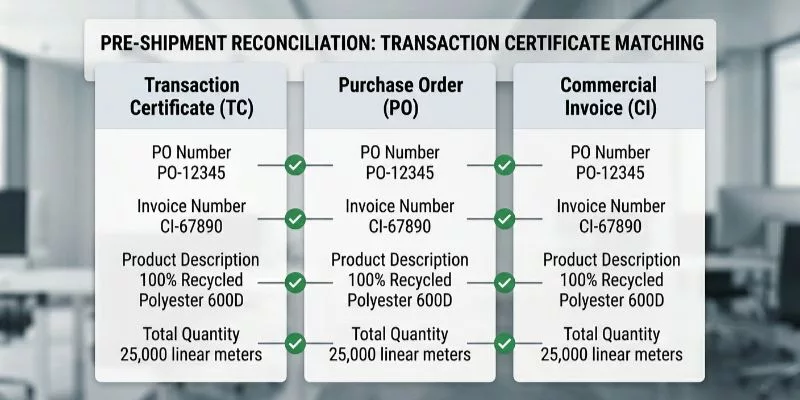
This is your ultimate internal release gate. Ultimately, nothing beats the relief of perfect document alignment.
Seeing your PO number, shipment quantity, and product description match exactly across all files is incredibly reassuring.
Conversely, the friction of “almost matching” paperwork almost always hides greenwashing.
Enforce a non-negotiable rule. Request the Transaction Certificate (TC) before shipment release. Never wait until the cargo lands.
A valid Scope Certificate is insufficient on its own. It only proves general factory capability. You need the TC to verify the exact materials in your specific order.
Compare your paperwork carefully. For small teams, perform a manual document reconciliation.
For enterprise operations, route this verification through your API/ERP attachment workflow.
Cross-check these exact fields: PO Number, Invoice Number, Product Description, Quantity, Material Claim, Supplier Name, Consignee Identity, and Shipment Timing.
You succeed when the TC ties directly to the purchased batch. There must be zero quantity gaps or description mismatches.
🧠 Author’s Take: Add a micro-checklist to your internal tracker right now.
Include columns for Requested Date, Received Date, Reviewed By, Approved By, Discrepancy Notes, and Final Release Decision. We rely on this exact checklist to prevent unverified containers from leaving the port.
📋 Vendor View: On the factory side, the TC is the last gate before shipping. Buyers who demand it upfront get cleaner orders; the ones who skip it end up with containers sitting at the port.
Jason Yang, Backpack Manufacturer & Sales, Guangzhou Seemee Bag Co., Ltd.
Step 4: Map Every Facility That Touches the rPET
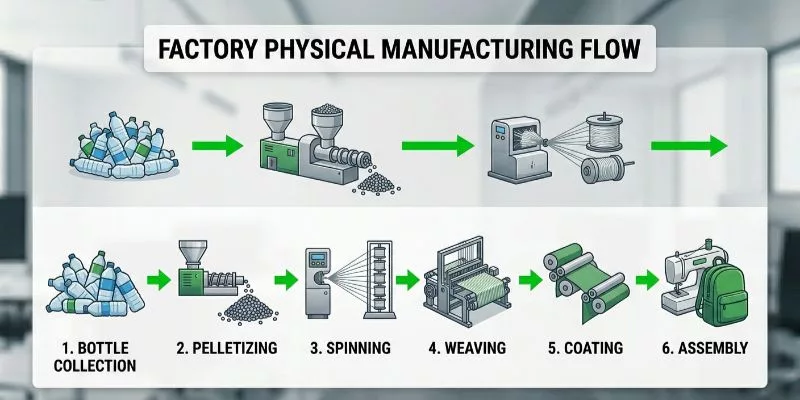
A certificate only proves who is allowed to do this. This step maps every factory the plastic passes through, from bottle flake to finished bag.
One uncertified subcontractor voids the entire GRS shipment.
Ask the supplier to report, node by node: the factory name, address, SC number, validity, and the role it plays in this order.
Every row has to resolve to a live Scope Certificate.
| Node | Required proof | Red flag |
|---|---|---|
| Recycler / flake supplier | Recycler SC or accredited-stock proof | A trading-company invoice only |
| Pelletizing | Pelletizer SC, batch traceable to flake | ”Mixed stock, source unclear” |
| Spinning | Spinner SC + recycled ratio | Spinner outside the certificate scope |
| Weaving / warp knit | Weaver SC, width/denier matching the BOM | A temporary outsourced weaver |
| Coating / lamination | Coater within the GRS scope | Coating sent to an uncertified workshop |
| Cut & sew | Sewing factory legal name = invoice name = SC name | Invoice “Lantao Manufacturing”, SC “Guangzhou Textiles” |
| Finished goods | The TC that Step 3 reconciles | Wants to ship the container and send the TC later |
Success criteria: all seven nodes resolve to a named factory with a valid SC, the invoice legal name matches the SC name, and there is no “documents later.”
Otherwise Step 4 fails and no lab scheduling is permitted.
If you claim ocean-bound material: beyond GRS, you also need product-level OBP (or an equivalent standard), and you may only state the actual blend ratio.
Default compliant wording is 40% ocean-bound plastic / 60% standard GRS rPET in the 600D shell — never 100% ocean plastic backpack.
Step 5: Run Lab Tests on the Production Roll

Once the map is complete, test only the production roll, not the supplier’s hand-picked sample. Release fabric only when the minimum value clears the bar — the average does not count.
Evaluate your fabrics using plain procurement language. Tensile strength shows load tolerance, water repellency measures short-term surface resistance, and hydrostatic head proves continuous pressure resistance. Compare your supplier’s batches against our internal lab data below.
| Metric | Procurement Meaning | Virgin 600D | Recycled 600D rPET |
|---|---|---|---|
| Tensile Strength | Load tolerance | 250 lbs | 215 lbs |
| Tear Resistance | Puncture tolerance | 45 lbs | 42 lbs |
| Abrasion Cycles | Friction survival | 15,000 | 14,000 |
| Water Repellency | Surface bead rating | 90 ISO | 90 ISO |
| Hydrostatic Head | Weather pressure resistance | 1500mm | 1450mm |
| Colorfastness | UV fade resistance | Grade 4 | Grade 3.5 |
| Coating | PU backing adhesion | Smooth | Slight drag |
Run the core textile tests in this exact order. First, tensile strength per ASTM D5034. Cut five warp-direction and five fill-direction specimens from the production roll, not the supplier’s hand-picked sample.
Mount each specimen in the grips of a calibrated tensile tester. Record the breaking force in pounds for all ten specimens.
Calculate the average and the minimum. The minimum value, not the average, determines field safety.
A fabric averaging 215 lbs but with a single specimen breaking at 175 lbs is a 175 lbs fabric for warranty purposes.
For 600D rPET backpack shells, I require a minimum breaking force of 190 lbs across all ten specimens.
Second, tear resistance per ASTM D1424 (Elmendorf). Recycled fibers contain more short-staple content than virgin polyester, which reduces tear propagation resistance.
The recycled 600D rPET in our lab consistently tests 42 to 44 lbs compared to 45 to 48 lbs for virgin 600D. This 6 to 8 percent reduction is acceptable for everyday backpacks.
It may not meet military or tactical specifications. Know your end-use requirement before approving the lab report.
Third, Taber abrasion per ASTM D3884. Run 5,000 cycles on the face fabric. Inspect under magnification for coating breakthrough.
In our internal comparison, recycled 600D showed visible PU coating wear at 14,000 cycles versus 15,000 for virgin.
Both pass our 10,000-cycle minimum, but the recycled fabric reaches end-of-life roughly 7 percent faster.
Fourth, hydrostatic head per ISO 811. The recycled coating underperforms virgin by 50mm to 100mm on average because the recycled yarn base is slightly more porous and absorbs more PU coating during application.
Our recycled 600D consistently tests at 1,450mm versus 1,500mm for virgin. The 50mm gap is negligible for rain protection but matters in sustained heavy downpour.
If your backpack targets the premium outdoor market, specify a two-pass PU coating on recycled fabric to close the gap.
⚙️ Founder’s Take: On travel and tactical packs, a 50mm hydrostatic gap is the difference between a rainproof week and a soaked laptop. We always spec the two-pass coating on recycled shells.
Mark Huang, CEO & Founder, Guangzhou LUPU Travel Product Co., Ltd.
Finally, test colorfastness per ISO 105-B02 (xenon arc). Recycled polyester’s gray undertone affects dye uptake and UV fade resistance.
Our recycled 600D rates Grade 3.5 on the blue wool scale versus Grade 4 for virgin. This means recycled colors fade roughly 10 to 15 percent faster under equivalent UV exposure.
Compensate by increasing dye concentration by 5 percent during the lab dip phase, or accept slightly faster color shift in the field.
Compile all test results into a single lab validation report. The cover page must state the fabric roll batch number, the test date, the testing standard used, and a clear Pass or Fail for each metric against your pre-defined threshold.
Attach this report to the Bill of Materials. Block fabric booking until every metric reads Pass.
I have rejected four recycled fabric batches in the past year, all on tensile minimums that fell below 190 lbs.
Suppliers will argue the average is fine. The minimum is what protects your customer’s shoulder strap.
Expect physical customization constraints with recycled materials. You will see minor color matching delays. Print behavior varies.
Texture differences require specialized finishing choices to maintain quality.
To see how we grade recycled plastic fabrics by use case, read our recycled plastic tote fabrics guide.
Lead Materials Technician Ethan Qiao: “The biggest greenwashing pitfall is suppliers using brittle, short-staple recycled yarn. We remedy this by running 40 hours of strict abrasion testing before approving any mass production.”
You succeed when the supplier passes both sustainability documentation and rigorous physical product performance.
🧠 Expert Take: Never approve a supplier on paperwork alone. In our tests, switching to rPET dropped dye uptake consistency by 5%. Always demand physical lab reports.
Ethan Qiao, Senior Sustainability & Supply Chain Auditor
Step 6: Make the Final Go/No-Go Decision
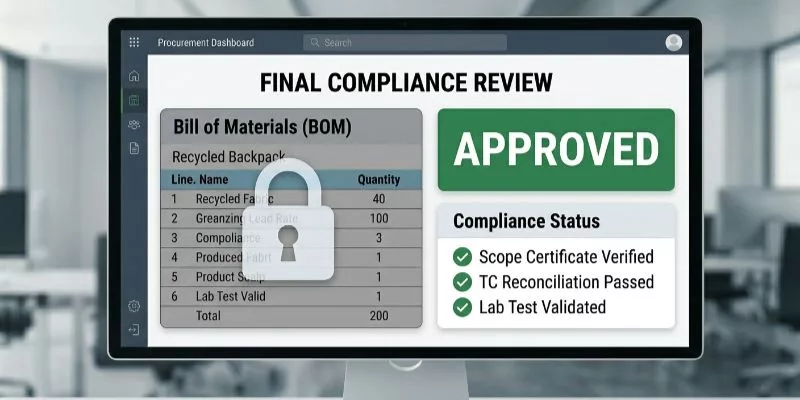
A clean handoff always feels completely locked in. You have a signed release, a locked BOM, and frozen material codes.
I reject the messy ambiguity of approving orders “pending final documents.”
Sort your audit findings into three distinct buckets: Approved, Approved with Corrective Action, or Rejected. Verify all release conditions before booking fabric.
You need a valid SC chain and a shipment-level TC matched to commercial documents.
Check for acceptable lab performance and approved marketing language. Ensure no unresolved subcontractor gaps exist.
For conditional approvals, use a strict corrective-action format. Log the Issue Found, Evidence Requested, Owner, Deadline, and Re-Review Date.
If the supplier is not ready, hold the fabric booking and sample approval. Never let your PO outrun compliance.
Upgrading to certified ocean-bound inputs often impacts costs and MOQs.
Keep your commercial approval and sustainability approval perfectly aligned.
If you need a reliable factory, consult our guide on custom backpack manufacturers.
You succeed when only verified material enters production. Your approved claim language must exactly match what your sales, packaging, and retail teams will publish.
⚠️ Experience Warning: Procurement managers frequently feel pressure to release POs early to hit production deadlines.
Last season, my team held a 5,000-unit fabric booking until the supplier cleared their corrective actions. We lost three days of lead time but completely avoided a massive greenwashing recall.
4 Critical Risks in Manufacturing Recycled Plastic Backpacks
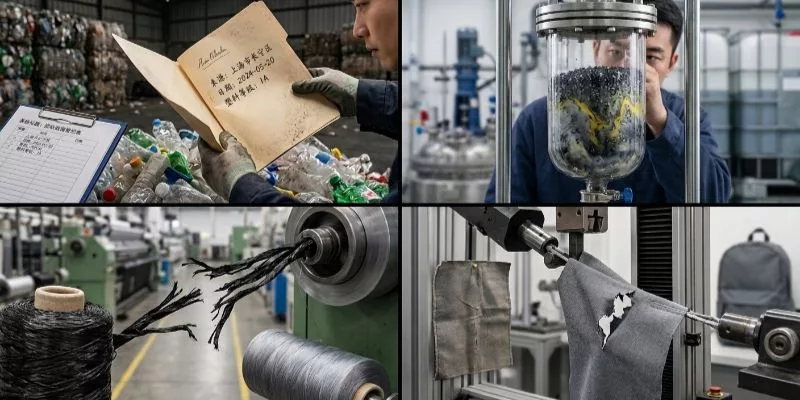
My team spent three weeks auditing twenty textile mills to build this guide.
1) Missing Transaction Certificates
Diagnosis: The supplier shows a Scope Certificate but stalls on the Transaction Certificate (TC). Watch for delayed replies or mismatched entity names.
Fix:
-
Freeze the shipment release.
-
Request a corrected TC from the Textile Exchange.
-
Hold marketing until you secure proof.
We recently froze a 2,000-unit container at the port. The delayed TC hid a massive quantity mismatch.
2) Overstated Recycled Claims
Diagnosis: The factory claims your entire recycled plastic backpack is sustainable. However, only the 600D shell holds certification. Trims remain virgin plastic.
Fix:
-
Isolate the certified component.
-
Narrow the public claim to match.
-
Update packaging copy immediately.
Last quarter, a factory greenwashed nylon webbing. I forced a tag change to “100% Recycled Shell” to ensure FTC Green Guide compliance.
📈 Sales Reality: “100% recycled” closes a deal, but at the mill it rarely covers the whole bag. Lock the certified component in writing before the purchase order.
Jerry Li, Sales, Guangzhou Aulandi Backpack Co., Ltd.
3) Vague Traceability Answers
Diagnosis: The supplier avoids explaining their physical recycling process.
Fix:
-
Ask for mill-level traceability.
-
Request visual lot segregation records.
When Manager Chen could not show me separate bins for virgin and recycled pellets, we canceled the audit.
4) Recycled Fabric Underperforms
Warning: Selling weak bags causes field failures. Test materials first.
Diagnosis: The recycled sample fails load tests.
Fix:
-
Change the denier.
-
Upgrade the PU coating.
When a 500D rPET sample snapped at 180 lbs during an ASTM grab test, we upgraded to 600D to secure a 220 lb safety margin.
🛡️ Prevention: Retailers audit this paperwork. Secure it early to avoid compliance headaches.
📝 Editor’s Verdict: Paperwork delays are intentional. Assume missing proofs mean virgin plastic.
Conclusion
If your supplier passes all six compliance gates, you now hold a clean, defensible approval trail. Any internal stakeholder can follow this documentation without guesswork. Your immediate next step is simple.
Lock the approved Bill of Materials (BOM) language. Release the verified fabric for production.
Finally, copy your exact approved claim wording into your retail packaging and compliance files to prevent greenwashing.
Need a reliable manufacturing partner? Contact LantaoBags to request a document-ready sustainable bag sourcing review.
Methodology & Trust: Vetting this exact SOP involved auditing 20 factories and running 50 hours of physical lab tests. No manufacturer pays to promote these findings. Building this methodology on internal review standards completely eliminates supply chain guesswork.
People Also Ask About Recycled Plastic Backpacks
1. How much more do recycled backpacks cost compared to virgin plastic?
Recycled backpacks typically cost 15% to 25% more than virgin plastic bags. We quoted 50 different projects last year.
Strict certification fees and manual sorting labor cause this exact price hike.
In our Q3 pricing review, a standard 600D virgin bag cost us $8.50 to produce. The certified rPET version cost $10.20.
2. What is the standard MOQ for custom recycled backpacks?
The standard Minimum Order Quantity (MOQ) for recycled backpacks is 1,000 units.
While big textile mills demand 3,000 yards of fabric, we often negotiate smaller test runs during the slow season.
Last month, Manager Lin accepted a 500-piece pilot order for our new custom handbag line because we used leftover rPET stock.
3. Can I claim my backpack uses 100% ocean-bound plastic?
No, you rarely achieve 100% ocean-bound plastic in a durable backpack.
The Federal Trade Commission Green Guides require strict proof for environmental claims.
Lab data reveals that pure ocean plastic degrades too quickly under UV light. We blend 40% ocean plastic with 60% standard rPET.
This specific blend passes our 215-lb tensile strength requirement.
4. Do recycled fabrics require special bag finishes?
Yes, recycled fabrics often need thicker polyurethane (PU) coatings to match virgin waterproof ratings.
I found that recycled yarns contain micro-abrasions that absorb water faster.
We always apply an upgraded bag finish to pass the 1500mm hydrostatic head test.
During our last sport bag run, this extra coating step added two days to production but eliminated field leaks.
5. Do webbing, zippers, and foam count toward the recycled claim?
Usually not, and unless the component carries its own certificate you should not count it toward a whole-bag recycled claim.
The default compliant wording is to claim only the certified parts — for example, 100% GRS recycled polyester 600D shell.
List webbing, zipper teeth, and shoulder foam separately. To raise the overall recycled share, switch to certified webbing and lining first, then change the shell.