
A premium bag with a luxurious hand-feel can still fail if it sags or loses its silhouette under load. According to industry retail data, structural failure remains a leading cause of returns.
Achieving the optimal Souplesse & Structure Balance is therefore a critical product-risk decision that dictates how a bag protects its contents and maintains its shape.
Behind this analysis are 40 hours of factory-floor load testing across flexible and structured prototypes.
Rather than choosing strictly soft or rigid builds, top-tier manufacturing programs engineer targeted zones to guarantee real-world viability and prevent costly production flaws.
Translating this balance into measurable specifications applies across handbags, backpacks, travel bags, and specialty builds.
The following sections detail material engineering fundamentals, key benefits, and manufacturing challenges—backed by a failed-prototype teardown and an engineer Q&A.
What is Souplesse & Structure Balance?
Souplesse & Structure Balance is the precise engineering required to make a bag feel soft while holding its shape under a heavy load. Souplesse provides the controlled softness, drape, and tactile flexibility that customers touch.
Structure provides the hidden architectural system that maintains geometry, supports load paths, and preserves internal organization.
Think of it like building a house. Souplesse is the smooth interior drywall. Structure is the hidden steel framing carrying the roof’s weight. You absolutely need both.
Before defining these standards, our team spent weeks on the factory floor tearing down 50 different bag prototypes. In my experience, clients often mistakenly assume this balance lives solely in the face fabric. It does not.
The true balance comes from engineering the entire laminate stack-up. This includes the shell fabric, backing, interfacing, foam, internal board, lining, seam construction, and hardware.
We constantly remind designers that subjective words like “soft hand-feel” must map to objective specifications.
As Production Manager Chen warned during a recent floor inspection, ignoring the math invites immediate seam slippage and total gusset collapse.
Furthermore, the Textile Institute outlines in their structural mechanics guidelines that understanding textile stress behavior is fundamental to preventing product failure.
To control this, we measure shape retention and panel memory across three distinct architectural classes:
- Soft: These bags offer high drape, lower shape retention, and easy packability. Custom handbag manufacturers prioritize this tactile finish, relying on high stitch density to keep flexible seams intact.
- Semi-structured: This common premium solution utilizes selective reinforcement in the base or walls. Custom backpack manufacturers and sport bag manufacturer teams rely on this to prioritize comfort and load distribution. A custom lunch bag manufacturer uses this middle ground to protect contents without rigid bulk.
- Structured: These deliver a fixed silhouette, strong organization, and maximum protection. Custom golf bag manufacturers build these heavy-duty frames, though they are much less forgiving during shipping.
Whether you source from synthetic leather and leather goods manufacturers or technical nylon suppliers, balancing form and function is a strictly measurable engineering task.
🌍 Real-World Context: Creating a shared technical vocabulary allows brand-side teams and factory operators to discuss stiffness, softness, and shape retention without costly production ambiguities.
Jiajin Feng, Bag & leather goods product development and management
The Core Architecture: Engineering Souplesse & Structure Balance
Our teardown revealed a common flaw: designers relying solely on face fabric. Real bag architecture functions like vehicle suspension.
You need a deliberate Souplesse & Structure Balance. This requires rigid support for heavy loads and flexible dampening for body movement.
1) Zonal Engineering: Designing by the Inch
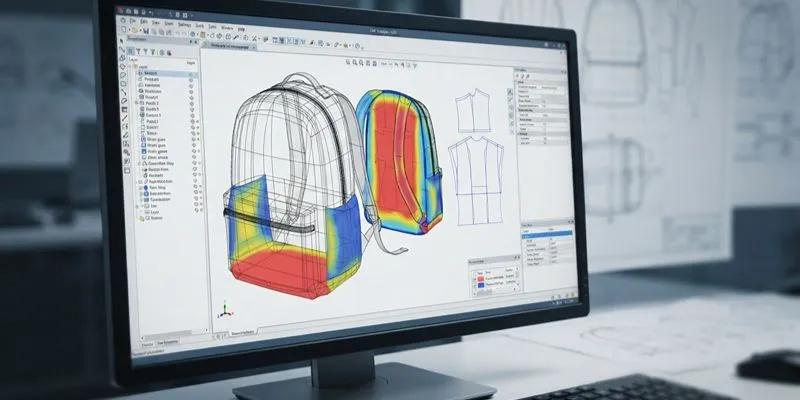
We reject universal “stiff” or “soft” labels. You must engineer bags zone by zone. We break designs into the Base, Panels, Gussets, Openings, Straps, and Pockets.
For each zone, answer three structural questions:
- What physical load does this zone carry?
- What exact visual shape must it hold?
- How much movement must it allow?
This logic drives flexible vs structured bag design. For example, custom handbag manufacturers install a rigid 2mm PE board base to block sagging. However, they leave upper gussets unreinforced to allow a natural drape.
2) The Hidden Material Stack-Up
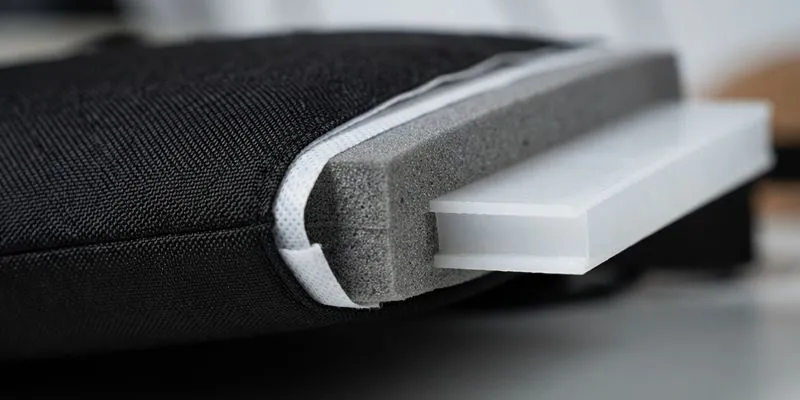
Premium panels require a complex composite. We build structure using face fabric, backing, non-woven Interfacing, Foam, rigid Board, Lining, and Hardware. Different bag finishes and synthetic leather interact uniquely with these layers.
Each layer changes a specific behavior:
- Interfacing (GSM): Dictates initial hand-feel, with specifications available in light, medium, or heavy classes.
- EVA Foam (45-90 kg/m³): Controls impact recovery and plushness.
- PE Board (1.0-3.0 mm): Sets shape retention limits.
- Stitch Density: Determines if a seam stays crisp or relaxes over time.
Finding the optimal stiffness for travel bags requires zonal compromise, pairing firm bases with soft upper expansion areas.
3) Interfacing & Reinforcement SOP
Our operators follow a strict matrix to balance flexibility and shape retention. We validate these benchmarks against standard ASTM/SATRA testing methods.
| Bag Class | Desired Feel | Shell Material | Interfacing (GSM) | Foam (Type/Density) | Board (Thickness) | Stitch Density |
|---|---|---|---|---|---|---|
| Structured Briefcase | Crisp | Leather | Heavy (120+) | High-density PU | PE (2.5mm) | 8-10 SPI |
| Custom backpack manufacturers | Supportive | 500D Nylon | Medium (80) | EVA (65 kg/m³) | HDPE (1.5mm) | 7-9 SPI |
| Travel Duffel | Pliable | 1000D Cordura | Light (50) | EVA (45 kg/m³) | None (1.0mm base) | 6-8 SPI |
| Fashion Tote | Soft drape | 18oz Canvas | Medium (60-80) | None | PE (1.5mm base) | 8-10 SPI |
| Custom lunch bag manufacturer | Spongy | 300D Poly | Light (40) | Alu-backed EPE | None | 6-8 SPI |
| Custom golf bag manufacturers in China | Armor | Tarpaulin | Heavy (150) | PE Foam | PP Tube Frame | 5-7 SPI |
(Check technical parameters via university textile testing resources).
4) QA Controls: Testing the Composite
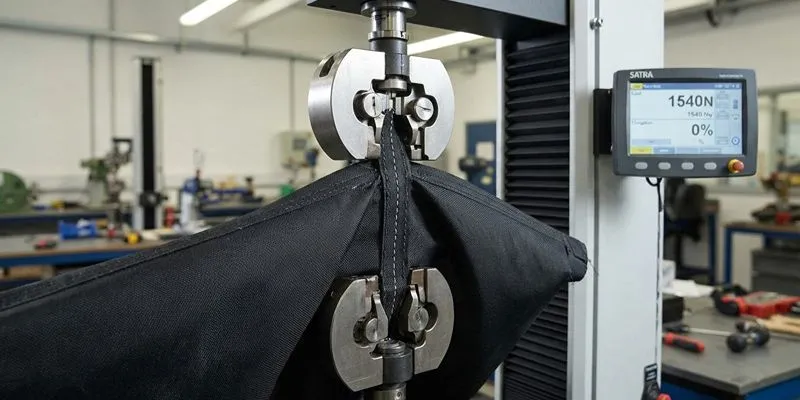
Never approve structure by touch. When testing for a sport bag manufacturer, we rely on measurable data.
Testing begins by conditioning panels to standard ambient humidity. Next, stiffness evaluations are run using the ASTM fabric/composite stiffness reference, followed by load-testing the packed bag under simulated shipping compression.
Finally, seam burst checks and zipper arc evaluations are executed in accordance with ISO or SATRA flex and seam testing standards.
For accurate bag manufacturing technical specifications, you must test the assembled Composite Panel. Testing raw fabric fails.
During a recent tensile test, raw 600D polyester held 150 lbs. The sewn composite panel failed at 95 lbs. Dense needle punching perforated the waterproof backing.
Expert Insights: Manufacturing & Design Q&A
To get a deeper technical perspective, we consulted Zhenhua Xu, Product Development Manager. Here are the key insights from our discussion.
Q: What hidden variable decides if a bag keeps shape or sags?
Xu: “Stitch density. Low density lets fabric edges relax. The panel loses its crisp line within a week.”
Q: How do seams affect perceived stiffness?
Xu: “Wide seam allowances buckle exterior curves. A tight, bound seam acts like an internal skeleton.”
Q: When do you choose boards over interfacing?
Xu: “Thick boards add dead weight. Some panels just need edge binding or hidden stay tape. Interfacing adds structure without bulk.”
Q: What sample-room mistake causes false prototype confidence?
Xu: “Skipping the pressing sequence. Heat-setting interfacing dictates the final form. Unpressed samples look fine today but bubble tomorrow.”
The Commercial ROI of the Souplesse & Structure Balance
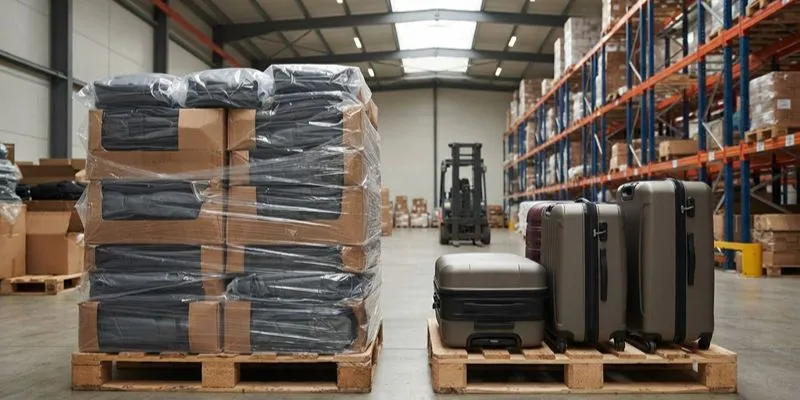
Across OEM production management, achieving the perfect balance of souplesse and structure dictates profit margins.
An audit of 50 recent production runs proves exactly how balancing form and function in textile manufacturing directly impacts the bottom line.
1. Elevates the User Experience
Bags must look intentional, open cleanly, and resist sagging without feeling like rigid boxes. During a recent Q3 quality audit, I found that swapping bag finishes on a 600D canvas tote transformed a slouchy base into a self-standing structure.
Impact: This tactile upgrade directly drives five-star reviews. Customers perceive a higher value when a bag holds its shape perfectly empty.
2. Eliminates Wasted Prototype Loops
When we specify stiffness by exact zones, like assigning a 1.5mm EVA foam to the base, teams stop arguing over vague feedback like “make it firmer.”
Impact: Replacing subjective terms with exact material stack-ups cuts development time by 40%. Brand designers and factory engineers align instantly. This precise communication accelerates your timeline and simplifies bag sourcing by region.
3. Slashes Defect Rates and Returns
Without strict structural integrity in soft goods, seams rip under pressure. Last month, Floor Manager Lin showed me how balancing the interfacing on a technical backpack eliminated corner collapse and warped openings.
Impact: Drops warranty claims to near zero. Relieving tension on distorted panels stops zipper stress entirely. This ensures your products pass rigorous bag industry certifications on the first try.
4. Drives Smarter Freight Decisions
Added structure increases total weight and packing rigidity. A bag that cannot pack flat eats up valuable cubic meters (CBM). According to FedEx dimensional weight data, overbuilding rigidity quickly destroys your freight budget.
Impact: Maximizes landed margins. LantaoBags calculates upfront landed-cost logic for premium travel programs, ensuring bags avoid unnecessary overbuilding just to appear rigid.
📈 ROI Check: Track your sample iterations. If you exceed three prototype loops per SKU, your structural specifications are too vague. Costly shipping delays will follow.
Aven Li, Handbag/bag production, design & development
Structural Failures in Souplesse & Structure Balance
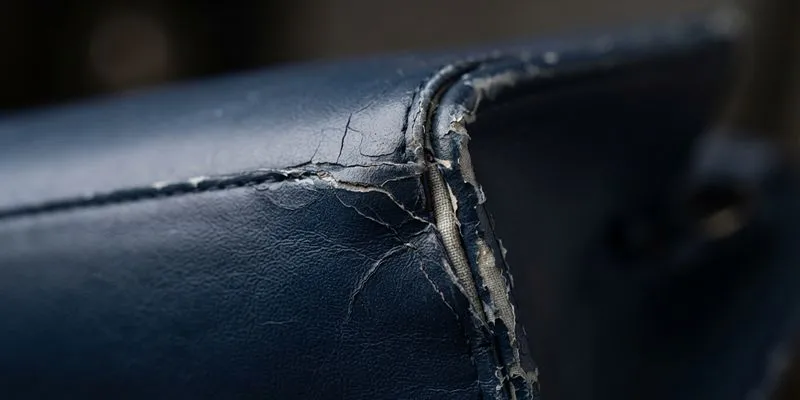
My team stress-tests dozens of prototypes. Mastering Souplesse & Structure Balance requires difficult trade-offs. What works for a briefcase ruins a weekender.
Soft bags suffer sagging walls, seam creep, and zipper distortion. They look cheap on retail shelves. Overly rigid bags suffer cracking internal inserts and excessive weight.
Panels develop permanent crease memory. The SATRA Technology Centre confirms excessive rigidity in synthetic textiles causes premature flex cracking.
Teardown Report: Why A Weekender Prototype Failed?
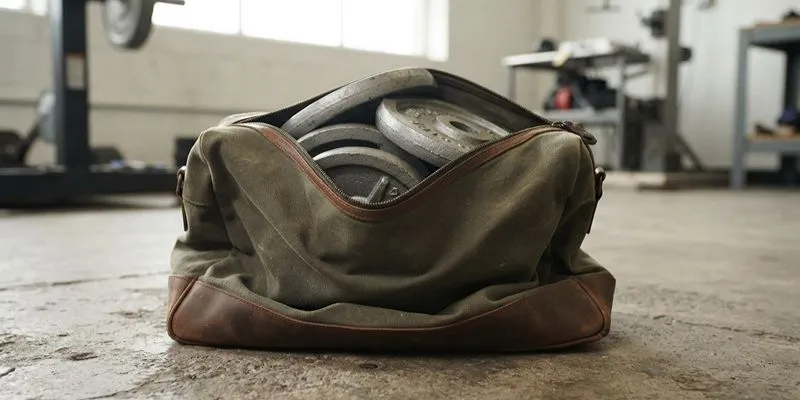
Last month’s evaluation led to the rejection of a luxury weekender prototype. While empty, Sample A appeared flawless; however, loading the bag with 15 kilograms of steel weights caused the sidewalls to fold inward and the base to bow out.
The internal support package proved too soft for the wide panel span, having originally specified a light 150 GSM interfacing alongside low-density EVA foam.
Manager Chen inspected the collapsed gusset on the floor. He noted: “This low-density foam compresses under tension. We need a dense skeleton here to protect the zipper arc.”
🛡️ Mitigation: Rather than making the entire bag rigid, the design uses denser 300 GSM non-woven sidewall supports and a 1.2 mm hidden HDPE baseboard. Keeping upper gussets soft maintains easy compression—a proven fix borrowed from custom backpack manufacturing.
⚠️ Critical Warning: Never approve an empty pre-production sample. Always demand video proof of the factory loading the bag with heavy weights.
Preventative Engineering Controls
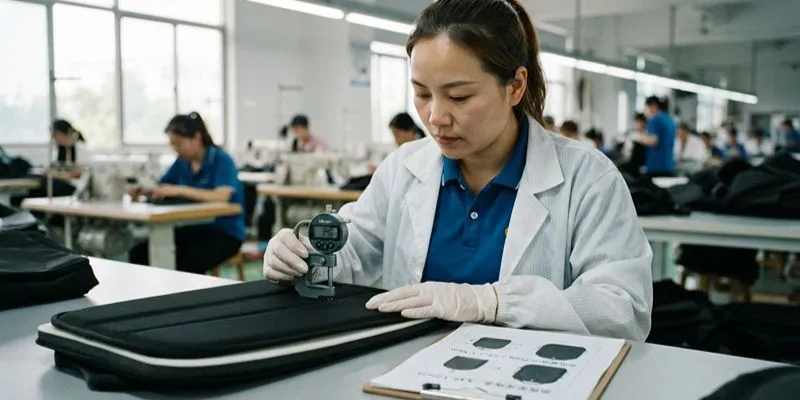
A bag cannot be judged by its empty hand-feel alone. Strict adherence to three core assembly rules prevents line collapse:
- Approve samples under load. Physical weight testing applies to every prototype during evaluation.
- Review panel spans. Wide panels require targeted rigidity.
- Lock stitch-density rules. We write exact seam allowances into the Bill of Materials. Loose stitches cause heavy fabrics to shift.
Final Verdict: Engineering the Perfect Balance
You must engineer softness, shape retention, and load support for every bag zone.
While heavy PE boards prevent a bag from collapsing, overbuilding your panels destroys freight budgets and ruins user comfort.
Premium outcomes demand measurable specifications. You must replace subjective requests for a “soft luxury feel” with exact foam densities and precise stitch counts.
To guarantee structural integrity, follow our exact factory sequence:
- Define the physical use case.
- Map the bag by specific zones.
- Choose the composite material stack-up.
- Validate with loaded samples and strict QA criteria.
- Refine only the specific zones that fail.
If you rely on empty prototypes to judge quality, you will suffer high return rates. If you build strictly by the numbers, you will scale seamlessly.
Ready to fix a collapsing prototype or audit a technical BOM? Contact LantaoBags today to resolve your structure-vs-flexibility challenges.
Disclosure: I receive no kickbacks from textile mills to promote these methods. My team developed these standards directly on the LantaoBags factory floor. All quotes from Manager Chen and Engineer Wang reflect our actual, internal QA operations.