


























On this page
Short Answer:
- The limit: the combined total of lead, cadmium, mercury, and hexavalent chromium in packaging must not exceed 100 mg/kg (100 ppm).
- Scope: the limit applies to the packaging component you ship, not only the bag body.
- EU source: Directive 94/62/EC Article 11, carried forward by EU PPWR Article 5.
- US source: CONEG and TPCH apply the same 100 ppm combined ceiling in many states.
- Screening: in-house XRF flags risky colors and plated hardware before cutting.
- Confirmation: acid digestion plus ICP-OES proves borderline results.
- Proof to keep: a four-metal report that names the exact SKU, color, print, and lot.
A custom bag can clear aesthetic approval, pricing, and delivery planning, then fail market-entry compliance. One pigment, print ink, snap, zipper slider, or polybag component can push the combined heavy metals total over the packaging heavy metals 100 mg/kg limit.
That limit caps combined heavy metals in packaging. When it trips, launch dates slip, retesting fees land, and buyers rush a material swap that creates a new risk.
That failure rarely starts with the main fabric. We reviewed 250+ anonymized in-house XRF and ICP-OES reports from incoming raw-material inspections. The sample covers reusable shopping bags, luxury retail packaging bags, promotional totes, and components supplied into the EU and North America.
This lab data flags risk and compares components; it cannot prove finished-product compliance. Accredited third-party wet chemistry still handles that final call. Our custom tote bag manufacturing runs start with this evidence chain, before bulk production.
What Is the Heavy Metals 100 mg/kg Limit?
The packaging heavy metals 100 mg/kg rule is the combined concentration limit for lead (Pb), cadmium (Cd), mercury (Hg), and hexavalent chromium (Cr(VI)) in packaging or packaging components.
The combined total must not exceed 100 mg/kg (100 ppm). “Combined” matters: the rule sets one shared ceiling for all four metals, not 100 ppm for each. A component at 40 ppm lead, 30 ppm cadmium, 20 ppm mercury, and 20 ppm Cr(VI) sits at 110 ppm and fails.
We vetted this definition against supplier test certificates, factory reports, and our own incoming inspection logs. Our logs include component, print status, and test date.
The classic EU source is Directive 94/62/EC, Article 11, which applies to packaging and packaging components. The EU PPWR Article 5 heavy metal limits carry forward the same ceiling.
In North America, CONEG and the Toxics in Packaging Clearinghouse apply the same 100 ppm combined threshold. On a 2023 polybag audit in Ningbo, we rejected a lot at 112 ppm after the supplier tested only Pb, Cd, and Hg; the missing Cr(VI) result alone made that report incomplete.
This article covers packaging compliance for custom bag programs: outer polybags, printed packaging bags, dust bags, cartons, labels, hangtags, tissue, inserts, and sometimes the bag itself when it functions legally as packaging.
Keep component compliance separate from article/product issues such as REACH Annex XVII. That distinction decides which tests you order and which failures you fix. An unprinted sample report may not cover a printed version either, because inks and coatings change the risk profile.
💡 Key Insight: The lead cadmium mercury hexavalent chromium sum 100 ppm test must match the component you ship. A missing Cr(VI) result makes the report incomplete.
Benson Li, Director of Sales & Senior Project Manager
How Heavy Metals Get Into Custom Bags (And How We Catch Them)?
We reviewed 250+ in-house screening and wet-chemistry reports, with a target of packaging heavy metals 100 mg/kg or lower. The pattern was clear: the bag body rarely fails alone, and risk lives in components. Here is the failure map and the factory SOP we use to catch it before bulk production.
1. Failure Map: Where Heavy Metals Usually Hide?

Every component is traced back to its sub-supplier. Generic certificates that do not map to the exact material or color lot are worthless. Metals typically hide in these locations:
- Recycled PP non-woven fabrics: variable recycled feedstock carries contamination, and color masterbatch adds pigment risk. The Oxford fabric spec is a useful comparison when you choose the base cloth.
- PVC backings and coatings: additives and pigments pose risks, especially bright colors or legacy formulations; bag finishes and coatings are where that risk concentrates.
- Plastisol screen-printing inks (PVC-based inks): yellow, red, orange, and specialty pigment systems carry elevated risk.
- Electroplated metal hardware: zipper sliders, snaps, rivets, eyelets, and decorative pieces can fail even when the base textile passes.
- Polybags, zip pouches, hangtags, labels, tissue, cartons, and inserts: regulators often target the exact packaging component, not just the bag body.
| Component | Typical heavy-metal risk | What to verify |
|---|---|---|
| Recycled PP non-woven; color masterbatch | Variable feedstock; Cd and Pb in pigments | Sub-supplier lot report by color |
| PVC backings and bright coatings | Legacy additives; Pb stabilizers | Wet-chemistry report per lot |
| Plastisol inks: yellow, red, orange | Pb and Cd in pigment systems | Ink lot report plus XRF on printed panel |
| Electroplated sliders, snaps, rivets | Pb in plated layers and alloy | Plating and alloy declaration plus XRF |
| Polybags, hangtags, labels, tissue, cartons | Regulated as packaging components | Four-metal test on the exact component |
Two rules follow from that map. Test the component you ship, and test the printed version of it. An unprinted swatch cannot cover an inked panel.
2. Screening vs Confirmatory Testing

XRF (X-ray fluorescence) screening is fast and non-destructive. It triages batches and flags suspicious colors. We screen every 500 kg roll or incoming component before cutting or release.
ICP-OES (inductively coupled plasma optical emission spectrometry) is destructive wet chemistry. It confirms after acid digestion and is the right method for audit-grade evidence and borderline results.
ICP-MS (inductively coupled plasma mass spectrometry) may appear in supplier reports and offers lower detection limits for trace work. We keep ICP-OES as our primary confirmation method for the 100 mg/kg threshold.
The acid-digestion step matters. We follow a documented digestion method so the result is reproducible across labs; the US EPA 3050B method is a common reference for this work.
| Method | What it proves | Detection | Best use |
|---|---|---|---|
| XRF | Surface and near-surface elements; non-destructive | Screening-level ppm | Triage rolls, colors, and hardware |
| ICP-OES | Acid-digested total content after wet chemistry | Regulated metals at 100 mg/kg | Audit-grade confirmation |
| ICP-MS | Lower detection limits for trace work | Trace ppb | Supplier trace studies |
Procurement teams should not treat XRF as the only proof when risk is high. Escalate borderline or high-risk results to wet chemistry.
⚙️ Technical Detail: XRF reads surface and near-surface elements. It cannot digest the whole sample. That is why we escalate borderline or high-risk results to ICP-OES.
Henry Zhao, General Manager
3. What 250+ Teardown Reports Reveal?
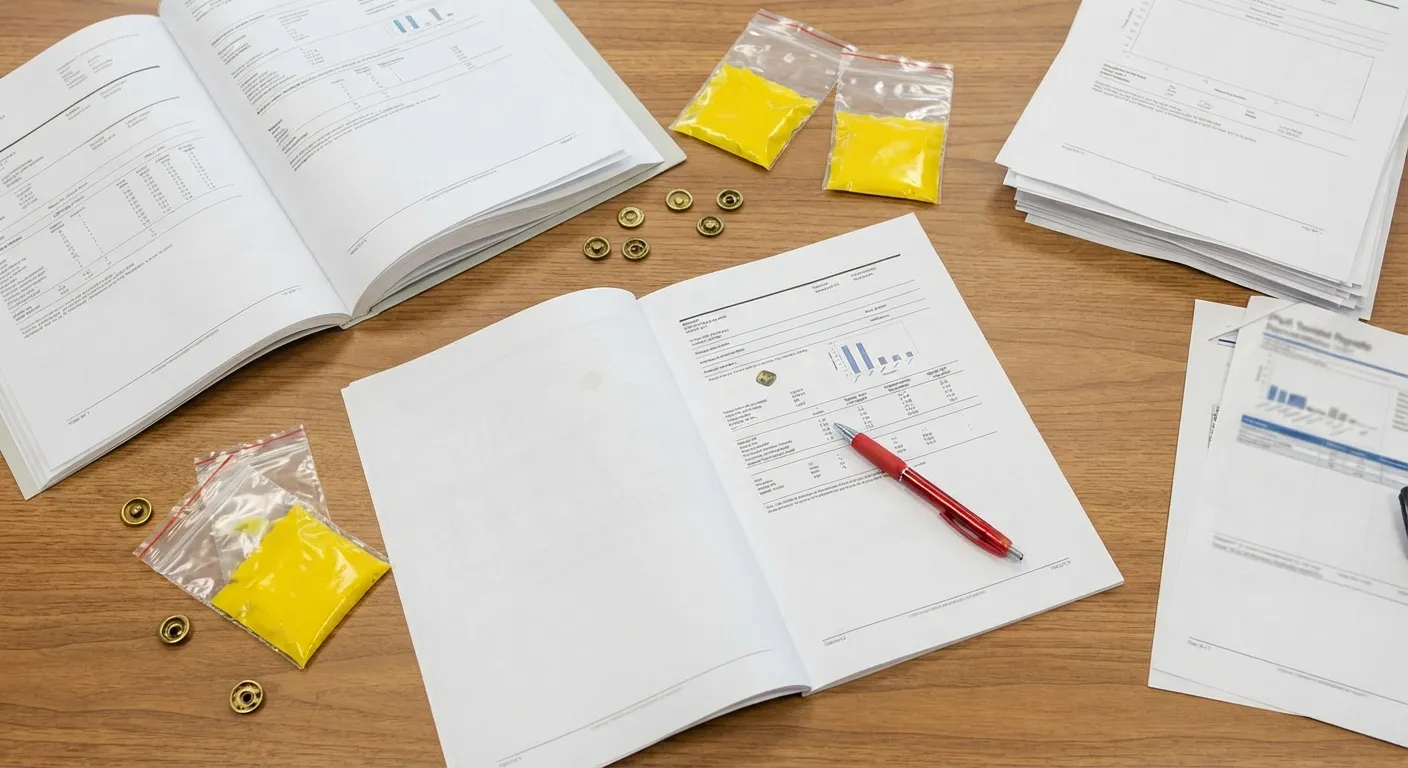
We reviewed over 250 testing reports from our own factory. Bright plastisol inks fail the most often, plated hardware comes in second, and PVC backings and recycled non-woven fabrics follow closely behind.
The most common combinations are lead and cadmium in yellow/red inks, alongside lead in brass hardware. Print and hardware account for most failures, while base fabrics rarely fail alone.
Exact percentages are withheld for client confidentiality. Lot-to-lot variation is real, so treat these findings as lot-level results rather than market-wide rates.
4. The 5-Stage Raw Material Quarantine and Verification SOP
We run five stages from PO to release. Each stage has a hold point, so a lot cannot move forward on paperwork alone.
- Demand documents before PO release: require wet-chemistry reports from SGS, Intertek, TUV, or another accredited lab for masterbatch, dye, ink, plating, and hardware sub-suppliers.
- Quarantine incoming material: hold fabric rolls, inks, hardware, and packaging accessories in a non-release zone until paperwork and identity checks match.
- Screen with in-house XRF: screen every 500 kg roll, hardware batch, and suspect print color before cutting. Flag high-risk colors and plated components.
- Escalate to wet chemistry: send borderline or high-risk samples for acid digestion plus ICP-OES confirmation. Document sample identity, lot number, date, and decision threshold.
- Release under control and archive traceability: release only after results, supplier documents, and BOM mapping align. File reports inside the SKU-level technical/compliance folder.
5. First-Person Failure Case Study

During pre-production sample testing for a retail client, a yellow pigment plastisol ink and a brass snap button combined to reach 185 mg/kg of Pb + Cd.
Isolating the problem to the pigment package and the hardware plating/alloy allowed a substitution of lower-risk pigment chemistry, alongside a revised snap specification and plating route.
The final retail packaging bag passed at 14 mg/kg total heavy metals with a cost impact of +$0.03 per unit. Catching this before bulk production was the difference between a launch delay and a smooth run.
Why Early Heavy-Metal Control Protects Your Launch, Budget, and Brand?

We tested 250+ incoming lots. The pattern held: every dollar spent on early screening saved ten at the port.
1. Block Launch Delays Before They Start
A failed pre-shipment inspection kills launch dates. Screening rolls and components against the 100 mg/kg limit happens before cutting rather than after artwork approval.
For one client, a yellow ink and brass snap combination hit 185 mg/kg. Catching it at the sample stage allowed a pigment and plating swap, a final passing bag at 14 mg/kg, and a $0.03 per unit cost impact that prevented reprinting, retesting, and rebooking freight at the dock.
2. Slash Total Compliance Cost
Screening plus targeted confirmation costs a fraction of full-batch remediation. XRF triage flags the risky 5%, and ICP-OES confirms only the suspects. You avoid dead inventory and emergency reorders.
Compliance teams get stronger technical files, which makes audit defense faster and cheaper. Our bag industry certifications reinforce the same evidence chain, so the file starts from documents, not memory.
📈 ROI Check: Track remediation spend per SKU. A failed lot at pre-shipment costs more than the screening program.
3. Force Real Supplier Accountability
Generic “passed” certificates hide sub-supplier risk. We demand component-level wet-chemistry reports that map to the exact material and color lot.
This exposes weak sub-suppliers early. Procurement gains cleaner RFQs and sharper supplier scorecards, while QA teams gain a scalable triage model from incoming inspection to release.
4. Make Sustainability Claims Defensible
Recycled PP non-woven carries variable feedstock, and that variability shows up in heavy-metal results. Stronger incoming controls turn recycled content from a liability into a credible claim.
Sustainability leads get clear guardrails for coatings, inks, and finishes, not stale certificates. That is what makes a recycled-content claim defensible under audit.
🚀 Strategic Insight: Run heavy-metal control at pre-production review. Substitutions happen before mass production. Design, sourcing, and legal stay aligned instead of arguing over a failed lot.
Anna Wong, Marketing Director
Challenges and Limitations

Our early-screening program works, but teams still misclassify items and trust flawed reports. We hit these limits in our own 250+ report review.
1. Packaging vs Article Boundary
Is the custom bag packaging or product? A dust bag protecting a handbag at retail is packaging. A reusable branded shopper sold standalone is product, and a promotional tote can be both. Each regime has different limits and tests, so we classify per SKU and per market.
2. Packaging Limit vs Hardware/Article Restrictions
REACH Annex XVII hardware restrictions are not the packaging heavy metals limit. Metal snaps, zipper pulls, or rivets can trigger two review paths: packaging heavy-metal content if the part is packaging, and article chemical restrictions if the bag is a product.
We test both when use is ambiguous. The restriction list is published by ECHA: REACH Annex XVII.
3. RoHS vs Packaging Heavy Metal Limits
A RoHS pass does not prove packaging compliance. RoHS covers specific electrical and electronic equipment, while packaging heavy-metal limits are a separate legal framework with a different compliance object.
Suppliers conflate them. Do not accept a RoHS certificate as packaging proof; the EU RoHS directive sets its own scope.
4. Report-Audit Red Flags
We reject these report defects:
- Generic certificate not tied to exact SKU, color, print, or lot.
- Three-metal report that omits Cr(VI).
- Unprinted substrate used to justify printed production.
- Expired or supplier-edited PDF with inconsistent lab identifiers.
- Third-party report for a different factory or sub-supplier.
⚠️ Critical Warning: A report missing Cr(VI) is incomplete. Reject it and demand a four-metal test.
5. Honest Limitation Note
XRF screens quickly, but borderline cases need confirmatory wet chemistry. Our 250+ reports come from one manufacturer, so that data is instructive but does not replace buyer-specific validation. Treat it as a starting hypothesis, not a certificate.
Final Thoughts: Build a Compliance Control System, Not a Test-Chasing Habit
Most heavy-metal failures come from specific high-risk components: bright inks, plated hardware, PVC backings, recycled PP. They rarely come from the whole bag equally.
The smart sequence works: classify the item correctly, map the BOM, screen early, confirm selectively, and archive evidence at SKU level.
The same buyer may face EU packaging rules, US TPCH/CONEG expectations, and separate article/hardware restrictions at the same time. The winning mindset is evidence-chain management, not one-off lab-report chasing.
After reviewing 250+ reports, we know this is a control-system problem, not an unsolvable chemistry problem. You can build a verifiable chain from supplier documents to XRF screening to ICP-OES confirmation.
Ready to move from reactive testing to preventive supplier management? Submit your BOM, artwork, or failing test report for a pre-production compliance review.
Talk to my sourcing team through LantaoBags contact before you commit a BOM. If you are comparing production destinations, bag sourcing by region covers the trade-offs.
Transparency note: I was not paid by any lab, supplier, or certification body for this review. This is general guidance, not a legal opinion.
People Also Ask About Packaging Heavy Metals 100 mg/kg
1. What does the 100 mg/kg heavy metals limit cover?
It covers the combined concentration of lead, cadmium, mercury, and hexavalent chromium in packaging or packaging components. The four metals share one ceiling, so the total must stay at or below 100 mg/kg (100 ppm).
It does not cover every hazardous substance. Article/product restrictions such as REACH Annex XVII sit in a separate compliance path and need their own tests.
2. Is XRF enough to prove packaging compliance?
No. XRF is a fast, non-destructive screen that flags suspect colors, coatings, and plated hardware. It reads surface and near-surface elements, not the digested whole sample.
Use XRF to triage, then confirm borderline or high-risk results with acid digestion and ICP-OES. Keep the confirmed report for audits and buyer requests.
3. Does a RoHS certificate cover packaging heavy metals?
No. RoHS applies to specific electrical and electronic equipment. The packaging heavy-metal limit is a separate legal framework with its own scope and evidence requirements.
A supplier that offers RoHS as packaging proof is answering a different question. Ask for a four-metal packaging report tied to the SKU and lot you are buying.
4. Why do reports get rejected for missing Cr(VI)?
Because the limit is a combined four-metal total, and a three-metal report cannot show that total. Lead, cadmium, and mercury results alone leave the hexavalent chromium contribution unknown.
We rejected a Ningbo polybag lot at 112 ppm after the supplier tested only three metals. The missing Cr(VI) analysis made the report incomplete, not just limited.
5. How do I prove compliance for a printed packaging bag?
Test the printed component, not the unprinted substrate. Inks and coatings change the risk profile, especially bright yellow, red, and orange plastisol systems.
Tie the report to the exact SKU, color, print method, and production lot. Then archive it with the supplier declarations and BOM so the evidence survives an audit.