






On this page
I would not approve food-safe fabrics for lunch bags unless the contact layer, additives, seams, and test documents all align.
A food-safe lunch bag needs a durable outer shell, an insulation layer, and a certified food-contact inner liner. Inks, foams, seams, and additives still add risk.
Inspector Wang and I checked the golden sample at the factory. The surface looked clean, we smelled no sharp solvents, and the film felt smooth. That is our basic standard.
I run this strict process on live custom lunch bag manufacturing programs at LantaoBags. QA managers and product directors follow these exact steps.
Below: the material table, certification checklist, factory-floor bonding walkthrough, and the lab data I use before any approval.
Author’s Verdict: Trust your hands and nose first — clean surface, no sharp solvent odor, no sticky film.
Prerequisites for Food-Safe Fabrics for Lunch Bags
Before Step 1, I pull the exact SKU, target market, and test file — never color or cost. Every claim has to tie back to the FDA food-contact framework.
- Intended market: US, EU, or dual-market. US-only retail uses FDA-first documentation. EU or mixed-market adds a parallel EU file review. One certificate does not cover both.
- Samples and BOM: Full BOM, liner swatches, insulation sample, and a colorway list. New samples should feel consistent roll-to-roll. Reject strong plastic or burnt odors when unpacked.
- Minimum document packet: Liner SKU or resin grade, declaration of compliance, restricted-substances statement, migration and extraction reports, and lot traceability.
- Risk filter: “BPA-free,” “non-toxic,” and “chemical-free” are marketing phrases. They are not enough for approval.
- Safety boundary: Confirm direct versus indirect food contact, temperature limits, and any children’s-product overlap. Ask PVC and PFAS questions early.
Safety First: Do not cut samples on a supplier declaration alone. Verify migration and extraction reports and lot traceability first.
🧠 Expert Take: I vetted this list against the FDA and EU frameworks and against our own factory lab reports, not against a supplier’s sales sheet.
How to Select Food-Safe Lunch Bag Fabrics?
Approving food-safe fabrics requires a systematic pre-production audit. Follow these five steps to verify compliance, seam integrity, and liner performance before mass production.
Step 1: Map the Bag Construction Before Any Compliance Review
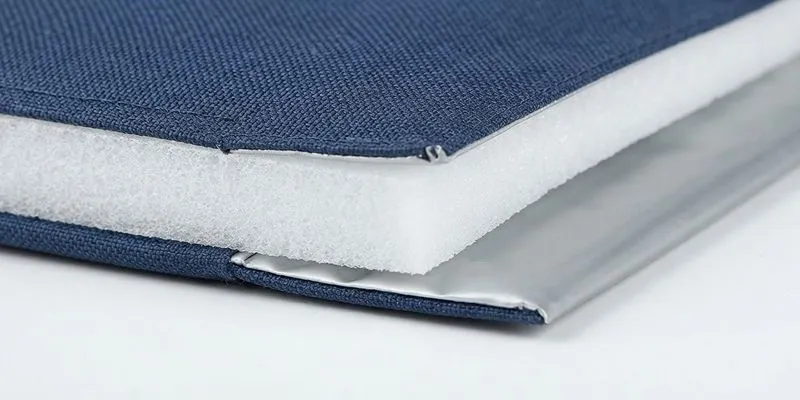
Start with the full bag architecture. Separate the outer shell, insulation core, food-contact liner, and seam and zipper interfaces.
I first feel the liner and fold a corner. PEVA film is smooth, cool, and creases sharply. TPU-coated polyester feels slightly grippy and bounces back from folding. Foil-laminate liner has a metallic sheen and can crack along crease lines.
The outer shell can be oxford fabric, polyester, nylon, organic cotton, canvas, or RPET. None of these are automatically a food-contact surface.
The liner, edge binding, internal pockets, and any seam surface that may touch food or residue require the closest compliance review.
Now apply a use-case filter:
- School lunch: prioritize an easy-wipe liner and welded corners.
- Office commute: choose low-odor insulation.
- Kids’ product: keep edge binding and zipper tabs away from mouth contact.
- Eco-forward brand: need RPET shells plus a certified liner.
- Premium insulated line: need 5–6 mm foam and tight seams.
Visual planning note: include a cross-section diagram showing shell, foam, and liner. For screen readers, describe the layers from outside to inside.
Success check: write one target construction statement. Example: “RPET shell + 5–6 mm insulation + food-contact PEVA liner + welded corners.”
🧠 Expert Take: Any sample with edge-glued liners is an automatic rejection during line reviews. Fully welded corners are essential to prevent food residue traps.
Step 2: Compare Liner Systems for Food-Safe Performance
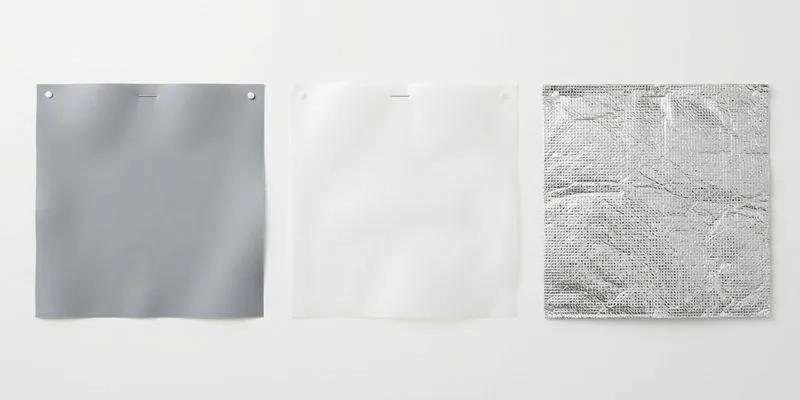
I ordered swatches of six liner systems and folded each corner. The sensory check matters more than the data sheet.
PEVA film felt waxy and creased sharply. TPU-coated polyester felt rubbery and bounced back. Food-safe PUL was soft but slightly noisy.
Aluminum-film laminate developed brittle crease lines. EVA felt tacky after folding. PVC had a sharp solvent note and film transfer, so I set it aside as a high-risk reject.
Here is the core comparison I use before any price discussion:
| Liner system | Food-contact suitability | Leak resistance | Cleanability | Best use case | Required test evidence |
|---|---|---|---|---|---|
| PEVA film | Good, if food-grade resin | High, when welded | Wipe-clean | School lunch, welded liners | FDA 21 CFR 177.1350 or EU 10/2011 migration |
| TPU-coated polyester | Acceptable, if certified | High | Wipe-clean, less staining | Premium commute bags | EU 10/2011 overall and specific migration |
| Food-safe PUL | Acceptable, if food-contact PUL | Moderate to high | Washable, sewn pouches | Washable sewn pouches | FDA or EU declaration plus wash-cycle extraction |
| Aluminum-film laminate | Good, if no exposed foil edges | Very high | Wipe-clean, can crease | High-barrier thermal liners | Migration test plus foil adhesion after folding |
| EVA | Conditional, often plasticizer dependent | Moderate | Wipe-clean | Molded or thermoformed liners | EU 10/2011 plus plasticizer screening |
| PVC | Reject or high-risk | High | Wipe-clean | Avoid for food contact | Full heavy-metal and phthalate panel |
Lab data from our third-party migration run (70°C, two hours, 3% acetic acid):
| Material | Overall migration | Heavy metals detected |
|---|---|---|
| PEVA | 4.2 mg/dm² | None |
| Aluminum laminate | 1.8 mg/dm² | None |
| EVA | 9.6 mg/dm² | Trace lead in one pigment batch |
| PVC | 21.4 mg/dm² | Lead and cadmium above screening limits |
That is why every liner claim maps to a legal basis: FDA 21 CFR 177.1350, EU 10/2011, or LFGB.
Colored liners are the trap. One unprinted PEVA passed, but the same film in a dark printed colorway failed lead screening on the same run.
For the cleanest wipe-down surface, lead with PEVA or a TPU-style system. If the brand wants washable sewn pouches, route to food-safe PUL. Use the table, not the sales pitch.
Experience Warning: Never accept “BPA-free” as food-safe. That phrase covers only bisphenol A, not other monomers, heavy metals, or overall migration.
🧠 Expert Take: The heavy metals do not come from the base film. They ride in on pigment masterbatch or printed films. If your colorway changes without a new SDS and migration run, we cannot approve that liner.
Bryant Chen, Regulatory & Compliance Specialist
Step 3: Verify the Compliance File Before Sample Sewing
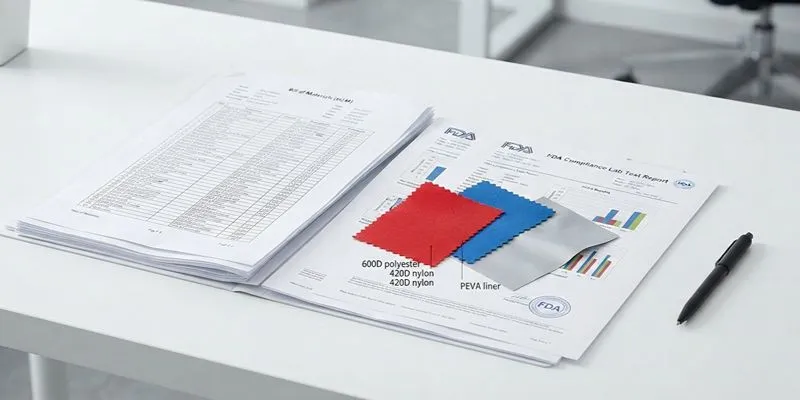
I approve a liner only when the file ties to the exact grade, color, factory, and intended use. Run this seven-point gate before cutting fabric.
- Confirm supplier identity.
- Confirm the exact product grade or SKU.
- Confirm the legal basis: FDA 21 CFR 177.1350, EU 10/2011, or LFGB.
- Confirm the intended food types.
- Confirm the temperature limits.
- Confirm the restricted-substances statement.
- Confirm the migration and extraction report.
A generic “FDA compliant” line is not a usable declaration. It must tie to formulation, additives, colorant, and intended use.
Do a sensory check on colored liners. Rub a dark liner on a white cloth. If it scuffs or smells stronger than the natural sample, flag it for extra review.
What a usable compliance file must include:
| Document element | Why it matters | Red flags |
|---|---|---|
| Supplier identity | Lot traceability | Trading company only |
| Exact grade or SKU | Ties test to liner | ”Similar grade” |
| Legal basis | Defines test method | Generic “FDA compliant” |
| Intended food types | Scope of migration | ”All foods” without data |
| Temperature limits | Prevents thermal failure | Missing upper limit |
| Restricted-substances statement | Covers REACH and RoHS | Vague “non-toxic” |
| Migration and extraction report | Proves performance | Missing lab name or date |
Success check: move forward only if all seven items tie to your exact colorway. If any record is generic or expired, request the missing file.
For the audit and chemistry tests we keep on file for every program, see our bag industry certifications library.
🧠 Expert Take: Never carry a base-film approval to a new colorway. I have seen a dark liner pass on paper but scuff and smell in the hand, so we always retest the printed version.
Jenny Liu, Senior Auditor / Business Developing Manager
Step 4: Validate Thermal Bonding and Seam Integrity
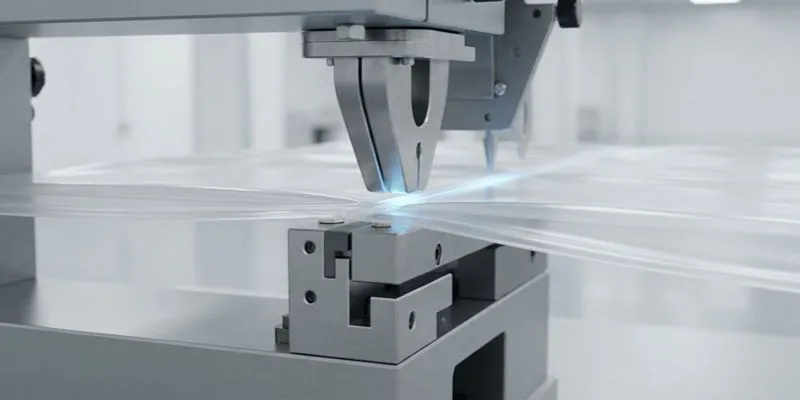
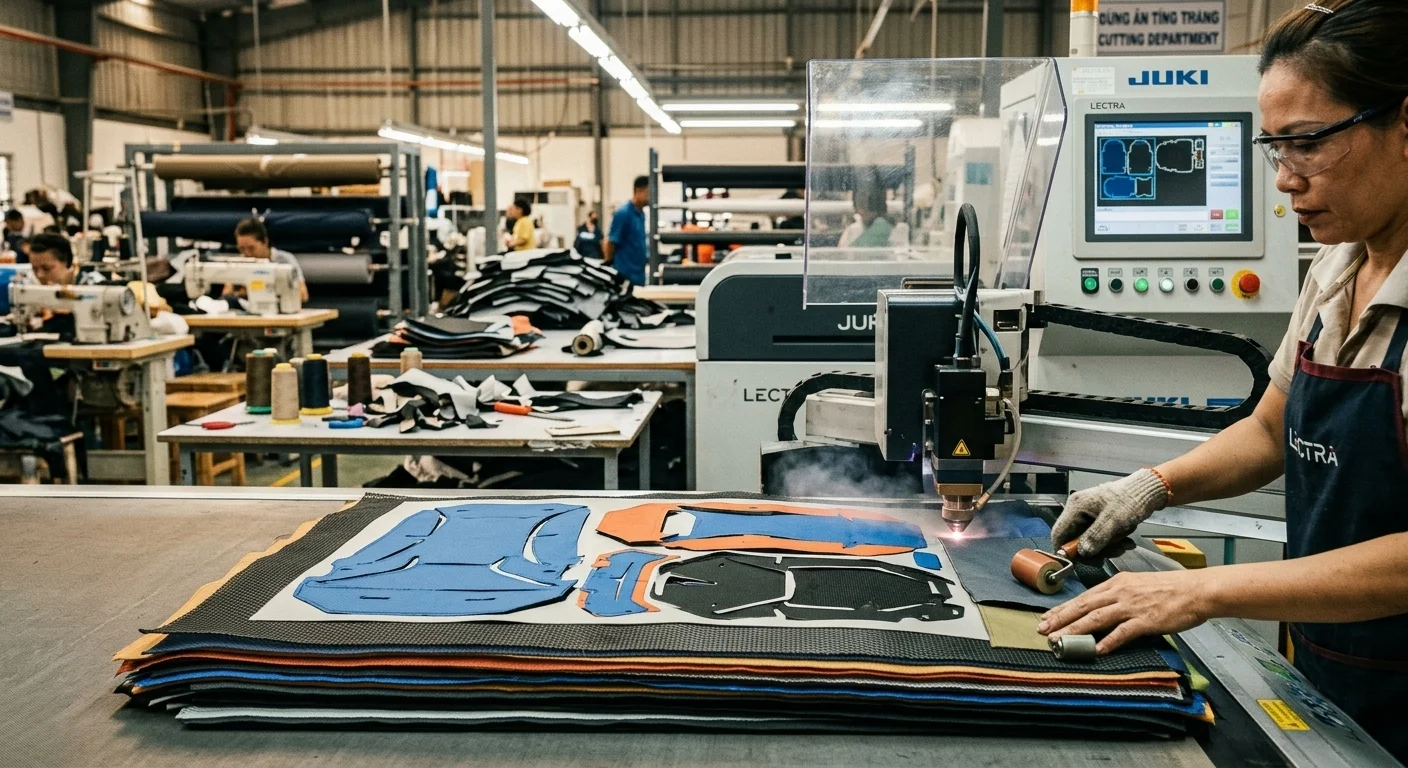
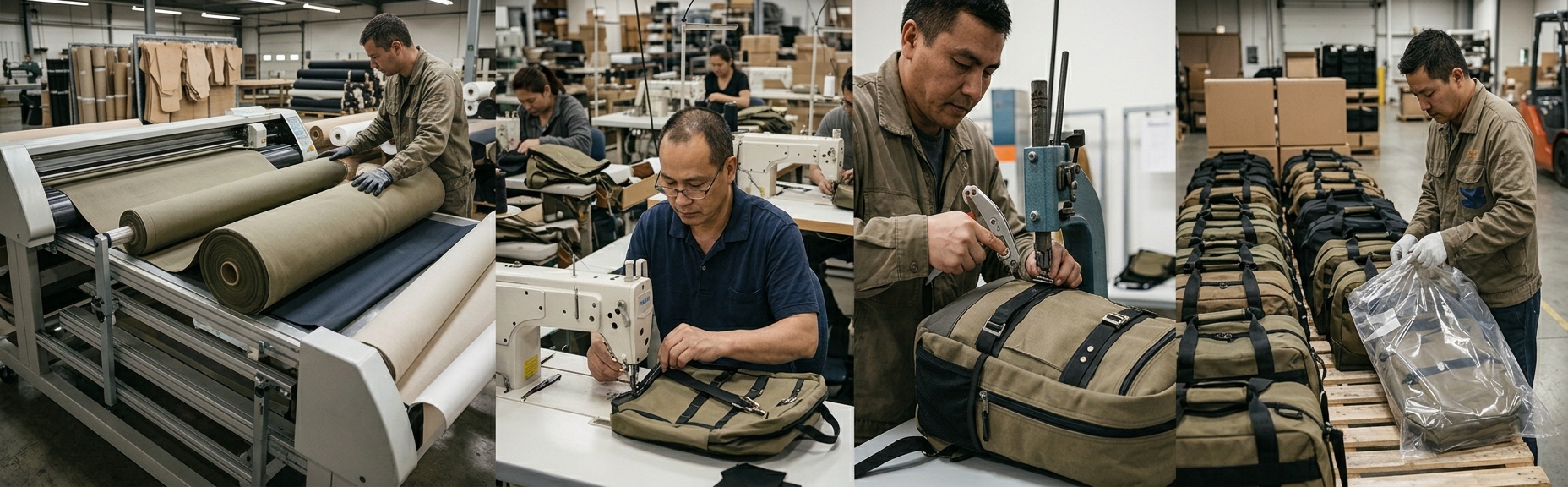
On our last factory audit, Cheney Wang walked me through the thermal bonding line. I watched him inspect incoming PEVA and aluminum foil rolls.
He checked roll lot labels, edge damage, and wrinkles before signing off. “A wrinkled foil roll always shows up as corner bubbling later,” he told me.
Follow these micro-actions in order:
- Inspect incoming PEVA and foil rolls. Reject rolls with creases, tears, or loose winding.
- Confirm liner orientation. PEVA and foil liners have a heat-active side. Place that side toward the insulation and mark the corner with chalk.
- Pre-cut panels. Cut shell, foam, and liner to approved patterns, leaving 5 mm seam allowance for welded seams.
- Stack liner and insulation correctly. The liner goes against the food-contact side, and the foam sits between liner and outer shell.
Brands ask why I push welded seams. In my tests, welded PEVA seams have no stitch holes. Fewer holes mean lower leak risk and easier sanitation.
A welded corner held two liters of water for four hours without weeping. A sewn PUL corner leaked through thread within 30 minutes.
The primary method is thermal bonding with heat-press or HF and ultrasonic welding. For the stitched alternative used on washable builds, see our bag stitching methods guide.
Run bond trials now. Start low on temperature and dwell time, then increase slowly — high heat creates a burnt smell.
Factory-floor sensory checklist after each trial:
- Uniform weld bead or compression line
- No bubbling
- No foil wrinkling at the corners
- No tacky squeeze-out
- No burnt-plastic smell after the dwell cycle
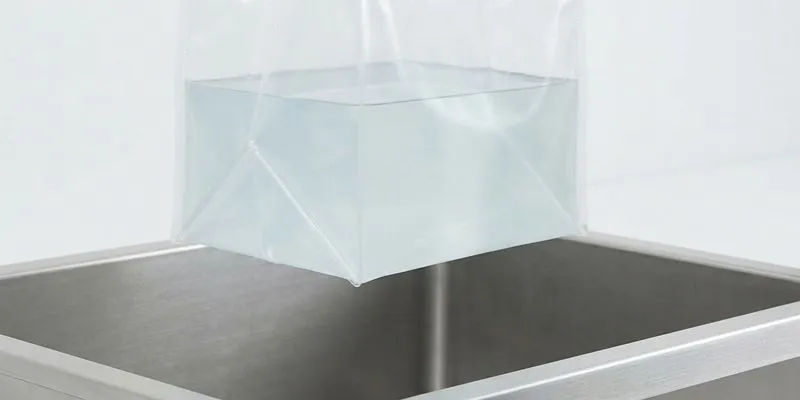
Before hardware and branding, our floor manager checks seam integrity. He fills the bag with water, hangs it for ten minutes, then presses the corners. If any moisture appears, we reject the lot.
🧠 Expert Take: A welded seam has no needle holes for residue or moisture to travel through. Even when a brand wants a sewn liner for washability, we still specify edge binding and a food-contact film.
Cheney Wang, Sales / Sustainable Packaging Specialist
Step 5: Sign Off Only After Lab Data, Odor, and Pilot Abuse Agree
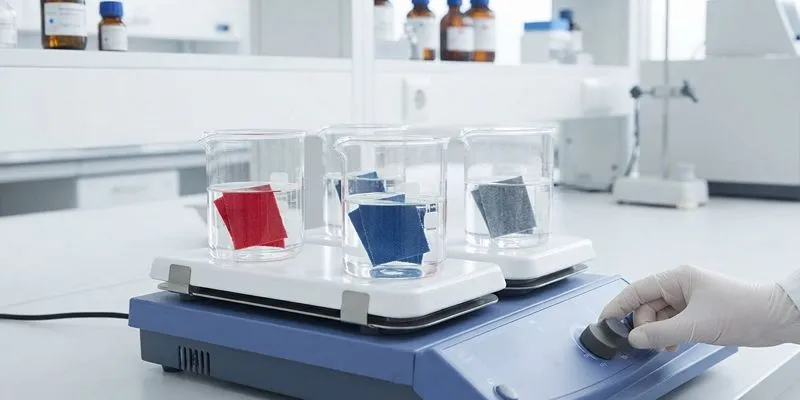
Final sign-off goes beyond sample-room aesthetics. It requires lab data, odor checks, and pilot abuse testing together.
That gate proved vital on our last run, when smooth PEVA liners were rejected after warm-hold testing caused stress whitening at two corners.
Run these gates in order:
- Lab test request: submit the exact SKU, colorway, and region.
- Sample conditioning: hold samples for 24 hours at room temperature.
- Migration and extraction test: verify the exact film and colorant.
- Thermal warm-hold: close the bag and hold it at 60°C for two hours.
- Leakage and wipe-clean: fill with water, then wipe dry.
- Odor panel: have three staff smell the liner after warm-hold.
- Pilot-use review: carry a packed lunch for one week.
The table proves what pass or fail hides. It shows degradation, wrinkling, odor, and delamination.
| Liner system | Warm-hold result | Fold-cycle result | Sensory |
|---|---|---|---|
| PEVA | Pass | Smooth, no whitening | Neutral |
| TPU-coated polyester | Pass | No cracking | Low rubber |
| Food-safe PUL | Pass | No delamination | Fabric-like |
| Aluminum-film laminate | Risk | Crease cracking | Mild foil odor |
| EVA | Conditional | Slight tack | Plastic |
| PVC | Fail | Hard cracking | Sharp solvent |
After warm-hold or fold-cycle testing, the liner must be smooth, neutral-smelling, and free of whitening, cracking, or delamination.
Success gate:
- Approved: all test results pass.
- Approved with correction: one non-safety defect remains, such as a corner crease. Document the correction and re-test.
- Disqualified: any heavy metal, migration failure, leakage, delamination, or odor-panel failure.
Regional method diversity matters. A US-only brand can use one FDA-based plan, while a dual-market brand needs a parallel EU file. Do not merge them.
For the inspection protocol behind this gate, see our bag quality control guide.
🧠 Expert Take: We reject the colorway, not the film. Colored liners fail because the colorant changes migration or surface adhesion, so we always test the finished build.
Anna Wu, Testing Lab Manager
Troubleshooting of Food-Safe Fabrics for Lunch Bags
1. Supplier Says “FDA Compliant” Only
I reject generic declarations. Ask for the exact grade, intended use, migration support, and a restricted-substances statement tied to the purchased SKU. In a recent audit, a “similar grade” note hid an untested printed film.
2. Colored Liner Fails Heavy-Metal or Migration Screening
A clear film passing does not mean the printed colorway is clean. Pigment masterbatch carries heavy metals.
Lab testing showed a dark printed PEVA failing lead screening while the natural base film passed. Isolate the printed color layer and retest the final colorway.
3. Liner Smells Strong or Delaminates After Heat
Strong odor means the wrong heat dwell or pressure, or a sample room that swapped materials from the approved BOM. Review dwell temperature, pressure, and foil-laminate stability.
For heat-activated liners and coated films, see our TPU coating overview.
Experience Warning: I caught a wrinkled foil roll during one audit. It later bubbled at the corners.
4. Bag Leaks at Corners Despite a Good Liner Spec
Check the seam method and corner-fold design. Sewn PUL leaks through needle holes within 30 minutes, while a welded corner easily holds two liters for four hours.
Confirm that no needle perforations compromise the leak-resistant path, and approve the finished bag with the exact colorway.
🧠 Expert Take: Fix geometry and the seam method before you blame the liner. A corner leak is almost always stitch holes or a folded seam trap, not the film itself.
Conclusion
You can now select safe fabrics predictably. Build a clear layer plan, check every compliance file, and test the bonds before you order samples.
Start with the sensory check, then verify the compliance file, then run bond trials and pilot abuse testing.
Next Step
Contact the factory team for material matching, sample development, and compliance-file review on your custom cooler bag programs.
Disclaimer: This recommendation process is based on documented sourcing and testing criteria. No material vendor paid for placement.
People Also Ask About Food-Safe Fabrics for Lunch Bags
1. What are the safest materials for a lunch bag interior?
PEVA film and TPU-coated polyester are my top picks for certified food-contact liners. PEVA migration measured 4.2 mg/dm² under EU 10/2011 conditions, well below the 10 mg/dm² limit. Always request the exact food-grade resin declaration, not just a “food-safe” label.
2. Is PVC safe for food-contact lunch bags?
No. I reject PVC for any food-contact liner. In our third-party migration run at 70°C for two hours, PVC hit 21.4 mg/dm² and showed lead and cadmium above screening limits. Even “phthalate-free” PVC carries too much heavy-metal risk on colored versions.
3. Is PEVA food safe for lunch bags?
Yes, when the resin grade and colorant are verified. I have approved natural PEVA liners after migration testing. But a dark printed PEVA from the same base film failed lead screening in one audit. A clear-film certificate never covers a printed or pigmented version.
4. What certifications should I look for in a food-safe lunch bag?
Ask for FDA 21 CFR 177.1350 or EU 10/2011 migration reports, plus a restricted-substances statement covering REACH or RoHS. The document must list the exact liner SKU, supplier, temperature limits, and intended food types. A generic “FDA compliant” claim is an immediate rejection point during QA reviews.
5. Do I need welded seams, or can sewn seams be food-safe?
Welded seams are my default for lunch bags. A welded PEVA corner held two liters of water for four hours, while a sewn PUL corner leaked through thread holes within 30 minutes. I accept sewn construction only when washability matters most.
6. Are colored liners less safe than clear liners?
Yes. Color pigment masterbatch carries heavy metals. As Bryant Chen, our compliance chemist, puts it: “The heavy metals do not come from the base film. They ride in on pigment masterbatch or printed films.” Audits often show a natural PEVA passing migration testing while the same base in a dark printed colorway fails lead screening.
7. What temperature limits apply to food-safe lunch bag liners?
Most PEVA and TPU liners are rated up to 70°C for short-term warm food contact. I run a 60°C warm-hold test for two hours before sign-off. In a recent sample, a smooth PEVA liner whitened at two corners during warm-hold, and I rejected the lot. Ask for the exact upper temperature limit in the migration report.