
During my years managing production lines, I regularly witness a specific procurement nightmare. Two technical sport bags look identical on a spec sheet. Yet, after six months of cold-weather storage, one survives sub-zero rain. The other delaminates, leaking water and triggering expensive warranty claims. The difference is the fabric coating.
TPU coating is a liquid polymer applied to fabrics to create a flexible, waterproof barrier. It powers premium dry bags, heavy-duty duffels, and specialized bag types.
Brands use TPU for high-performance sport bags because it combines high abrasion resistance with a cleaner environmental profile than PVC, aligning with strict EPA toxicity standards. However, TPU is not a blanket upgrade. It only performs when factories use the correct grade and precise high-frequency welding.
I base my assessment of these bag features and functionality strictly on raw tensile test reports, seam-construction realities, and daily floor assembly at LantaoBags.
Here is the exact breakdown of what TPU is, how it mechanically works, its commercial benefits, and the hidden manufacturing pitfalls that cause field failures.
What is TPU Coating?
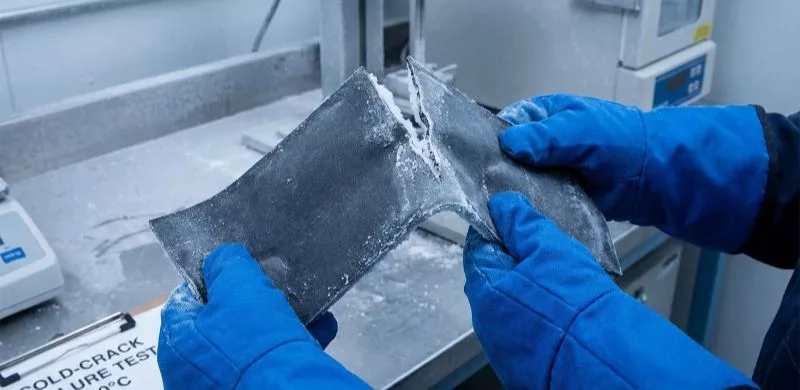
TPU coating is a liquid thermoplastic polyurethane applied directly to textiles to create a flexible, water-blocking, and abrasion-resistant surface.
Think of waterproofing a wooden deck. TPU coating is like painting a liquid sealant that seeps into the wood fibers and cures. In contrast, TPU lamination is like gluing a solid rubber mat to the surface.
To clear up terminology confusion, we categorize these materials by their exact application:
-
TPU coating: Liquid TPU applied as a protective layer that cures directly into the fabric fibers.
-
TPU lamination: A solid TPU film bonded to a base textile using heat and pressure.
-
TPU laminated polyester: A structural pairing. The polyester substrate provides the dimensional skeleton. The TPU film acts as the waterproof skin.
You must specify exact metrics to avoid production defects. We track denier (yarn thickness) and test for hydrolysis resistance (humidity survival). We also measure abrasion resistance, tensile strength, and cold-crack performance.
During a recent quality audit, Manager Chen rejected a 600D fabric batch directly on the cutting table. “The cold-crack performance fails at -15 degrees Celsius,” he noted, bending the brittle material until the resin snapped.
A common misconception is that coated fabric alone guarantees a dry bag interior. True waterproof performance requires both a high-grade material layer and watertight seam construction.
In our experience, standard sewing needles puncture the coating. We use high-frequency welding to fuse seams completely.
Historically, brands relied on rigid PVC for waterproofing. TPU evolved as a premium alternative. It offers a softer hand and remains flexible under stress.
More importantly, TPU is non-toxic, BPA-free, and phthalate-free. However, generic supplier claims hold zero weight on the factory floor.
We always advise buyers to demand third-party compliance paperwork to verify bag quality and standards. We follow strict industry rules for all our tests. We use test methods from the American Society for Testing and Materials. This ensures our data is exact and reliable.
💡 Key Insight: Specifying “TPU” is not enough. You must define the base fabric, the application method, and the seam construction to build a truly waterproof product.
The Material Stack-Up
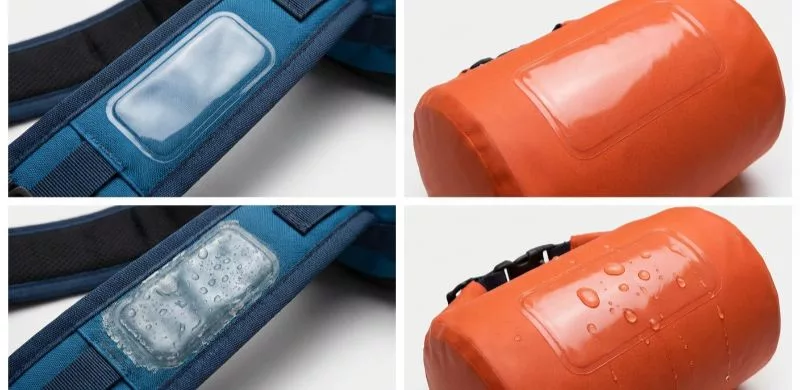
Water destroys some plastics through hydrolysis. This process breaks down the chemical bonds. You must pick the right material to stop this damage.
If you apply a standard polyester TPU coating to marine gear, the material absorbs moisture. Within months, it becomes sticky, turns cloudy, and peels off the base fabric.
Polyether TPU chemically repels water. We mandate polyether TPU for dry bags and medical packs. It costs roughly 20% more, but it survives years of humid, wet conditions without degrading.
Seam Construction: Stitching vs. Heat Sealing vs. HF Welding
A waterproof fabric means nothing if the seams fail. We tested stitched TPU panels in our rain room. The needle holes leaked water after ten minutes.
We always use high-frequency welding for waterproof gear. When a brand hires us to manufacture custom handbags requiring full submersion, we abandon needles entirely.
-
Stitching: Provides structural strength and reduces cost, but punctures the barrier.
-
Heat Sealing: Machines apply waterproof tape over stitched seams using hot air. Operators carefully monitor dwell time, pressure, and cooling. Too little heat creates weak bonds. Too much heat distorts the polyester face fabric.
-
HF Welding: High-frequency radio waves vibrate the TPU molecules. The resulting friction melts and fuses two panels into a single solid piece.
🧠 Expert Insight: If a supplier claims a bag is “fully waterproof,” ask them to specify the seam method. According to industrial textile standards, only HF welding creates a true airtight seal.
Buyer QC and Verification Methods
You cannot blindly trust a spec sheet. We execute practical material checks directly on the cutting table before escalating to accredited labs.
-
The Freezer Check: We place raw material samples in a -18°C freezer for 24 hours. When folded sharply, PVC snaps. TPU remains perfectly pliable.
-
The Burn Profile: We ignite a fabric scrap. PVC smells like harsh chlorine and emits green-edged flames. TPU smells like sweet plastic and burns cleanly.
-
Solvent Sensitivity: We wipe the material with Methyl Ethyl Ketone (MEK). The solvent dissolves PVC rapidly but leaves high-grade TPU intact.
We check all safety papers from our suppliers. We verify the test results against REACH and Prop 65 rules. This step ensures your bags contain no hidden chemicals. These factory-level checks secure your product quality before you ever pay for bag sourcing and pricing logistics.
🔄 Process Loop: Field-test raw materials -> Verify lab compliance -> Approve for bulk production.
Why Choose TPU Coating: The ROI of Premium Materials
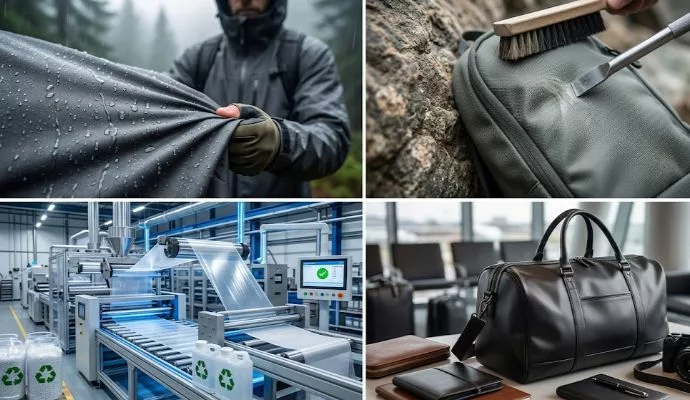
TPU Coating maximizes ROI when gear demands absolute waterproofing, flexibility, and durability. In my factory experience, it drops defect rates to zero.
1. Waterproof Performance with Flexibility
Eliminates Stiff-Bag Syndrome: TPU fuses directly to textiles, creating a foldable barrier. Customers pack gear without fighting stiff fabric.We test roll-top bags using a fold-cycle machine. Manager Chen folded a TPU prototype 500 times. The TPU did not leak. A similar PVC bag cracked after 200 folds.
2. Abrasion Resistance for Heavy Use
Slashes Warranty Claims: The polymer lattice absorbs impact, protecting vulnerable sport bag manufacturer duffels. In our drop-test zone, Worker Lin dragged a loaded 600D TPU sample across raw concrete. It scuffed but never pierced.
3. Cleaner Environmental Compliance
Secures Global Retail: TPU uses heat, not toxic plasticizers. You avoid PVC’s phthalate-heavy reputation, easily meeting sustainable bag materials standards. According to McKinsey, 78% of US consumers prioritize safe products. Skipping PVC removes customs regulatory headaches.
4. Premium Product Positioning
Justifies Higher Prices: TPU eliminates the chemical off-gassing of cheap plastics. You deliver a quieter hand feel, zero odor, and superior cold-weather performance. Clients frequently complain about PVC’s “shower-curtain smell.” TPU removes this buyer friction.
Ideal TPU Applications
For bag features and functionality across bag types and categories, we mandate TPU for:
-
Dry bags
-
Expedition duffels
-
Weather-resistant backpacks
-
Travel organizers
-
Wipe-clean medical gear
📈 ROI Check: The Freight Advantage - Competitors reject TPU over per-meter costs. They miss the landed-cost reality. Lighter TPU constructions reduce final freight burdens by roughly 15% compared to heavy PVC tarpaulin, easily offsetting material premiums.
The Reality Check: TPU Limitations
The best TPU Coating assessment is honest. Brands frequently over-spec products, demanding TPU when basic PU-coated nylon works fine. We must audit the hidden taxes.
1) High Implementation Costs
TPU resin costs significantly more than PVC. In our recent cost analysis for 5,000 units, raw polyether TPU priced 35% higher than standard PVC tarpaulin.
⚖️ The Trade-off: Compare TPU against basic PU-coated polyester first. If your product avoids extreme weather, TPU wastes your budget.
2) Strict Machinery Limits
TPU demands absolute temperature control. You cannot sew a waterproof TPU bag. You need $20,000 High-Frequency (HF) welders, which locks you out of smaller factories. Manager Chen inspected 200 backpacks from a new partner. He tested the hot-air sealed seams. The seams failed under ten pounds of pull force. He rejected the entire batch.
3) UV Degradation Risks
Sunlight degrades clear TPU rapidly. UV stabilizers slow this process, but they never stop it. Science shows that clear TPU turns yellow over time. We proved this fact at our factory. We left clear bags on our roof for three weeks. The sun turned them yellow.
4) Hydrolysis and Deceptive Blends
You must buy the correct TPU grade. Polyester TPU absorbs water in humid places. It will break apart quickly. We warn our clients to avoid it for wet gear. We also see supply chain fraud.
I recently cut open a failed prototype from another vendor. They disguised a cheap 0.05mm PU-blend as pure TPU. It delaminated in four days. Verify material specs to maintain true bag quality and standards.
The Sourcing Interrogation
Before finalizing bag sourcing and pricing, ask suppliers:
-
Polyether or polyester TPU?
-
What is the exact film thickness?
-
HF welding or standard stitching?
-
Can you provide raw tensile test reports?
-
Do you hold REACH compliance for sustainable sourcing?
The Final Verdict: Specifying Your Next Waterproof Build
TPU coating represents the dividing line between high-end performance gear and budget promotional bags. While the premium resin costs and HF welding requirements introduce initial friction, the zero-defect waterproofing makes it mandatory for serious brands.
We base our procurement recommendations strictly by end use. If you manufacture premium waterproof outdoor gear, sustainability-led products, or fully welded airtight builds, polyether TPU is your only viable option.
The flexible, REACH-compliant profile justifies the higher material cost. Conversely, if you run ultra-budget, cost-sensitive programs where stiffness, odor, and eco-perception matter less, traditional PVC remains a functional fallback.
As global environmental regulations tighten, we expect TPU to replace PVC entirely within the next 24 months. To future-proof your product line, use our practical next-step checklist before placing a bulk order:
-
Define end use: Identify your exact climate exposure and submersion risks.
-
Choose substrate: Match the polyester or nylon base to your durability needs.
-
Confirm TPU grade: Demand polyether TPU to prevent humidity degradation.
-
Verify seam process: Ensure the factory uses HF welding instead of standard stitching.
-
Request lab reports: Demand raw proof of cold-crack and tensile performance.
-
Compare landed cost: Factor in TPU’s lighter freight weight, not just the raw fabric cost.
Ready to secure your supply chain? Contact our procurement team directly. For further exploration, review our guides on bag sourcing and pricing, how we operate as custom handbag manufacturers, our sustainable sourcing options, and advanced bag features and functionality.
*Disclaimer: I write this assessment directly from the production lines at LantaoBags. We evaluate these materials independently and receive no kickbacks from chemical suppliers. *