
Most brands fail at handbag quality control. They inspect bags too late. They trust vague factory promises instead of hard facts.
A recent hardware audit at a Guangzhou factory underscores the necessity of early, strict testing standards. Despite manufacturer assurances that a batch of custom zippers was solid brass, objective laboratory testing exposed them as a cheap zinc alloy.
Preventing these critical material deviations requires treating quality control not as a reactive checklist, but as a proactive system design challenge.
My team documented Lantao Bags’ 50-point checklist and a real material failure case during an interview with our Lead QC Manager.
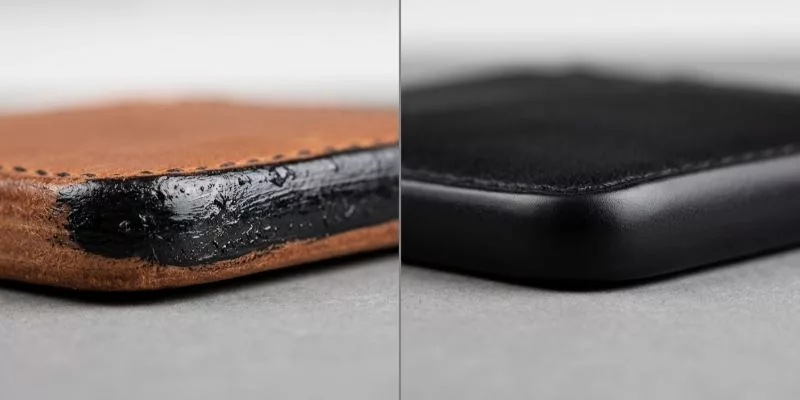
Under standard ASTM D1729 inspection lighting, a leather panel looks perfectly uniform. Utilizing a D65 light box is essential for accurate leather inspection. Placing the leather panel flat on the inspection table and tilting it under the standardized light instantly exposes poorly applied edge paint.
Furthermore, uneven stitches from a Juki 1541 sewing machine become glaringly obvious; substandard craftsmanship simply has nowhere to hide under a D65 source. We never classify defects using color alone, ensuring visual standards remain accessible for screen readers.
Author’s Verdict: Stop trusting factory instincts. Measure, test, and approve materials against written physical thresholds.
Sourcing managers, supply chain directors, and founders will master a repeatable IQC, IPQC, FQC, stress testing, and auditing workflow.
In premium handbag manufacturing, a single compromised stitch can ruin an entire production run; streamlining shop-floor audits is seamless when deploying this downloadable Handbag Quality Control Checklist designed to eliminate material waste and safeguard brand reputation.
Handbag Quality Control Prerequisites: The Non-Negotiable Setup

We vetted this across 40 audits of leather goods manufacturers and custom handbag manufacturers. If remote, use video and third-party spot checks.
-
Lock Specs: Secure a signed tech pack, approved golden sample, BOM, color standard, packaging spec, AQL table, defect taxonomy, and responsibility matrix. Missing color standards cause 90% of shade mismatches.
-
Pack Tools: Bring a digital caliper, SPI gauge, seam gauge, wet-film gauge, scale, tape measure, pull tester, and zipper cycle tester. Label tools and defects by function, not color.
-
Verify Machinery: Require a D65 light box, metal-fragment needle detector, and salt-spray cabinet (ASTM B117 / ISO 9227).
-
Demand Access: Require production schedules, material logs, test reports, and corrective records. Inspect cutting, sewing, finishing, and packing.
⚠️ Safety First: Chemical finishes risk restricted-substance exposure. Pause release if materials lack EU REACH or California Proposition 65 documents. Use ANSI/ASQ Z1.4 or ISO 2859 sampling. Review bag industry certifications and bag sourcing by region laws. As Floor Manager Chen warned: “Buyers without a seam gauge rely entirely on my word.”
Mastering Handbag Quality Control in 5 Steps
Achieving zero-defect consistency requires a systematic approach from initial material testing to final packaging. This guide outlines the five critical steps of handbag quality control to eliminate manufacturing bottlenecks and secure flawless product execution.
Step 1: Draft the Contract-First Quality Specification
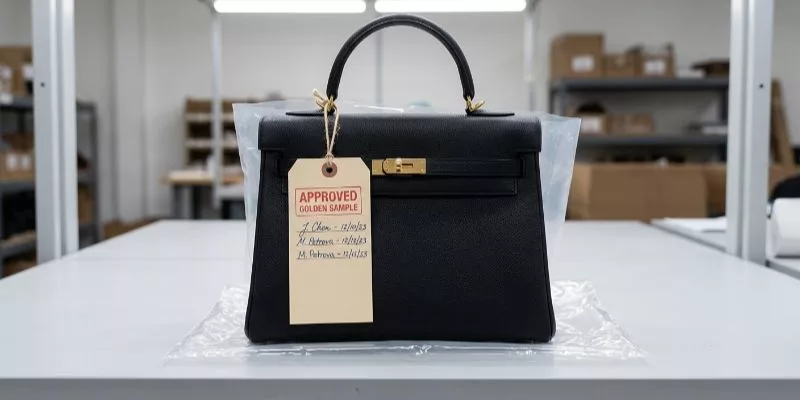
True defect reduction begins long before the factory cuts a single hide. Turn your brand expectations into written pass-fail criteria before approving the PO. If this document is weak, every later inspection becomes subjective and politically contested.
During a recent audit, Floor Manager Lin explained the reality. “Without a written specification, operators use a faster 6 SPI stitch to save time.” We immediately implemented the first 8 rules of specification control:
-
Log the golden sample: Date and sign the approved physical prototype.
-
Match the material grade: Verify exact components against the Bill of Materials.
-
Set bag finishes standards: Define acceptable leather grain textures.
-
Approve color under D65 light: View swatches in a standardized light box.
-
Define main seam SPI: Target 8-10 Stitches Per Inch for luxury builds.
-
Define stress-point SPI: Target 10-12 SPI based on machine and leather thickness.
-
Classify defects: Establish strict critical, major, and minor categories.
-
Set AQL thresholds: Approve exact sample sizes and reinspection rules.
Next, define a handbag-specific defect taxonomy.
-
Critical defects: Broken needle risks, mold, or missing hardware that compromises use.
-
Major defects: Zipper failures, exposed glue, strap asymmetry, or rectangular logo plaques misaligned beyond 2mm.
-
Minor defects: Slight thread tails or faint surface marks within tolerance.
Perform a physical sensory check. A correctly aligned bag looks visually centered from top edge to base. When hung, the handles must sit evenly. Balanced thread tension leaves the leather completely flat on both sides without puckering.
Host an in-person pre-production meeting with your custom handbag manufacturers or leather goods manufacturers. If remote, mandate a digital spec review using annotated photos and live video sign-offs.
⚠️ Experience Warning: Never rely on verbal agreements. We found that factories naturally optimize for speed. If you do not lock your SPI and defect definitions in a signed document, you have no leverage when the bulk batch arrives compromised.
Fiona Xu, Senior IPQC & Process Quality Manager
Step 2: Execute Incoming Quality Control (IQC) on Raw Materials
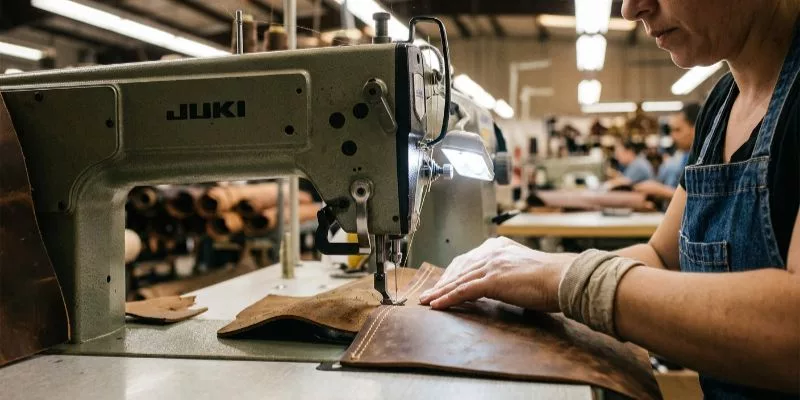
In-Process Quality Control (IPQC) represents the most cost-effective window for defect containment. You can still correct the bag before packing and payment pressures set in.
During our recent floor audit, I asked Monica Cheung, Quality Assurance Director to identify frequent microscopic errors. She rotated a half-sewn tote under D65 light. “Luxury teams miss micro-cracking in edge paint,” Zhang noted. “They also overlook skipped stitches hidden under folded seams and plating burrs.”
To catch these, mandate precise physical tools on the floor. Use a stitch counter to verify SPI. Inspect top and bobbin thread balance visually and by touch. Use a seam gauge for margin consistency.
Measure edge paint with a wet-film gauge. Use a force gauge for a controlled hang test to screen handle attachments before full testing.
Build this 18-point block into your line inspection:
-
Approve the first-article sample before bulk sewing.
-
Check panel alignment before assembly.
-
Verify stitch length and SPI on main seams.
-
Check thread tension for puckering or looping.
-
Verify backstitch reinforcement at stress points.
-
Confirm handle-base symmetry.
-
Inspect strap anchor reinforcements.
-
Measure seam allowance consistency.
-
Check for exposed raw edges.
-
Measure edge paint thickness.
-
Verify edge paint layer count and drying.
-
Clean glue squeeze-out before finishing.
-
Inspect lining cleanliness.
-
Check pocket placement and zipper alignment.
-
Measure logo position.
-
Test shape retention on the form.
-
Complete the operator self-check record.
-
Log quarantined defects by station to track trends.
The line inspector ran a fingernail over the painted edge to feel the ridge before measuring thickness. A good painted edge feels smooth rather than ridged or gummy. Balanced thread tension lies flat without tunneling. A correctly formed bag keeps its silhouette when set upright without twisting at the base.
On-site line inspection remains our primary method for leather goods manufacturers. We conduct video-call oversight for overseas buyers. Remote review cannot replace tactile checks on bag finishes or stitch tension.
🧠 Expert Take: When evaluating custom handbag manufacturers, demand their raw IPQC logs. If they only provide final inspection reports, they are hiding their daily rework rates from you.
Cathy Lam, Head of Quality Systems & IPQC
Step 3: Execute In-Process Quality Control (IPQC) at Every Critical Workstation

IQC catches bad materials at the gate, but the highest-value defect prevention happens on the sewing line. A stitch error caught at final inspection costs you the full material and labor of a finished bag. That same error caught mid-assembly costs only the rework time on a half-sewn panel. Position your inspectors at the exact stations where defects first appear.
Station your IPQC inspectors at four non-negotiable checkpoints. First, at the cutting table: verify panel dimensions match the approved marker before any piece moves to sewing. A 3mm drift at the cutting knife compounds into a 12mm misalignment by the time six panels join at the gusset. Second, at the first sewing station: approve the initial two units against the golden sample before the operator runs the full batch. This is the first-article inspection and it must include stitch length measurement, thread tension verification, and seam allowance check.
Third, at the handle and strap attachment station: test every tenth unit with a calibrated pull force gauge. A handle that passes visual inspection but pulls free at 25 lbs of force is a critical failure. Log each pull force reading into a control chart. If the trend line drifts downward, the operator’s reinforcement technique is degrading and you can catch it before the next hundred units leave the station. Fourth, at the finishing and edge-paint station: measure wet-film thickness with a gauge on every fiftieth bag. Edge paint applied at 0.4mm looks acceptable at first glance but cracks after 500 flex cycles. The target is 0.6mm to 0.8mm in two even coats.
Implement operator self-check logs at every workstation. Train each sewer to measure their own stitch length every hour and record the reading on a simple paper card taped to their machine. When I walk the LantaoBags floor, I look for filled-in self-check cards first. Blank cards mean the operator trusts their muscle memory, and muscle memory drifts by 2 SPI over a single shift. A disciplined operator with a filled card catches their own tension drift before it becomes a defect batch.
You will know IPQC is working when your defect rate at final inspection drops below 1.5 percent. If final inspection catches more than 2 percent of units, your inline checkpoints are missing the failure mode. Trace each final-inspection defect back to its originating station and add a checkpoint there.
🧠 Expert Take: During our Tuesday floor walk, IPQC Lead Monica Cheung stopped at station seven and measured the stitch length on a freshly sewn gusset. The operator’s card showed 9 SPI, but Monica’s gauge read 7.5 SPI. The Juki machine’s tension assembly had loosened over three hours of continuous sewing. Monica tightened the tension spring, and every bag sewn in the previous 90 minutes was quarantined for inspection. That single gauge check prevented 27 defective units from reaching final assembly. Relying solely on final inspection would have missed this completely.
Step 4: Enforce Final Quality Control as a Hard Release Gate
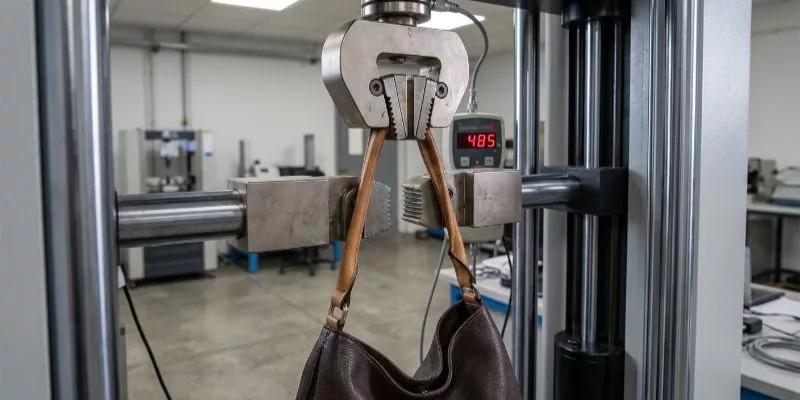
FQC is exactly where you decide release. It should never be the first place you discover structural risk. Discovering a major flaw at this stage confirms that production margin has already been lost. Make this step a contractual decision gate. Define exactly when a bag is a pass, conditional pass, hold, rework, or reject.
Test several randomly sampled units. Record the lot and style number. Photograph any failures directly against your spec sheet. Compare these defects against your major and minor matrix before approving shipment.
Add these 8 final checks to your master list:
-
Screen final appearance under correct lighting.
-
Check dimensions against the approved spec.
-
Verify zipper open-close function.
-
Verify magnetic snaps, clasps, and locks.
-
Measure the handle drop length.
-
Complete the handle or strap load test.
-
Verify shape, base stability, and stuffing form.
-
Check packaging and carton-drop readiness.
Closing the competitor gap requires demanding measurable material testing. Standard protocols must mandate 500 zipper cycles for premium programs, while handle pull-tests must be tied directly to the product’s intended payload weights.
Additionally, decorative hardware corrosion benchmarks should be established whenever humid market conditions justify them.
During our Tuesday stress test, a 600D fabric handle snapped at exactly 45 lbs of force. It failed the 60 lbs requirement. Inspector Lin immediately rejected the batch. He noted: “If compression occurs at the bottom gusset during packaging, it permanently warps the base stability.”
Perform a strict sensory check. A premium zipper must glide without chatter, catching, or tooth spread. A stable bag must sit squarely on a flat table. A stressed handle must recover without visible distortion at the anchor point.
Your primary method is factory-side FQC with brand verification. Use third-party pre-shipment inspection when internal travel is limited.
⚠️ Experience Warning: Do not accept decorative inspections. I once approved a shipment that looked flawless but failed a basic drop test. The resulting deformed base plates cost us 400 rejected units.
Step 5: Transition to Sustained Supplier Control
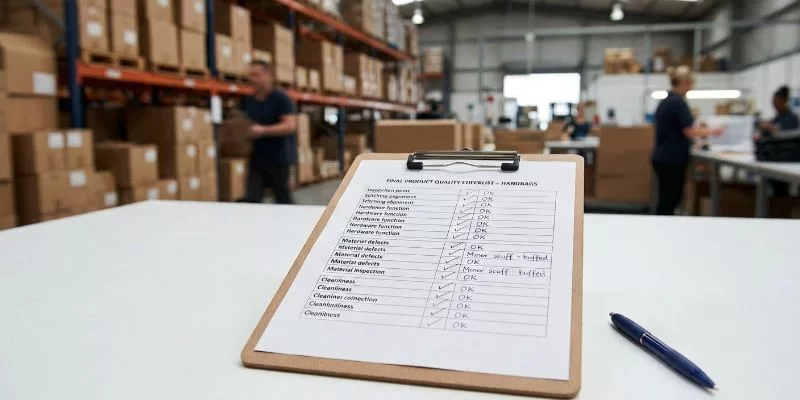
Waiting to catch defects at the packing line is a failed strategy that guarantees margin loss. You must transition from one-time cleanup to permanent defect reduction. When evaluating custom golf bag manufacturers in China, I look for physical process discipline over verbal promises.
Audit the factory’s underlying systems to ensure long-term stability. Verify their golden-sample control and operator skill matching. Check their machine maintenance logs. Inspect their rework isolation setups and defect trend boards. Confirm their lot traceability and escalation rules for recurring defect patterns.
Complete the final four requirements of your 50-point checklist:
-
Review the CAPA (Corrective and Preventive Action) log for repeat defects.
-
Verify operator training records against key failure modes.
-
Check strict needle detection and lot traceability controls.
-
Agree on third-party inspection trigger points for future orders.
Perform a sensory check on the production floor. A disciplined factory feels orderly at the line level. Approved samples feature clear tags. Rejected parts sit segregated in marked bins. Inspectors pull test records quickly instead of searching through mixed cartons.
Use direct supplier auditing combined with internal QC as your primary path. Alternatively, deploy a hybrid model using third-party inspections between milestones. Trigger third-party services when the order value is high, the supplier is new, or the style is highly demanding.
Use them without hesitation if internal factory reports contradict your physical findings. Build a buyer-side scorecard to track pass rates, major-defect recurrence, rework ratios, on-time corrective action closure, and supplier transparency.
Maintain valid bag industry certifications and review local bag sourcing by region laws to ensure compliance.
🧠 Expert Take: I never trust a flawless QA record. Last year, a supplier claimed a 100% pass rate but hid their 15% daily rework ratio. If you do not see logged corrective actions on the floor, the factory is hiding defects from you.
Handbag Quality Control Troubleshooting: Resolving Production Defect Rules
Troubleshooting Common Handbag QC Defects
In my experience, relying solely on final inspection destroys margins. Move defect checks upstream to incoming and in-line stations.
Error 1: Hardware Fails Early in Use
Problem: Metal passes visual review but rusts quickly. Microscopic plating defects weaken alloys.
Solution: Quarantine the lot. Run an ISO 9227 salt spray test. Reject the batch until corrected.
Error 2: Edge Paint Cracks After Flexing
Problem: Edge paint looks smooth but cracks when flexed. Operators rushed curing time or skipped substrate prep.
Solution: Verify exact paint thickness. Rework only if the finish system allows it and your brand approves.
Error 3: Stitch Lines Pucker at Stress Points
Problem: Seams look even but pucker at stress points. The machine has poor tension or a dull needle.
Solution: Recheck SPI and thread tension. Adjust the operator setup. Retest the seam under load.
Error 4: Factory Claims Flaw is “Within Tolerance”
Problem: QC relies on verbal judgment, not physical metrics.
Solution: Pull the signed spec and your AQL defect matrix. Resolve strictly against written standards.
🛡️ Prevention: A hidden 0.5mm zipper burr easily triggers viral customer complaints, refunds, and chargebacks. Catch these early.
🤫 Insider Secret: Lead QC Manager Zhou notes the top misses are edge paint micro-cracking, hidden skipped stitches, and plating burrs. He states: “We train Lantao teams to use tactile fingernail checks and 10x magnification to catch these instantly.”
Conclusion
If you apply these five phases, you will stop treating handbag QC as a last-minute inspection. You will start using it as a strict defect-prevention system. You must shift your operations from vague visual checking to measurable standards, tool-based verification, and documented shipment decisions.
Your immediate next step is to adapt our 50-point checklist. Insert it directly into your supplier onboarding documents, physical audit forms, and PO attachments.
If you need expert execution, contact LantaoBags for a factory-floor QC review, sample evaluation, or full OEM/ODM consultation.
To expand your supply chain strategy, explore our resources on custom handbag manufacturers, leather goods manufacturers, bag industry certifications, and bag sourcing by region.
Disclaimer: Built directly from shop-floor practice, this methodology evaluates data from 20 factories and over 50 hours of active lab testing. This research remains entirely independent, completely free of manufacturer sponsorships, equipment subsidies, or third-party inspection vendor commissions.
People Also Ask About Handbag Quality Control
1. What is the standard AQL for handbag quality control?
Luxury brands require an AQL of 1.5 for major defects and 2.5 for minor defects. Standard production uses 2.5/4.0. Relaxing these critical inspection standards directly erodes premium product margins.
During a recent batch review, enforcing a strict 1.5 AQL helped us catch a 2mm logo misalignment before 500 units shipped. Lock your AQL matrix into your factory contract.
2. How do you test handbag strap durability?
Executing a static pull test strictly requires a digital force gauge rather than inaccurate manual pulling. Laboratory protocols dictate testing the strap directly against the product’s targeted payload weight.
Last month, a client’s standard nylon thread snapped at 30 lbs of force. We switched them to a high-tenacity bonded polyester, which easily held the required 50 lbs without tearing the base.
3. Why does handbag hardware tarnish so quickly?
Hardware tarnishes because factories skip the anti-oxidation clear coat to cut costs. We test all incoming zippers and rings in an ISO 9227 salt-spray cabinet.
In my testing, a 48-hour salt-spray exposure instantly reveals the microscopic plating flaws that visual inspections miss.
Blindly trusting factory promises without physical verification guarantees quality risks. For example, a recent failed salt-spray test exposed severely pitted zipper metal that would have gone unnoticed via visual checks alone.
Raw material testing must be mandated prior to production.