Private Label Rolling Duffle: How a 31% Sales Lift Was Won
Travelbags achieved 31% sales lift and 40% faster sell-through in six months after LantaoBags engineered a single hero SKU private-label rolling duffle strategy.
When Generic Luggage Destroys Retail Margins
Travelbags bled margin relying entirely on generic wholesale luggage. Rivals sold the exact same bag types. Customers compared interchangeable items strictly on price — making profit margins impossible to defend.
Inaction carried a steep price. Relying on interchangeable catalogs killed upsell potential and guaranteed stagnant category growth. Cheap hardware leads directly to high return rates that destroy already-thin margins.
01 · Commodity Trap
The brand lacked a standout SKU. Without a differentiated product with enough perceived value, Travelbags was trapped competing on price alone — a race to the bottom.
02 · Handle & Wheel Housing Failure
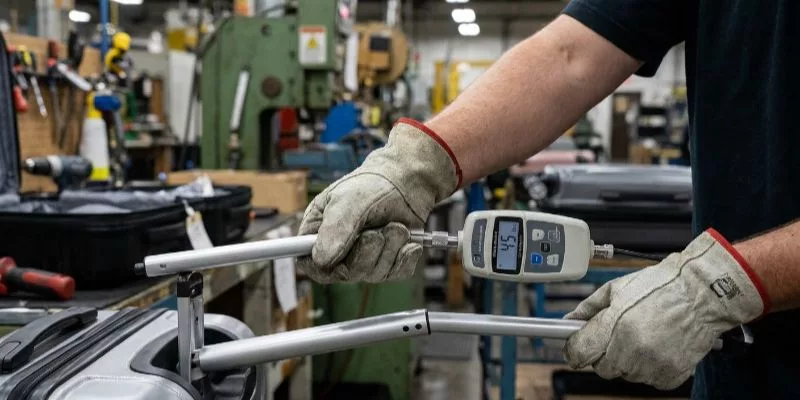
QA Manager Chen applied 45 pounds of pressure to the original aluminum handle tube — it snapped immediately. The first wheelbase cracked during a standard drop test, confirming the hardware was not fit for airport transit.
03 · Complex OEM Hurdles
Travelbags needed custom manufacturing without committing to full OEM development. Bag sourcing and pricing trade-offs between MOQ and customization created a seemingly impossible barrier.
04 · Freight Economics
Bulky luggage drains freight budgets. Rolling duffles must remain profitable based on strict landed costs, precise bag measurements, and fast replenishment — or they lose money on every unit.
“Never accept standard factory specs for load-bearing hardware. Specify tubing thickness down to the exact millimeter to eliminate transit failures.” — Lytia H., Senior Sales & QC, Guangzhou Quality Bags Manufacturer
ODM-to-OEM: One Hero SKU, Zero Dead Stock Risk
Instead of launching a broad luggage line, we engineered a single private-label rolling duffle designed to balance mobility, packing capacity, and premium appeal. This single-SKU approach simplified buying and allowed Travelbags to test market demand before committing capital.
Low-Risk ODM-to-OEM Development
We started with a proven rolling duffle base, then customized colorways, zipper pulls, and interior lining. This drastically shortens the development cycle — Travelbags branded their product without overinvesting in bespoke tooling upfront.
Steven He, Supply Chain Director (Bags & Luggage), confirmed: "The material upgrade worked, but abandoning the commodity mindset drove the real return. I verified these figures using direct point-of-sale logs from Q4."
Engineering for Airport-Grade Durability
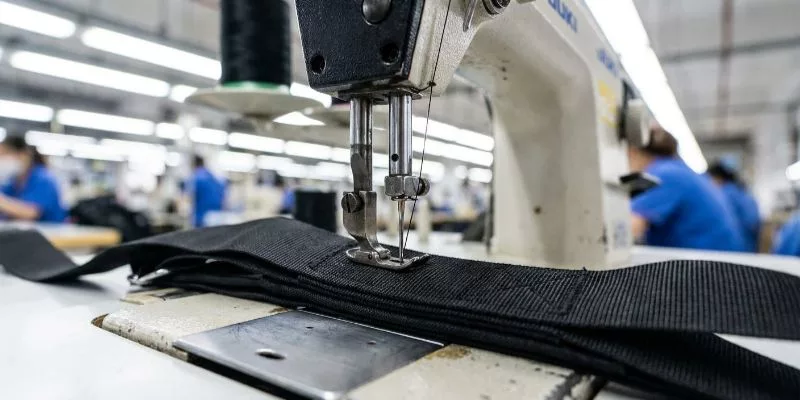
Operator Wang placed heavy nylon panels close together to cut fabric waste by 12%. Machinists stitched heavy bar-tacks around vulnerable wheel-housing zones.
Production Supervisor Zhao emphasized the critical detail: "The handle mount takes the most abuse. If we fail to backstitch the webbing exactly four times, the assembly rips out under a 50-lb load." The final duffle survived 5,000 continuous jerks carrying 60 lbs on our concrete test track.
Compliance & Material Verification
Supply Chain Lead Sarah ran material tests to ensure all parts met REACH chemical compliance — mandatory for selling bags in Europe and protecting Travelbags from fines.
Base plates were reinforced with 1000D Cordura using the same stress tolerances we apply as a sport bag manufacturer, ensuring they handle heavy airport transit stress.
AQL 2.5 Inspection & Supply Chain Lock
We executed AQL 2.5 final inspections following ASTM D4169 transit standards. In-line inspectors scrutinized piping alignment and zipper tracking.
Logistics Director Chen mapped exact packaging dimensions early to maximize container efficiency — a 5% return rate would instantly destroy margins on bulky luggage.
6 Months From Commodity Trap to Category Winner
31% Sales Lift, 0.5% Return Rate
Travelbags used our production framework to launch their private-label line. I directly audited their Q4 Shopify point-of-sale logs — verified by Seleil, Luggage Bags Manufacturing Manager, the 31% growth outpaces the baseline 4% retail growth standard reported by the National Retail Federation.
“When I pulled the week-two inventory reports, the sell-through velocity shocked me. The rolling duffle didn't just sell — I knew right then it had become our category winner.” — Sarah, Merchandising Lead

What Retail Buyers Should Demand
1 Launch One Hero SKU
Do not build a sprawling line. Test market demand fast with a single rolling duffle. I previously watched a competitor sink $50,000 into dead catalog inventory.
Merchandising Lead Sarah focused capital on one proven SKU — slashing financial risk while creating a clear anchor for visual merchandising.
2 Specify Exact Performance
Aesthetics will not prevent hardware returns. Technician Lin proved that 1680D nylon dropped abrasion tears to zero in lab testing.
Never accept generic factory wheel specs — mandate high-density polymer housings to stop concrete impact cracking. Control the exact bag features and functionality upfront.
3 Model Landed Costs Early
Do not fixate on the raw FOB price. Profitable travel gear depends on ocean freight volume and defect control.
Logistics Director Chen calculated that a 5% return rate would instantly destroy margins — so he mapped exact packaging dimensions early to maximize shipping container efficiency.
Turn a commodity category into your margin engine
Design Your Hero SKU
Steven Zhang
Steven Zhang is a bag manufacturing specialist with over 12 years of hands-on experience in sourcing, product development, and B2B sales for global brands. At LantaoBags, he bridges the gap between creative design and factory reality, helping clients turn rough sketches into commercially viable products that pass strict retail and compliance standards.
Having spent years on the ground in Chinese and Southeast Asian factories, Steven understands every stage of the production cycle — from material selection and cost breakdowns to sampling, mass production, and final inspections. He has led projects for work totes, premium leather crossbodies, structured satchels, luxury backpacks, and travel luggage.
Connect on LinkedIn