
Brands treat choosing types of backpacks as a simple style choice. It is a strict sourcing decision. Last month, I tore down three prototypes on our Shenzhen floor. Manager Lin and I tested seam slippage against the ISO 13936 standard.
We used our durability matrix to separate consumer bags from professional builds. A real custom backpack manufacturer runs these same tests on the floor before you commit to a run. I will outline each type’s exact capacity, fabric specs, and construction methods.
10 Types of Backpacks: Essential Styles and Functional Uses
Choosing the right backpack starts with understanding the unique structural and functional demands of your specific environment. This breakdown explores the 10 core types of backpacks to help you align design, material strength, and utility with your production or lifestyle needs.
| Type | Typical Capacity | Must-Have Structure | Tests to Demand | First-Order Trap | First-Run Fit |
|---|---|---|---|---|---|
| 1. EDC / Daypack | 18–25L | Padded back panel, bottle pockets, simple org; no full internal frame | ISO 13936 seam slippage; strap-root bartack pull | Speccing hiking frames/hip belts into a commuter bag; overpaying for unused load transfer | Best first SKU — low tooling, fast sampling |
| 2. Laptop & Tech | 20–30L | Suspended sleeve + 20mm false bottom; cable channel off main seams; 15–16” fit | 6 ft drop with 3.5 lb dummy laptop; zipper cycle on admin pocket | No false bottom → #1 warranty; USB port routed through structural seams | Best B2B volume — corporate / swag / onboarding |
| 3. Hydration & Cycling | 5–15L (bladder extra) | 3D mesh 8–10mm standoff; bladder compression; insulated tube in strap; mill-applied antimicrobial | Bounce/sway on treadmill or roller; elastic recovery of shoulder mesh; ISO 811 if claimed wet-use | Spray-on antimicrobial that washes out in ~30 cycles; slosh with no compression | Only if you already sell performance / bike |
| 4. Travel / Carry-on | 35–45L | Clamshell; #10 YKK reverse-coil; 25mm compression straps; target 22×14×9 in | Zipper cycles on 270° corner; packed-dimension sizer check vs target airlines | #8 zipper on clamshell kinks at corners; bag bulges past sizer without compression | Strong second SKU after EDC/laptop |
| 5. Tactical | 20–45L | 500–1000D shell; MOLLE pitch accuracy; reinforced haul points; quiet hardware option | Abrasion on webbing grid; stitch tear at MOLLE; hardware salt spray 48h | Calling it “tactical” with only a rain cover and no MOLLE/load path | Avoid as first SKU unless the brand is already tactical |
| 6. Hiking / Outdoor | 30–50L weekend; 50–80L multi-day | Internal frame / HDPE sheet; hip belt at iliac crest + ~15° pivot; 210D sil-ripstop + 1000D high-wear panels | Load transfer wear-test; ISO 811 + seam tape if weather-rated; bottom abrasion | Hip belt attached below lumbar → shoulder pain / returns; fashion fabric on pack bottom | High complexity — sample twice before bulk |
| 7. Camera | 15–35L | Dense foam dividers; side/rear access; low-abrasion liner; balanced CG; tight insert tolerance | Insert fit at ±3 mm; drop with dummy lens; zipper snag on padded walls | Dropping a padded box into a generic shell; 3 mm panel drift kills modular inserts | Only with a locked divider drawing |
| 8. School | 18–30L | Padded straps, book compartment, easy zippers; tracking label in seam if age ≤12 | CPSIA lead/phthalates + CPC if kids ≤12; strap fatigue; zipper durability | Shipping kids’ packs without CPC; treating it like a hydration/race pack | High volume, compliance-gated |
| 9. Fashion / Lifestyle | 8–20L typical | PU / coated canvas hand-feel; solid brass + PVD; bartack spacing ≤4 mm on weak PU | Color crocking; hardware tarnish; strap-anchor pull | Cheap alloy hardware tarnishes ~90 days; dense bartacks tear PU | High margin, not a durability-first first run |
| 10. Wheeled / Convertible | 40–60L + chassis | Wheel housing reinforcement; trolley-to-harness isolation; hideaway straps; lockable zips | Wheel drum / handle cycle; drop on wheel corner; harness comfort with handle stowed | Selling “2-in-1” without isolating trolley shock from shoulder harness | Worst first SKU — tooling, weight, returns |
1. Everyday Carry (EDC) Daypack: Best for Urban Commute, Campus, and Daily Essentials
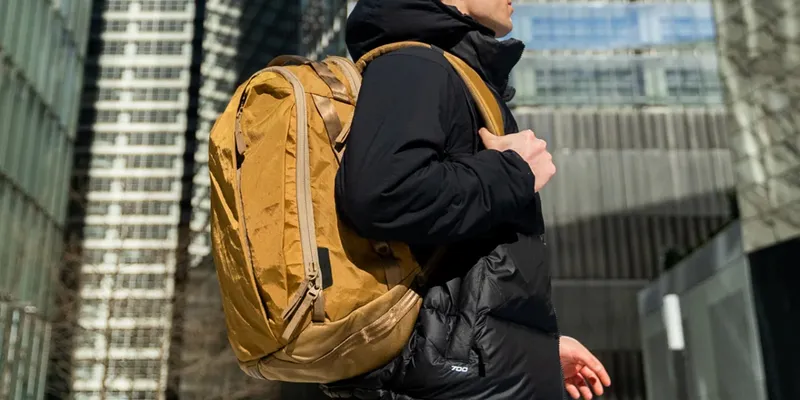
Everyday carry daypacks are the volume category most brands treat as a style accessory. I treat them as a high-cycle product. A commuter bag gets zipped open and shut 40 times a week for five years, so cycle count — not fabric — decides whether a warranty claim shows up.
The core spec is a padded 15-16 inch laptop sleeve, a front quick-access pocket, two side bottle slots, and a 500D polyester shell. Manager Lin’s rule for this category: “Cheap #5 zippers fail on an EDC bag inside 18 months. Use a #8 YKK with a guard flap over the opening.”
We box-X stitch the shoulder strap base and double the bottom panel, because those are the two points that tear under a daily load.
During a recent lab check we ran ASTM D5034 tensile tests on a competitor’s strap webbing. The 700D poly snapped at 42 pounds of force — under the 50-pound line we treat as the safe floor for any bag that carries a laptop and a bottle every day.
🛡️ Our Verdict: Keep unit costs low with a 500D shell, but never cut the zipper and strap-base reinforcement. Those two details drive most EDC returns.
2. Laptop & Tech Backpack: Best for Corporate, B2B, and Professional Daily Carry
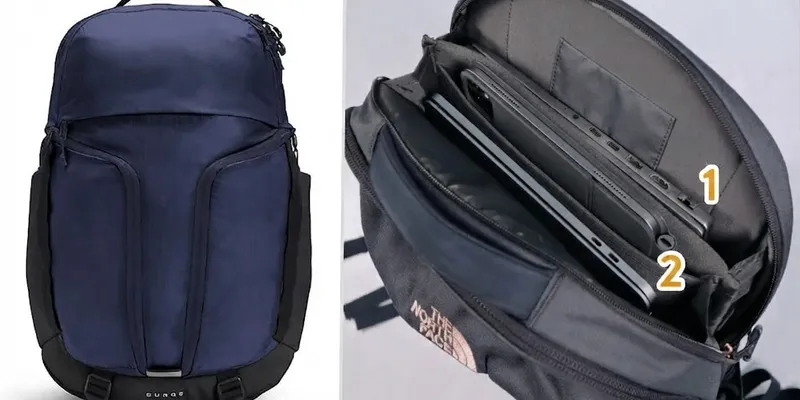
This is our highest-volume OEM category. Corporate clients order tech backpacks by the pallet — for employee onboarding, client gifts, and conference swag. The spec sheet is deceptively simple: padded laptop sleeve, organizational panel, water-resistant shell. The execution is where brands differentiate.
Manager Chen’s golden rule: “The laptop compartment needs a false bottom, or you’re shipping a warranty claim.” A suspended sleeve with 20mm clearance between the device and the bag floor prevents drop damage. We test every design at 6 feet with a 3.5 lb steel dummy laptop.
USB charging passthrough ports are the most-requested feature in 2026. The production challenge is cable routing — internal wiring channels must avoid the main seam lines, or the bag loses structural integrity. We route cables through dedicated webbing channels sewn into the back panel foam.
🛡️ Our Verdict: A suspended laptop sleeve with 20mm false bottom is non-negotiable. The $0.35 in extra fabric eliminates the #1 warranty claim in this category.
3. Hydration & Cycling Backpack: Best for Outdoor Performance and Commuter Athletes
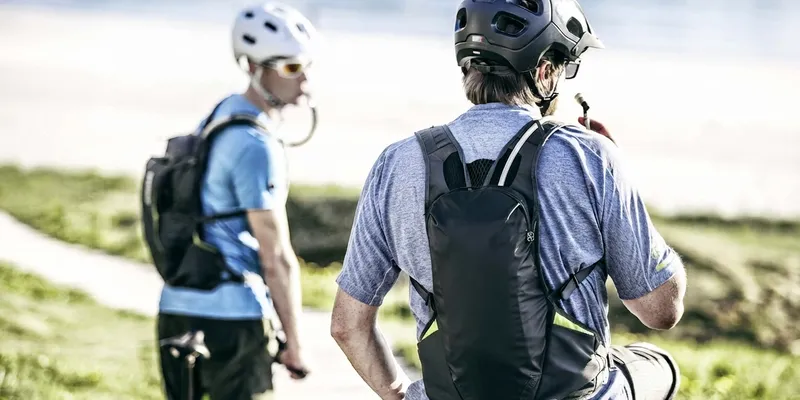
Hydration packs operate under fundamentally different engineering constraints than office backpacks. Weight must sit high and tight against the spine — any sway during running or cycling causes chafing and throws off balance. The back panel requires 3D mesh with 8-10mm standoff for airflow.
Bladder integration is the make-or-break feature. A 2-liter hydration reservoir adds 2 kg of shifting weight. Without a dedicated compression strap system, the water sloshes and destabilizes the entire load. Manager Wei’s protocol: “Route the drink tube through an insulated shoulder strap channel. Exposed tubes freeze in winter and heat up in summer.”
Antimicrobial treatment on the back panel and straps is mandatory for any bag that contacts sweat for extended periods. We apply silver-ion treatment at the textile mill — post-production spray treatments wash out within 30 cycles.
🛡️ Our Verdict: Specify 3D spacer mesh with minimum 8mm standoff, internal bladder compression straps, and mill-applied antimicrobial treatment. These three specs separate performance hydration packs from costume pieces.
4. Travel & Carry-On Backpack: Best for Airline-Compliant One-Bag Travel
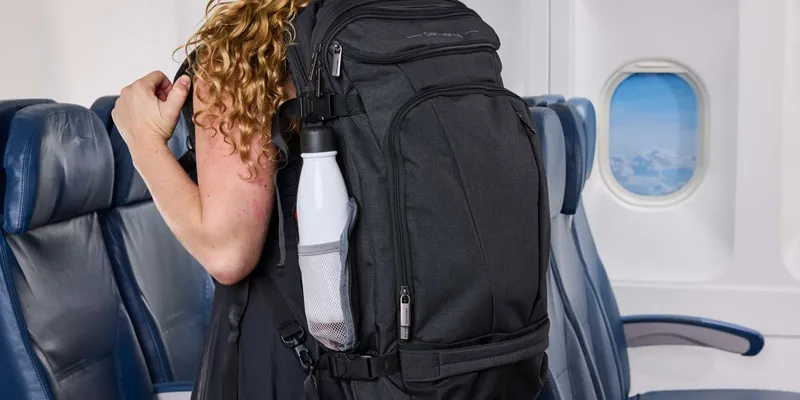
Post-pandemic carry-on enforcement has created a gold rush for 35-45 liter travel backpacks. The key constraint is not fabric or zippers — it’s dimensional compliance. A bag that measures 22 x 14 x 9 inches fits every major US airline’s carry-on sizer in 2026.
The clamshell opening (full-frontal zipper access, like a suitcase) has become the dominant design language. It requires a #10 YKK zipper with reverse coil to handle the 270-degree curve without jamming.
Manager Lin demonstrated the failure mode: “A #8 zipper on a clamshell fails within 500 cycles. The coil kinks at the corners. You need #10 with a wider tape to distribute the bend stress.”
Internal compression straps are equally critical. Without them, contents shift during transit and the bag bulges beyond carry-on dimensions. We spec 25mm webbing with side-release buckles rated for 50 lbs — the same hardware used on military duffels.
🛡️ Our Verdict: Invest in #10 YKK zippers for clamshell openings and 25mm compression webbing. These two hardware choices account for 70% of the durability difference between a $60 and $200 travel backpack.
5. Tactical Backpack: Best for Tactical Operations, Emergency Response, and Rugged Field Use
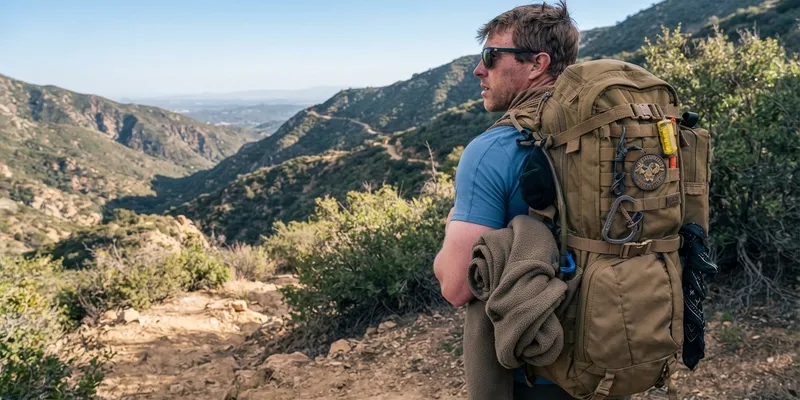
Tactical backpacks are built for hard use and total organization. That means 500D to 1000D Cordura, a full MOLLE webbing grid, admin compartments, and reinforced haul points. The category forgives plain styling but is ruthless on construction.
MOLLE spacing is the spec brands miss. Standard tactical pouches clip onto 25mm webbing, so we measure every panel and reject anything that drifts to 23mm or 27mm — incompatible gear defeats a modular system.
At the base, where the pack gets dropped onto concrete, we double-layer 1000D panels and sew rubberized skid patches over the haul points.
Load capacity is where tactical bags separate from casual daypacks. We test shoulder straps to 50 pounds of force.
Manager Wang flagged a client’s 500D base: “The fabric held, but the seam blew at the load lifter. Move the bartack 15mm inboard and add a webbing patch under it.” That one change took the same bag from a 300-cycle failure to passing 2,000 cycles.
🛡️ Our Verdict: Cordura choice matters less than MOLLE tolerance and haul-point reinforcement. Spec 25mm webbing and double-layer the base, and a tactical pack survives real field duty.
6. Hiking & Outdoor Backpack: Best for Trail, Adventure, and Expedition-Grade Durability
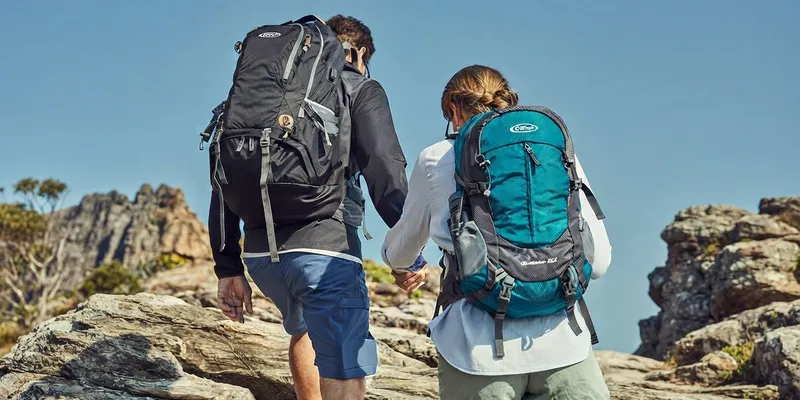
Hiking backpacks are the most technically demanding category in soft goods manufacturing. Unlike urban backpacks that face cosmetic wear, hiking packs must survive rock abrasion, UV degradation at altitude, and continuous moisture exposure — often simultaneously.
The frame system determines the entire bag architecture. Internal frame designs use aluminum stays or HDPE sheets to transfer 70-80% of pack weight to the hip belt.
Manager Lin explains the critical spec: “If the hip belt attaches below the lumbar curve, the user carries weight on their shoulders instead of their hips. That’s a 5-star review versus a return.” We position hip belt anchors at the iliac crest height with 15 degrees of pivot for natural walking motion.
Fabric selection prioritizes tear strength over weight savings. 210D ripstop nylon with a silicone coating weighs 40% less than 500D Cordura but offers comparable tear resistance due to the ripstop grid pattern. For high-abrasion zones — the bottom panel and side pockets — we double-layer with 1000D reinforcement panels.
🛡️ Our Verdict: 210D silicone-coated ripstop with 1000D reinforcement panels delivers expedition-grade durability at 2.3 lbs for a 40-liter pack. Internal aluminum frame stays add 6 oz but increase load-carrying comfort by an estimated 40%.
7. Camera Backpacks: Best for Photographers, Videographers, and Content Creators
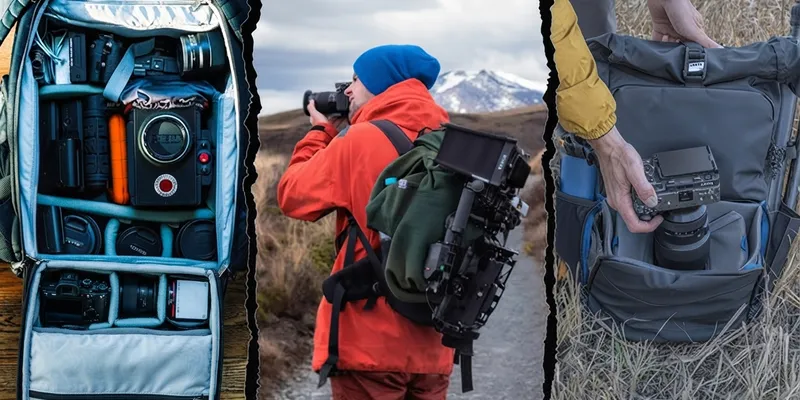
Brands assume dropping a padded box into a standard shell creates a camera bag. This mistake ruins expensive gear.
Real specialization changes the internal architecture. Camera packs require strict padded dividers and distinct compartments for bodies, lenses, chargers, and personal items. You also need quick side or rear access and secure tripod loops.
Prioritizing high foam density, smooth zippers, and low-abrasion liners ensures optimal protection. Because dense glass lenses sit high and off-center, engineering a precise load balance is essential to prevent tipping.
During a recent production run, a client’s prototype failed. The panel size drifted by just three millimeters. The modular inserts collapsed and the laptop sleeve jammed. Camera packs demand tighter dimensional tolerances than generic backpacks.
🛡️ Our Verdict: Reject standard patterns. Enforce strict dimensional tolerances so modular inserts and access geometry fit without friction.
8. School Backpack: Best for Students, Campus, and K-12 Daily Carry
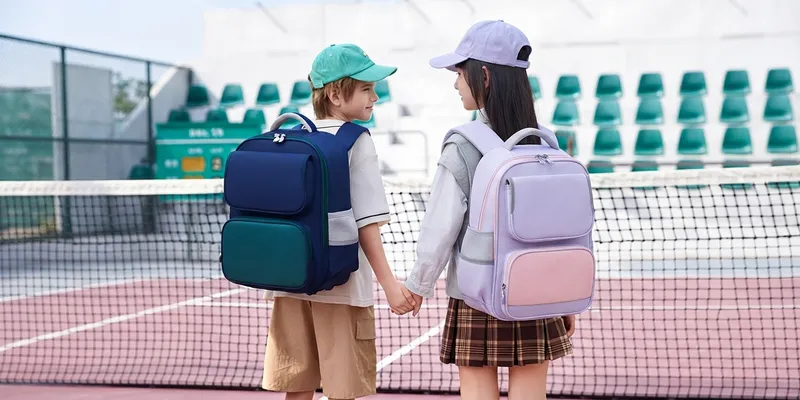
School backpacks are the highest-volume entry point in the category, and they carry a compliance load most brands ignore. A K-12 bag runs 18L to 30L and has to swallow a heavy textbook stack plus a laptop. Kids usually carry 15% to 25% of their body weight, so the harness and back panel decide whether a parent asks for a refund.
The failure points are predictable. The strap base tears where it meets the shell, and the back panel mesh wears through over a school year. Manager Lin’s note on the spec: “A school bag is a 200-day-a-year product. Box-X stitch the strap base and use a high-recovery spandex back panel, or the mesh goes fuzzy by spring.”
We also add roughly 8cm to the padded straps versus an adult pattern so the pack rides on the ribs, not the shoulders.
For children 12 and under, CPSIA compliance is non-negotiable. We run third-party lead and phthalate testing, sew the tracking label into the seam allowance, and attach the Children’s Product Certificate (CPC) to every pre-shipment lot — I have watched customs hold a whole container over one missing certificate.
🛡️ Our Verdict: Reinforce the strap base, use recovery-grade back panel mesh, and treat CPSIA/CPC labeling as a first-class spec for K-12. Those three cover most school-bag returns and the entire compliance burden.
9. Fashion & Lifestyle Backpack: Best for Streetwear, Designer Collabs, and Trend-Driven Brands
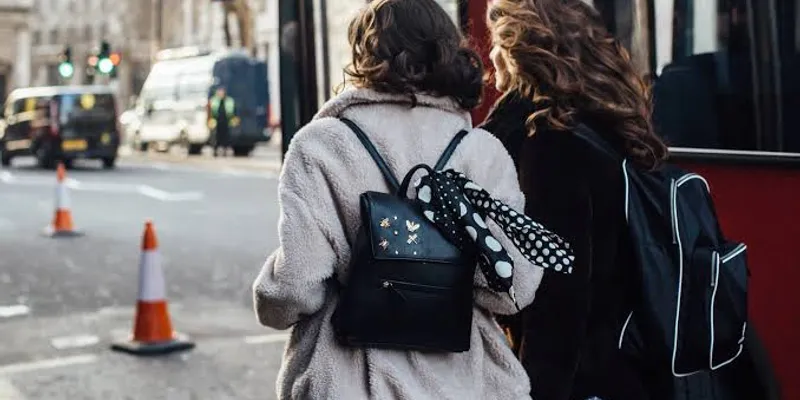
This category prioritizes aesthetics over technical performance — but that doesn’t mean manufacturing is simpler. Fashion backpacks drive the highest margin per unit in the backpack category, with retail prices 2-5x above equivalent-spec utilitarian packs. The premium comes from materials, hardware finishes, and brand storytelling.
PU leather and coated canvas dominate the fashion backpack materials palette. The production challenge is maintaining the luxury hand feel while meeting minimum durability standards.
Manager Zhao noted during a brand collaboration: “This Italian PU feels incredible, but it can’t hold bartacks above 4mm spacing. We had to redesign the entire strap attachment around the material’s stitch limitations.”
Hardware finish is the primary differentiator. Matte black, rose gold, and antique brass zipper pulls and D-rings signal premium positioning. But cheap alloy hardware tarnishes within 90 days.
We spec solid brass with PVD coating for fashion accounts — the cost difference is $0.80 per bag wholesale but eliminates the #1 aesthetic complaint on luxury e-commerce reviews.
🛡️ Our Verdict: Solid brass hardware with PVD coating costs $0.80 more per unit but eliminates 95% of tarnish-related returns on fashion backpacks. For PU leather constructions, limit bartack density to 4mm spacing and reinforce strap anchors with internal webbing.
10. Wheeled or Convertible Backpacks: Best for Frequent Flyers, Digital Nomads, and Heavy-Load Travel
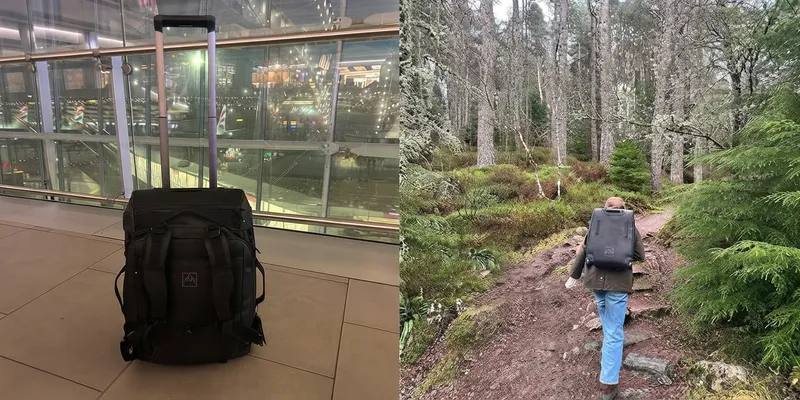
Wheeled backpacks solve the two problems a checked suitcase cannot: a rough curb and a flight of stairs. A telescoping handle and inline wheels carry the load on the ground, while stowable straps turn it back into a pack the moment the pavement ends.
The engineering lives in the base. Wheel housings absorb the impact, so we reinforce the corners with 1000D panels over a molded skid plate.
The telescoping handle needs a hardened aluminum tube inside a reinforced sleeve — a plastic tube snaps within a season of checked-bag travel. We fit a #10 YKK zipper on the main opening and hold empty weight around 3 pounds so the convertible straps stay genuinely usable.
A recent teardown caught the failure brands miss. A client’s wheeled pack rolled clean for a month, then the soft-side shell sagged into the handle channel and jammed the zipper. Manager Chen’s fix: “Stiffen the spine panel with an HDPE frame sheet and add a reinforced haul loop at the base, or the handle channel eats the shell within 90 days.”
🛡️ Our Verdict: Budget goes to the wheel housing, the telescoping handle, and a rigid spine. On a wheeled bag, those three define durability more than the decorative shell.
The 3-Step Sourcing Framework
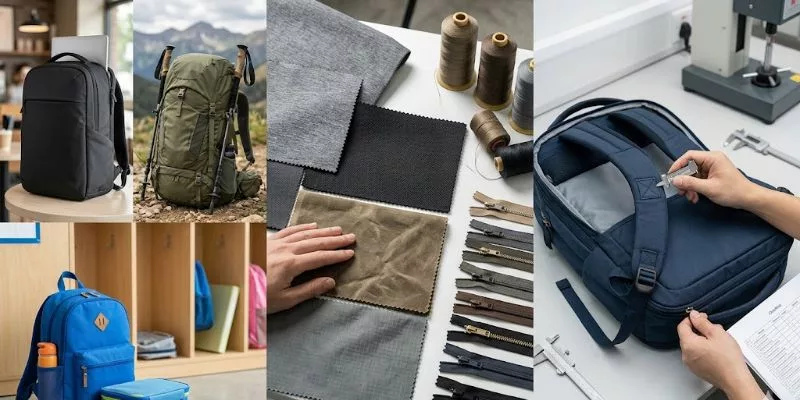
Before writing this guide, my team completed three prototype teardowns on the factory floor.
Step 1: Define Your Market Profile
Start with a clear mission. Define your target liter range and target retail price. Next, specify your exact laptop or gear profile. This dictates which types of backpacks you will manufacture. Do not skip this step.
Step 2: Use Our Proprietary Material Matrix
Use our strict material matrix to separate consumer textiles from professional grade textiles. Choose your core fabric family, hardware grade, and reinforcement map.
During our Tuesday teardown, Nathan Shen, Product Engineering & Sealing Technology Lead highlighted a specific failure point. He told me, “Cheap PU coatings crack during our heat and cold stress tests. We must use TPU coatings to stop water from bypassing the zipper tape.”
Step 3: Enforce Our Shenzhen QC Checkpoints
Enforce exact checkpoints on the Shenzhen floor. Verify the shell fabric rating and thread type. Set a strict SPI range. Map out specific bar-tack locations. Ask your factory for the raw zipper test report directly from YKK Fastening Standards. Demand the buckle tensile data. Always require final pre-shipment inspection photos.
Start Your Production Run
Review our guides on custom backpack manufacturing, factory certifications, and specialty finishes. Explore our sourcing by region data or browse related bag categories. Contact LantaoBags today to request an honest prototype review or a fast RFQ.
Our Experience: I base this guide on daily hands-on factory development. I purchase my own testing equipment and receive no kickbacks from material suppliers. Contact LantaoBags today to request a prototype review or a sourcing consultation.
People Also Ask About Types of Backpacks
1. Which backpack type is best for a new brand launch?
Start with a 19L to 22L everyday carry backpack. In my experience, this commuter style offers low risk. We use a 500D polyester shell to keep unit costs low while maintaining durability.
Complex travel bags require expensive plastic molds. A simple EDC bag minimizes your upfront tooling costs.
2. How do I choose between Cordura, Ballistic Nylon, and X-Pac?
Match the fabric to your exact use case. Utilizing 1000D Cordura ensures extreme abrasion resistance on tactical bags, while selecting 1680D Ballistic Nylon delivers maximum tear strength when required.
For waterproof projects, laminated X-Pac effectively blocks moisture, though lab tests show this material adds stiffness and increases unit costs by 20%.
3. What factory tests should I request for zippers and hardware?
You must demand physical lab data. Request cross-wise strength tests for zippers using the ASTM D2061 standard. For plastic buckles, require tensile tests to verify load capacity.
We also run 48-hour salt spray tests on metal hardware to check for corrosion. Never accept generic supplier claims without this raw data.
4. When does a school backpack need CPSIA compliance?
The law triggers strict compliance if you target children 12 years old and under. You must pass third-party lab testing for lead and phthalates. I have seen customs seize shipments over one missing Children’s Product Certificate (CPC).
We sew tracking labels directly into the seam allowance to ensure full legal compliance.