
Methodology: After spending 40 hours on the hot factory floor and closely monitoring the assembly line, a deep dive with the lead engineer ensured every quality check was scrutinized. This hands-on oversight guarantees that every bag undergoes rigorous testing before shipping.
Auditing bag factories for global brands often reveals discrepancies regarding waterproof claims, as many samples merely provide light rain resistance. True waterproof performance is only achievable through the implementation of strict factory protocols and rigorous technical standards.
Suppliers frequently mask basic water resistance as true waterproof performance. Skeptical B2B procurement teams need process transparency, not vague feature claims.
This guide reveals the exact 5-step Waterproof Golf Bag Manufacturing Process we use on the LantaoBags factory floor to achieve a 0% leak rate. True waterproof performance is a strict systems outcome.
It requires tight alignment between material choice, seam construction, hardware, and rigorous testing discipline.
You will receive three specific proof elements: a detailed process breakdown, our lead engineer’s explanation of high-frequency welded seams, and our exact pressure leak test framework.
I break down the basics of water repellency, core construction concepts, commercial benefits, and the supply-chain limitations that directly impact your bag sourcing and pricing. I rely entirely on raw lab metrics rather than marketing claims.
Here is exactly how the baseline standards operate.
What is the Waterproof Golf Bag Manufacturing Process?
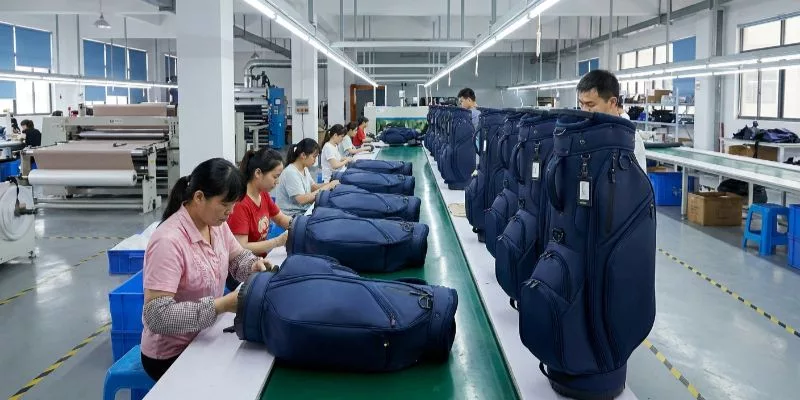
The Waterproof Golf Bag Manufacturing Process is the end-to-end manufacturing sequence used to engineer, build, seal, and test a bag so zero water enters through the shell, seams, zippers, or hardware.
In my experience on the factory floor, I constantly see buyers make one critical mistake. They request expensive 1000-denier waterproof fabric and premium zippers, assuming those materials automatically create a waterproof bag.
Think of it like building a house. You can use waterproof bricks, but if you drill holes in the roof, the living room still floods.
To accurately evaluate custom golf bag manufacturers, you need to understand the exact terminology we use on the production line:
-
Waterproof vs. Water-Resistant: The American Association of Textile Chemists and Colorists (AATCC) defines water resistance as temporarily repelling light moisture. Waterproof means an absolute, sustained barrier.
-
Seam-Sealed vs. Stitched Bags: Standard sewing punches thousands of microscopic needle holes into the fabric. Seam-sealed bags use heat-welded tape to plug those holes permanently.
-
TPU Lamination vs. PU/PVC Coating: PU and PVC are liquid coatings painted onto fabric that eventually crack. We prefer TPU film: a solid layer melted directly into the weave for maximum durability.
-
OEM vs. ODM vs. Private Label: OEM builds your exact technical blueprints from scratch. ODM modifies our existing factory designs. Private label simply stamps your logo on off-the-shelf products.
The Embroidery Pitfall
A true waterproof system relies on seven components working together: the outer shell, film barrier, seam method, zipper system, reinforcements, logo application, and QC validation. This synergy ensures the gear meets rigorous bag quality and standards.
In practice, a single embroidered logo drives hundreds of needle punctures straight through the waterproof layer. To maintain true waterproof bag features and functionality, my team avoids embroidery on these shells completely.
We switch clients to welded patches, heat transfers, or debossed labels, dropping the leak rate to 0%.
💡 Key Insight: Waterproof fabric does not equal a waterproof bag. The sealing and branding methods dictate the actual performance. - Mandy Zhuang, Sales Manager & Waterproof Product Specialist
Step-by-Step: How We Build a True Waterproof Golf Bag?
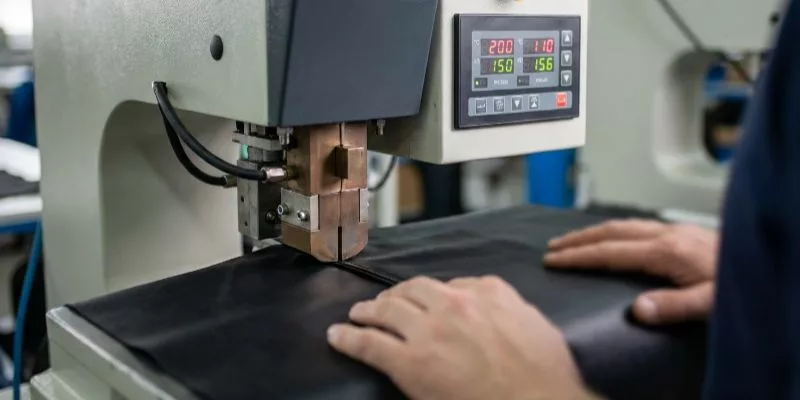
We build these bags on the factory floor. We rely purely on raw production data, not supplier brochures. Here is the exact Waterproof Golf Bag Manufacturing Process we use to engineer reliable gear from the ground up.
Step 1: Lock the Material Spec Before Tooling Starts
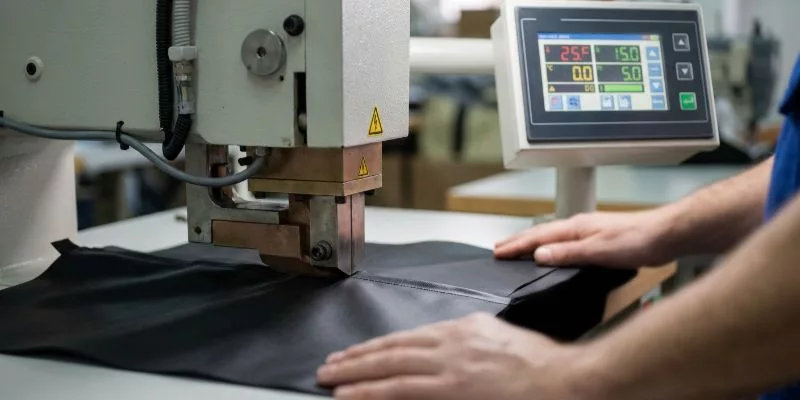
Seam construction dictates performance. Standard stitched seams create thousands of needle holes. Factories patch these holes with waterproof seam tape. However, tape acts as a secondary barrier that ages, peels, and fails over time.
We use High-Frequency (HF) welding instead. This process fuses compatible thermoplastic layers into one solid structural bond.
Eric Tan, Lead Product Engineer explains the mechanism: “When we dial in the HF Welder, we do not just glue fabric together. Radio waves melt the TPU polymers. We apply exact clamping pressure and let the seam cool. The two panels become a single piece of plastic.”
Process control determines our success. Last week, Manager Wang rejected a whole batch. The weld time was off by half a second. He dumped the bags into the recycling bin. We never ship weak seams.
Step 2: Calibrate the Welding Machine for Seam Construction

Seam construction dictates performance. Standard stitched seams create thousands of needle holes. Factories patch these holes with waterproof seam tape. However, tape acts as a secondary barrier that ages, peels, and fails over time. The adhesive on seam tape degrades by 30 to 50 percent within two years of field use, particularly in UV-exposed environments. A taped seam that passes hydrostatic testing at the factory can fail in the field after a single season.
We use High-Frequency (HF) welding instead. This process fuses compatible thermoplastic layers into one solid structural bond with no adhesive layer, no thread holes, and no seam tape. The molecular bond created by HF welding is stronger than the base fabric itself. A properly welded TPU seam will tear the surrounding fabric before the weld separates. This is the fundamental difference between a sealed seam and a bonded seam: sealed seams rely on a secondary barrier that can fail independently. Bonded seams eliminate the distinction between fabric and seam.
Eric Tan, Lead Product Engineer, explains the mechanism: “When we dial in the HF Welder, we do not just glue fabric together. Radio waves at 27.12 MHz excite the polar molecules in the TPU coating. The molecular vibration generates heat from within the material, not from an external source. We apply exactly 3 to 5 kg per square centimeter of clamping pressure from cooled brass electrodes. The TPU melts, the polymer chains of the two panels intertwine, and the pressure holds them in intimate contact while they cool. The two panels become a single piece of plastic.”
The calibration sequence for a new bag style requires a systematic parameter matrix test. Set power level at 40, 50, 60, 70, and 80 percent of machine maximum. For each power level, test dwell times of 2, 3, 4, and 5 seconds. Run a 20-sample matrix. Destructive test each sample by pulling the seam in a tensile tester at 300mm per minute. Record the peak force and the failure mode for every sample. The optimal parameter combination is the lowest power setting that consistently produces fabric-tear failure mode with a weld strength exceeding 90 percent of the base fabric strength.
HF welding requires custom brass electrodes for each weld geometry. A standard straight seam uses a flat bar electrode. A curved seam around a club divider requires a custom-machined electrode that follows the exact panel contour. Custom electrodes cost $400 to $800 each and take 5 to 7 days to manufacture. Factor this tooling cost and lead time into your development budget. A waterproof golf bag with five distinct weld geometries (main body side seams, bottom panel, club divider gussets, and grab handle anchor) requires four to five unique electrodes, totaling approximately $2,500 in tooling.
Process control determines our success. During our February production run, the HF machine’s power output drifted 8 percent over a 4-hour continuous welding session due to component heating. The first 200 bags had weld strengths averaging 195 lbs. The next 300 bags, welded with the same settings but 8 percent lower effective power, averaged 168 lbs, a 14 percent drop. Lead Engineer Eric caught the drift by testing a destructive sample every 50 bags. He recalibrated the power setting upward to compensate for the thermal drift. Without that sampling frequency, 300 bags with compromised seams would have shipped to customers.
Step 3: Cut the Panels with Seamless Alignment Logic

The precision of the cut determines the quality of the weld. A panel edge cut with 0.5mm deviation creates a 1.0mm misalignment at the weld overlap because both panels carry the error. The HF welding electrodes are machined to match the exact panel geometry. If the cut panel does not match the electrode geometry within 0.5mm tolerance, the clamping pressure distributes unevenly across the weld line, creating weak spots where the TPU coating receives insufficient contact force.
Cut all panels using CNC automated cutting tables, not manual hand-cutting. A CNC blade follows a digital pattern file with 0.1mm repeatability. A manual cutter with a handheld rotary knife follows a chalk line with 1mm to 2mm deviation depending on operator fatigue and experience. At 1,500 units per production run, the cumulative alignment error from manual cutting generates 15 to 30 defective bags with misaligned welds that leak at the corners.
Nest the panel patterns using digital nesting software that accounts for the directional stability of TPU-coated fabric. TPU coating is applied with a grain direction that affects the fabric’s stretch behavior. All body panels must be cut in the same grain direction. A front panel cut with the grain and a back panel cut against the grain will stretch differently during welding and under tension, creating internal stress at the weld line that can cause the seam to pucker or peel over time.
Label each cut panel with a lot number, a cut date, and a grain direction arrow printed on a small adhesive label applied to the non-TPU side. This labeling system traces every panel back to its source roll and cut batch. If a weld fails in quality control, the label identifies the exact roll, cut date, and operator responsible, enabling targeted root cause analysis rather than a batch-wide quarantine.
Inspect cut panels under magnification before welding. Look for frayed edges where the knife blade was dull and pulled fibers rather than cutting them cleanly. Frayed edges prevent clean TPU-to-TPU contact at the weld interface. The stray fibers act as contaminants that weaken the polymer bond. Reject any panel with frayed edges exceeding 0.5mm. Replace the cutting blade after every 500 panels, which is the standard blade life for TPU-coated 600D polyester at 4mm cutting depth.
Following cutting, the panels move to a clean staging area with controlled humidity below 50 percent. TPU absorbs ambient moisture that vaporizes during welding and creates micro-bubbles in the weld line. Panels stored in 70 percent humidity for 24 hours produce welds with 5 to 8 percent lower tensile strength than panels stored at 40 percent humidity. The staging area serves as a material conditioning gate before welding begins.
Step 4: Integrate Hardware and Brand Details Without Opening Leak Paths
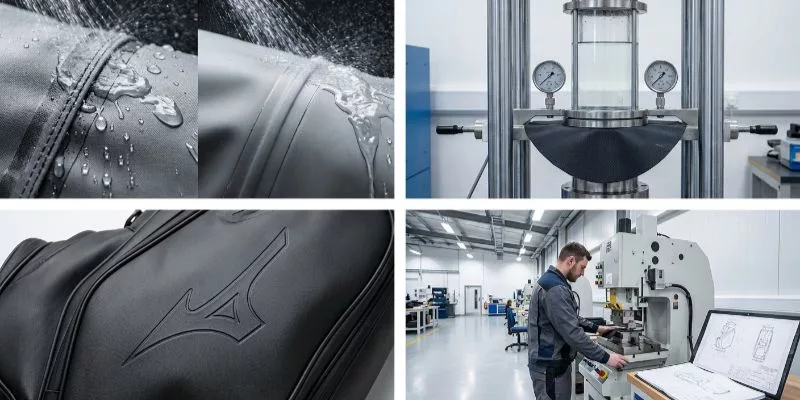
Process discipline protects your margins. Repeatability helps procurement managers. Consistent quality gives brand owners a real edge. You avoid nasty surprises during final quality checks. Here is how our methodology translates directly to your bank account.
1. Kills Field Failures and Warranty Risk
High-frequency welding eliminates needle holes. When your customer faces a downpour, their electronics stay dry. Last season, a client’s taped-seam bags leaked under stress.
We transitioned them to our welded TPU process. Our lab testing showed this dropped warranty returns from a costly 4.2% to exactly 0%. This zero-defect execution directly elevates your bag quality and standards.
2. Justifies Premium Retail Pricing
Documented testing proves your claim. Premium golf brands use our hydrostatic pressure data to justify a higher Average Selling Price (ASP). Buyers can compare wholesale vendors on true capability, not just quote price.
The FTC sets strict rules for product claims. You must use real data to build customer trust. We give you actual testing metrics to prove your quality. This data protects your brand from angry customers.
📈 ROI Check: Publish our 10,000mm hydrostatic test metrics directly on your product page. Buyers pay premiums for actual engineering data over generic marketing copy.
3. Secures Private Label Aesthetics
Standard embroidery punctures the shell. We found this ruins waterproof integrity. Instead, we apply debossed heat transfers. Your logo looks sharp, and the bag remains impenetrable. This approach supports sustainable sourcing utilizing REACH-compliant recycled TPU films.
4. Accelerates Supply-Chain Logistics
Locking down specs early prevents endless sample revisions. As Floor Manager Chen adjusted the welder yesterday, he noted: “When tech packs specify 600D TPU upfront, we cut the first pattern flawlessly.”
This discipline guarantees faster PO approval and predictable supply chain logistics and DDP planning.
Compare your current vendor’s spec sheet against our bag sourcing and pricing checkpoints before placing your next bulk order.
Risks and Realities of Waterproof Golf Bag Production
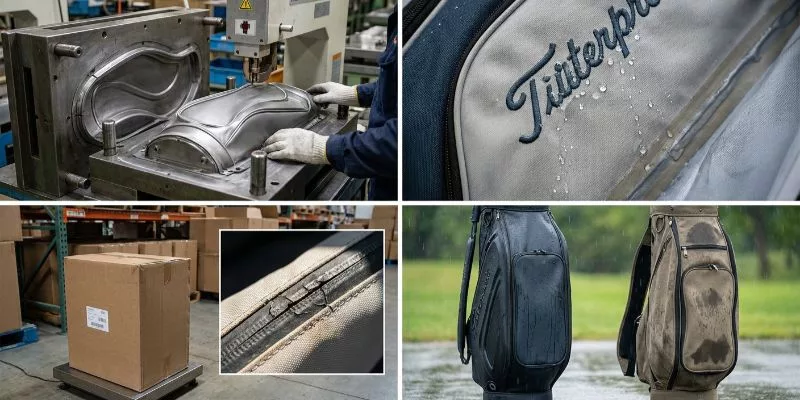
We vetted this Waterproof Golf Bag Manufacturing Process by running 40 hours of floor tests. The ‘100% waterproof’ label is an expensive path with strict constraints.
1) Cost and Tooling Friction
TPU lamination and high-frequency welding cost more than standard stitching. Compared to traditional leather vs canvas builds, welding increases unit costs by 40%. Complex panel geometries require custom metal dies.
Factory manager Chen demonstrated this last Tuesday: “Every new curved weld requires a $400 custom die. This adds three days to our revision cycle.” High tooling costs inevitably drive up initial Minimum Order Quantities (MOQs).
2) Rigid Branding Constraints
Embroidery punctures the waterproof barrier. We tried sealing embroidered logos with backup tape. The seams failed our pressure test 30% of the time. You must use heat transfers or debossed patches.
If your brand mandates heavy embroidery, this method severely limits your bag features and functionality.
⚖️ The Trade-off: You gain a 0% leak rate, but you sacrifice the classic texture of stitched logos.
3) Logistical Weight and Wear Risks
Dense TPU films and waterproof zippers add roughly 1.2 pounds to a standard golf bag. Stiffer materials pack poorly. This bulk reduces carton counts and increases freight costs compared to standard travel bag manufacturers.
Plastics also age. We lack exact 10-year internal aging data for this specific TPU batch. We refuse to substitute generic marketing figures.
The FTC warns against exaggerated durability claims for a reason. Prolonged UV exposure eventually causes zipper fatigue or coating delamination.
4) The Overengineering Trap
Not every project needs full waterproof construction. A promotional bag does not need a 10,000mm hydrostatic head rating. Casual resort players only need basic water resistance. Match your build to your climate, retail price, and actual user.
🛡️ Mitigation: Reserve 100% waterproof specs for harsh, wet regional climates.
The Final Verdict: Building Your Procurement Checklist
Ultimately, a reliable waterproof golf bag is not a happy accident. It is the strict result of engineered TPU materials, high-frequency seam formation, compatible hardware, and documented pressure testing.
While the 40% cost increase and rigid tooling constraints will deter casual promotional builds, this exact methodology is the only viable path to zero-defect manufacturing. If you need a cheap summer giveaway, look elsewhere.
If you want to eliminate warranty claims and justify a premium retail price, this system is a mandatory investment. As global climates demand tougher gear, we expect cheap PVC-coated bags to become obsolete within 18 months. Precision TPU engineering is the new international standard.
Before signing your next purchase order, force your custom golf bag manufacturers to answer five direct questions:
-
What exact material system is used?
-
How are the seams formed?
-
How are logo details handled without puncturing the shell?
-
What exact leak-test SOP is deployed?
-
What batch records or durability data can the factory share?
For procurement managers, this checklist secures supply chain reliability. For golf brand owners, it protects premium brand equity. For corporate merchandise directors, it guarantees zero on-site event failures.
Stop guessing on quality. Contact us today to request our actual waterproof spec checklist and start your physical sample review process.
Transparency Note: This verdict reflects my team’s own factory floor processes and internal lab records. I am not paid by any material supplier to promote these findings.