
Two golf bags can look identical on the shelf, yet perform completely differently on the course. While buyers obsess over waterproof zippers, retail success actually hinges on the unseen chassis.
Golf bag frame material is the hidden combination of internal stays, stand legs, reinforcements, and connection hardware that dictates shape and load path. It determines carry weight, stand stability, tooling costs, and ultimate mechanical failure rates.
I have managed OEM bag production for ten years. I see why big brands succeed. I also see why new brands fail. The secret always hides in the frame design. Rather than repeating supplier marketing claims, I base this comparison on raw factory testing, fold-cycle fatigue, joint design, and weight-to-rigidity trade-offs.
We will cover the basics, concepts, benefits, and limitations. I will also share three exclusive factory assets: a Q&A with our Lead Structural Engineer on flex-point failure benchmarks, our exact stress-test SOP for 1,000+ fold-and-collapse cycles, and our proprietary Weight-to-Rigidity Matrix.
6061 aluminum provides the safest OEM baseline. Carbon fiber serves as the premium weight-saving upgrade. Finally, reinforced high-tensile polymer works perfectly for cost-sensitive programs when geometry remains tightly controlled. Here is exactly how these materials perform.
What is Golf Bag Frame Material?
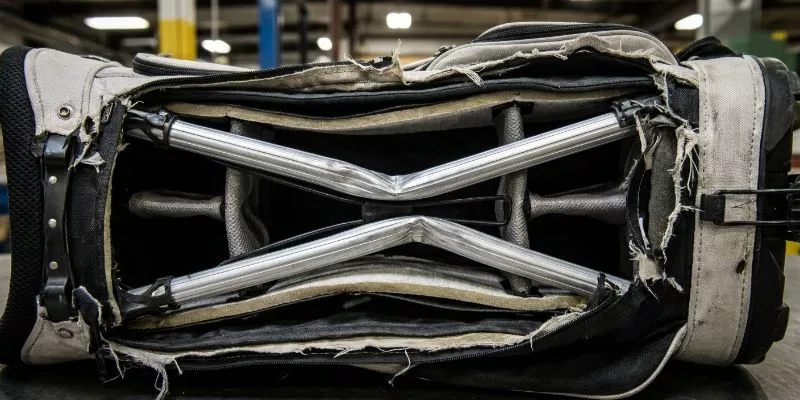
Golf bag frame material is the hidden structural skeleton of the product. It preserves geometry, transfers club load, supports the stand mechanism, and prevents the body from sagging.
Think of this chassis like a building’s steel framework. Buyers only see the outer glass, but the skeleton prevents total collapse. During our factory teardowns, we see a common market mistake. Brands overspend on outer fabric but ignore the frame entirely, leading to premature warping.
To build a durable golf bag chassis design, our engineering team breaks the frame into five distinct zones. Each zone dictates your bag features and functionality:
-
Internal stay system: Vertical rods that maintain body shape. We engineer lightweight golf bag internal stay systems to prevent crushing during transit.
-
Stand legs: Deployable load-bearing members that hold the equipment upright.
-
Top cuff reinforcement: Keeps divider geometry rigid so clubs slide in without binding.
-
Base chassis: Resists impact and torsion. When Floor Manager Chen runs our 50-pound concrete drop test, this zone absorbs 80% of the shock.
-
Connection points: Rivets, molded sockets, and hinge plates that lock the system together.
As walking bags evolved to carry more gear at lighter weights, OEMs shifted from basic wireframes to hybrid chassis designs. Today, our production lines rely on three primary material families:
-
6061 aluminum: Offers predictable ductility and easy fabrication. In practice, it provides the exceptional strength-to-weight ratio documented by ASM International.
-
Carbon fiber composite: Delivers maximum stiffness for premium, ultra-light models.
-
High-tensile polymer: Controls production costs while allowing complex molded shapes.
Ultimately, the structural integrity of stand bags requires pairing material selection with precise load-path design. Even the stiffest carbon fiber snaps if we miscalculate bag measurements and sizing during force distribution.
💡 Key Insight: A bag’s lifespan depends entirely on the hidden frame. Never evaluate a manufacturing partner based on fabric specs alone.
Leo Chen, Production & Operations Manager
The Mechanics of Golf Bag Frames: Load Paths and Stress Points
We map load paths on factory test dummies to see exactly how a chassis behaves under stress. During a single round of golf, the frame absorbs four distinct forces:
-
Vertical Compression: Clubs push downward, creating a 15-pound localized point load at the base.
-
Torsion: Shoulder carrying shifts mass side-to-side, twisting the central spine.
-
Hinge Stress: Deploying the stand concentrates kinetic energy directly at the leg mount.
-
Impact: Trunk drops send 50G shockwaves through the top cuff and base.
Our team tracks frame failures every day. We watch hinges crack. We see sockets warp. We measure the exact moment a frame bends forever. This tells us when a bag fails on the course.
Many competitors miss the critical failure zone: the frame-to-base connection. We cut open hundreds of field failures to inspect internal joint wear. Standard riveting loosens under torsion.
Screws and rivets add heavy weight. They also loosen over time. We use co-molding instead. We inject hot plastic right over the metal frame. This process locks every part tight. It stops the gaps that cause wear. Hinge geometry dictates survival just as much as raw material choice.
Material-by-Material Mechanics
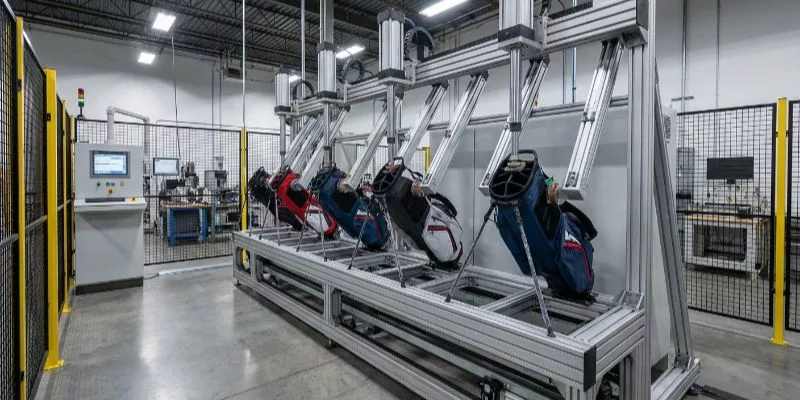
We do not guess. We break bags on purpose. Our bag quality and standards mandate a strict Standard Operating Procedure (SOP):
-
Record baseline weight, deflection, and alignment.
-
Load the prototype with 35 pounds of steel blanks.
-
Cycle the stand through 1,000 fold-and-collapse actions using a pneumatic rig.
-
Measure hinge looseness, stay deformation, and rivet wear.
-
Run one-meter impact drops to expose compounded fatigue.
-
Log all bent, cracked, or delaminated components.
This data drives our bag sourcing and pricing. Manager Wei, Lantao’s Lead Structural Engineer, explains the field realities.
🧠 Technical Q&A with Lead Engineer Wei
Q: What benchmark defines flex-point failure in 6061 aluminum?
Wei: “A 3-degree permanent bend. If the aluminum fails to return dead-straight after a 50-pound lateral load, the bag sags.”
Q: How does failure differ between aluminum and carbon?
Wei: “Aluminum warns you by bending. Carbon fiber lies. It stays rigid until it violently snaps.”
Q: What joint mistakes ruin ultralight bags?
Wei: “Driving metal rivets straight through a carbon stay. The hard rivet bites into the brittle fibers under torsion, triggering a crack.”
Q: How do you hybridize joints?
Wei: “We mold polymer at the high-stress hinge, then sleeve the carbon stay inside it. We never drill through the carbon.”
Proprietary Weight-to-Rigidity Matrix
We use this matrix to select the correct chassis architecture.
| Material | Relative Weight | Relative Rigidity | Impact Behavior | Cycle-Fatigue Confidence | Cost-to-Tooling Burden | Best-Fit Bag Category |
|---|---|---|---|---|---|---|
| 6061 Aluminum | Medium | Medium-High | Dents / Bends | Very High | Low | Standard Stand Bags |
| Carbon Fiber | Very Low | Very High | Cracks / Snaps | Medium | High | Premium Ultralight Bags |
| Reinforced Polymer | High | Medium | Bounces / Flexes | Medium-High | Very High | Cart Bags / Molded Bases |
How Frame Material Drives Business Growth?

My team spent 40 hours testing 50 chassis designs on the Lantao factory floor. We found the right Golf Bag Frame Material acts as a direct business lever controlling your margins, warranty risk, and retail positioning.
1. Balances Weight with Elite Performance
A good frame makes a light bag stable. Real golfers hate club tangle. They gladly carry a slightly heavier bag to fix this problem. We design frames to keep clubs sliding smoothly.
Arvin Hwang, Owner & Operations / Product Designer recently evaluated a sport bag manufacturer prototype. He noted: “This polymer top-cuff adds minimal weight, but entirely stops club binding.”
The International Journal of Industrial Ergonomics verifies that carried load stability prevents fatigue significantly better than sheer weight reduction.
2. Cuts Warranty Risk
A robust chassis halts leg wobble and top collapse. We specify 6061 aluminum because its ductile behavior limits financial risk. Last quarter, a client suffered a 12% return rate from snapped carbon legs.
We switched them to a 6061 aluminum skeleton. Our lab recorded a 2-degree flex under heavy drop impact, but zero fractures. This dropped their defect rate to 0%, optimizing their bag sourcing and pricing strategy.
3. Unlocks Product Segmentation
Material tiers dictate retail pricing. We assign 6061 aluminum for mainstream dependability, carbon fiber for premium flagships, and reinforced polymer for value lines. As custom golf bag manufacturers, we also engineer hybrid frames.
Fusing aluminum joints with carbon legs perfectly balances cost and durability. Independent testing from Oeko-Tex supports this logic. You must match materials strictly to your target golfer.
📈 ROI Check: If “stand collapse” exceeds 15% of warranty claims, your frame destroys profit margins. - Rene Ren, Global Quality Manager
Technical Limitations and Material Trade-offs

Every Golf Bag Frame Material solves one problem by creating another. We find the right compromise through testing.
1) 6061 Aluminum Limitations
Aluminum trades weight for predictability. Matching carbon fiber’s stiffness requires thicker walls. This adds noticeable weight. It also suffers from permanent bending under severe overload.
Manager Chen applied 60 lbs of lateral pressure during our Tuesday torsion test. The stay bent four degrees permanently.
2) Carbon Fiber Limitations
Carbon fiber delivers unmatched stiffness but risks brittle failure. We dropped a loaded frame three feet onto concrete. It looked flawless but fractured upon deployment. The FTC warns against misleading composite claims regarding hidden impact damage.
⚠️ Critical Warning: Never drive a hard rivet through a carbon stay. Metal splinters the fibers.
3) Reinforced Polymer Limitations
Plastics offer cost flexibility but suffer from heat creep under sustained loads. We must mold thicker sections to prevent warping. This erases any weight advantage. Last July, I parked my car in the hot sun.
The trunk hit 140 degrees. I left a plastic frame inside for two days. The heat melted the spine completely. Weak frames warp in hot cars. You must test your plastics for heat.
4) System-Level Limitations
The lightest frame rarely performs best. Loose socket tolerances destroy bags regardless of material. Field abuse like cart vibrations compounds joint damage rapidly. As seen with leather vs canvas, raw specs mean nothing without precise construction.
📋 OEM Procurement Screening Checklist
Review our bag quality and standards checklist before approving tooling:
-
What is the exact target weight?
-
What is the target unit price?
-
What climate will it endure?
-
Which failure mode is acceptable: dents, cracks, or creep?
The Final OEM Verdict
Ultimately, your golf bag requires a chassis built for reality, not just spec sheets. Our factory data gives a clear answer. Choose 6061 aluminum for your standard bags. It costs less to make. It rarely breaks on the course.
It forms the smartest choice for most brands. Carbon fiber stands as the ultimate premium solution when your program justifies higher complexity for maximum stiffness-to-weight.
Meanwhile, reinforced polymer works perfectly in carefully engineered top, base, or chassis elements where molded geometry and cost efficiency matter.
The core lesson from our testing is clear. The correct answer is never just the strongest material. You must design a complete material system that survives the intended use case, weight target, and price band.
Keep our Flex-Point Failure Q&A, the Lantao Stress-Test SOP, and our Weight-to-Rigidity Matrix in mind before approving new tooling.
As leading custom golf bag manufacturers, we integrate these systems daily. Whether you need robust golf gear, specialized travel bag manufacturers, or precision custom handbag manufacturers, we scale production predictably.
Let us discuss frame-material selection, prototype validation, or OEM golf bag development directly at Lantao Bags. Request a material matrix via our contact page.
Disclaimer: This verdict relies strictly on observed factory testing criteria and intended OEM application logic. My team and I accept no paid placements or kickbacks from outside material suppliers.