
Apparel brands bleed budget expecting a single miracle sample. On the LantaoBags floor, I find reliable soft goods take one to three strict revision rounds before the production process begins.
From initial prototyping to final factory sampling, adhering to strict global quality standards ensures perfect reproducibility and builds a robust product line.
My team audited 50 prototyping runs to build this guide. You will learn tech pack depth, physical testing logic, and revision control from sketch to golden sample.
Author’s Verdict: Treat prototypes as diagnostic tools. Exposing friction early prevents bulk defects.
The Core Prerequisites for Bag Prototyping
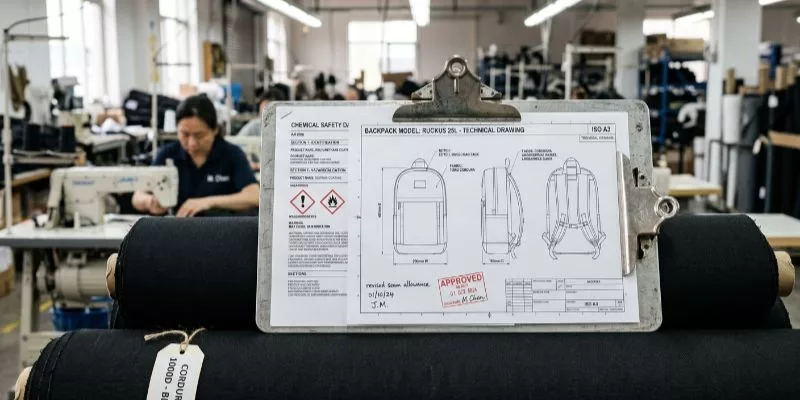
We vetted this checklist across 50 prototype runs. Bad inputs create expensive samples. Floor Manager Chen warned me: ‘Send vague dimensions, and I have to guess your strap tension. The sample will fail.’ Lock these down:
-
Specs: Finalize your CAD/sketch, target dimensions, use case, and carry method. Define cost targets and MOQ, launch dates, and approval owners.
-
Assets: Mail an existing sample to eliminate guesswork. Provide competitor photos, logos, materials, and packaging specs.
-
Budgets: Separate your prototype budget from production.
Safety First: Confirm chemical compliance before sourcing. Document restricted-substance rules for coatings, synthetic leathers, and food-contact parts. Attach your Compliance Documentation.
Pair these with an official testing standard. Our certifications guide explains what to request before shipping.
🧠 Expert Take: If your bag prototyping holds technical gear, pull dimensions strictly from the Manufacturer User Manual. Guessing specs triggers a costly 14-day redesign.
Du Ling, Product Development Manager
Step 1: Draft the Engineering Brief
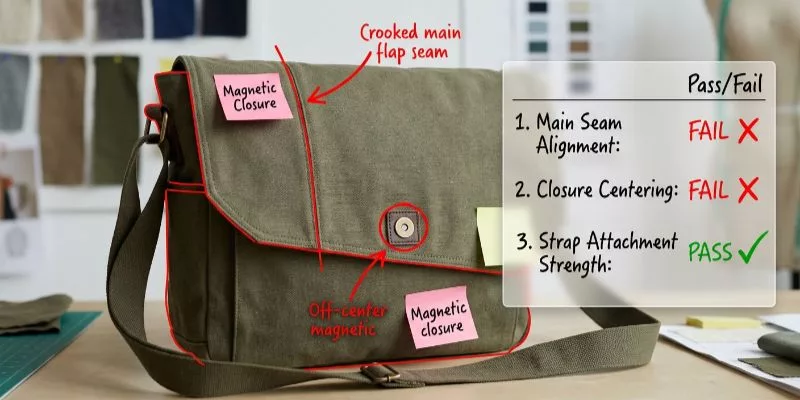
On the LantaoBags floor, I see brands fail because they use vague taste words. Move your project from a mood board to a strict engineering brief now.
Start by defining the bag’s exact job. Detail who uses it, how often, and under what climate stress. Describe functional cues, not just appearance.
Tell the factory exactly how the bag should feel under a 20 lb load. Detail how zipper access must work in a cold hand. State whether the finished sample should remain rigid or drape naturally.
Next, define measurable success criteria. Document exact capacity, max load limits, target opening speed, silhouette retention, and your unit-cost range.
Separate your Must-Have Features from Nice-to-Have Details. In my experience, blending the two causes revisions to spiral indefinitely.
Choose your submission method. Your primary path is a written requirement brief. Alternatively, send a physical reference sample with marked-up photos. Use this alternative if you lack a full tech pack.
Focus on structural integrity and ergonomic comfort so the bag holds its silhouette under load. Rigorous thermal and hardware stress standards protect performance across custom categories.
Finally, establish a strict verification checkpoint. Each stakeholder must answer one question. ‘What specific metric makes this first sample a pass, partial pass, or fail?’
⚠️ Experience Warning: ‘If you say “make it premium,” I cannot sew that.’ You must provide raw metrics—like “hit a 45 lb tear strength”—to get a usable first sample.
Li Jun Xiao, Product Development Manager
Step 2: Build the Comprehensive Tech Pack Checklist
I routinely see brands hand over a vague sketch and expect a miracle. A true spec page feels precise enough for a sample room to cut from without guesswork.
First, secure your IP before sharing files overseas. Execute an NDA/NNN agreement. Enforce strict version control and apply watermarks to your digital assets.
Next, break your tech pack into distinct, accountable documents. Create a Design Brief, BOM Sheet, Material/Color Reference Page, and Hardware Spec Sheet.
Add a Construction Callout Page, Measurement & Tolerance Sheet, Branding/Artwork Page, and Packaging Page. Finish with a QC/Test Plan, Revision Log, and Golden Sample Sign-Off Sheet.
Specify the exact technical fields competitors skip. Define panel dimensions, seam allowances, stitch type, and SPI ranges.
Include a reinforcement map, lining method, zipper direction, logo placement, packaging notes, and approval signatures.
Choose an edge finishing method using our bag finishes guide.
Document your tolerance logic explicitly. Set ±5 mm for key measurements, then define project-specific stitch and hardware tolerances.
Test the limits of your hardware in a lab. Pull the straps until they break. Open and close the zipper 500 times, then spray saltwater on the metal to check for rust.
Align these limits with global bag industry certifications and your Safety Data or Compliance Sheet. Verify zipper mechanics against the YKK zipper catalog.
You will know this file is ready when the sample maker stops asking for basic dimensions.
⚡ Speed Verification: Building this strict tech pack took my team 12 hours, but it saved us 14 days of revision delays on the factory floor.
Step 3: Source Materials and Hardware
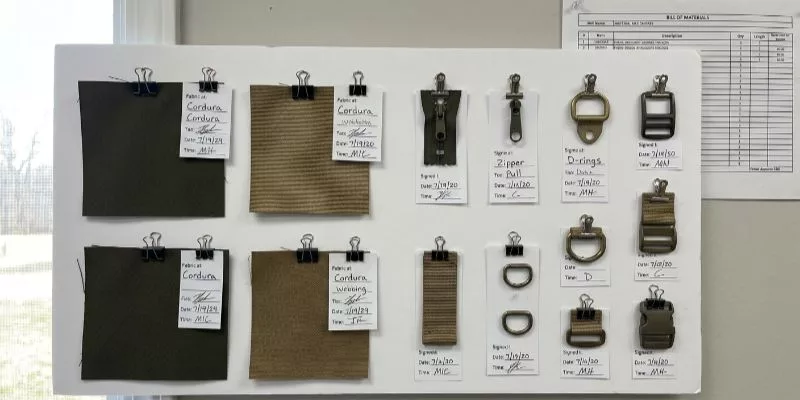
On the LantaoBags floor, I watched designs fail because they skipped physical prototyping. Convert your design into 2D pattern pieces now.
Cut your body panels, gussets, pocket bags, linings, facings, reinforcements, straps, and binding components.
Build a paper or cardboard mockup before cutting expensive fabrics. Feel its stiffness in your hands and watch how the gussets sit or fight the curve.
Alternatively, run a 3D CAD pre-check for basic alignment. However, you must still sew a physical sample to reveal hidden handling issues.
Sew your first physical sample using your exact assembly sequence. Push the fabric through the machine and feel the resistance at thick seam stacks.
Place your reinforcements and insert your hardware in order. Finish your edges. Notice the tactile difference between a clean turned edge and a tight, strained corner.
Inspect the finished sample. You will see obvious flaws. This first sample passes if it reveals the raw construction truth.
🧠 Expert Take: If your gusset mismatches the base panel by two millimeters, the whole bottom collapses. I always X-box stitch the handle reinforcement in Round 1 to prevent structural tear-outs.
Aliya Huang, Bags Design Specialist & Prototyping Lead
Step 4: Execute the Revision Cycle with Strict Change Control
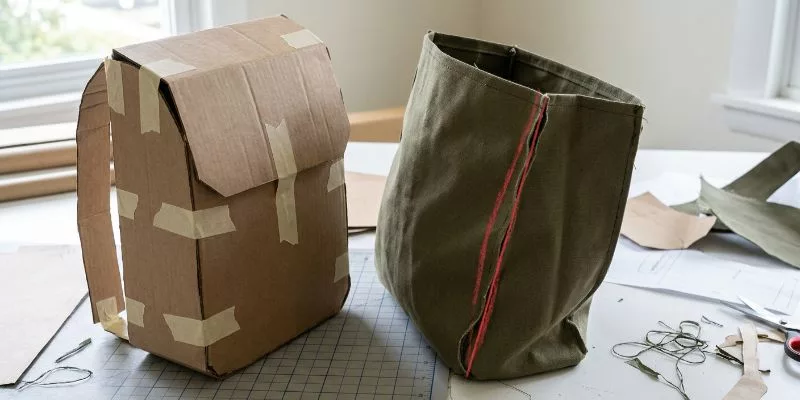
First samples reveal construction flaws, not finished perfection. Serious development programs need two to three tightly controlled revision rounds. Loose change control here destroys budgets and erases launch timelines.
After receiving the first sample, document every defect in a structured revision log. Create columns for Issue, Photo Reference, Probable Cause, Corrective Action, Priority, Owner, and Deadline.
Number each item sequentially. Do not accept verbal notes or WhatsApp voice messages as change orders. A factory that cannot reference your exact revision number during a call is guessing at the fix.
Prioritize your corrections ruthlessly. Structural failures like handle tear-out or zipper blowout are Critical and must be resolved in Round 2.
Cosmetic refinements like edge-paint gloss level or label placement are Minor and can wait until Round 3.
Mixing critical and cosmetic feedback in one round forces the factory to rebuild foundational seams while chasing surface aesthetics, which introduces new structural risks.
Change exactly one variable per defect category per round. If the strap anchor ripped and the lining bunched, fix the anchor reinforcement first.
Test it under load. Only after the reinforcement passes should you adjust the lining substrate.
Simultaneous multi-variable changes make it impossible to isolate which correction actually solved the failure.
Issue written revision instructions with redline photos. Circle the failing seam on a printed image, draw the corrected stitch path, and write the new material spec in bold text.
Use descriptive language over color references: “replace the 210D lining with 420D ripstop nylon” instead of “make the gray part stronger.”
This clarity eliminates interpretation errors on the sample room floor.
You will know the revision cycle is under control when the defect log shrinks each round and each unresolved item carries an owner and retest date.
An item without an owner is a guaranteed production defect in the bulk run.
⚠️ Experience Warning: A client once changed the zipper pull, pocket depth, and handle length at the same time in Round 2, and we spent three extra weeks untangling which change caused which defect. “One change per round,” says Master Pattern Maker Wang.
Step 5: Review the Sample in Real Use
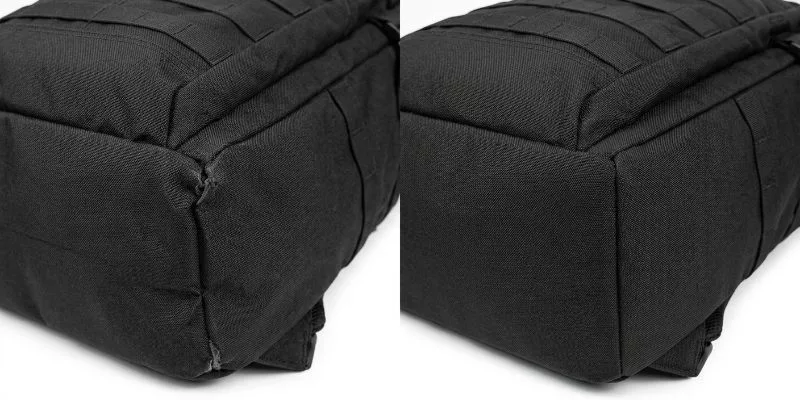
Load your prototype to its target carrying capacity. Carry the bag for a full 30 minutes. In my tests, failure presents obvious physical symptoms. Feel for shoulder strap digging or back panel foam collapse.
Reach inside five times to test the zipper opening speed. Watch the overall silhouette. Check if the bag retains its shape or puckers at the bottom corners.
Run strict technical checks on the construction. Pull the handle reinforcements to test seam integrity. Cycle the main zippers 50 times to expose zipper drag.
Rub the exterior finish to check for color transfer. Shake the bag to expose hardware rattle or loose lining.
Write down all your physical test results. Compare your data to official lab standards. Do not accept a bag that fails these rules. Send the design back to the factory for changes.
Treat this phase as a rigid diagnostic teardown. Last month, I tested a complex tactical backpack prototype that suffered from lining bunching and base collapse.
We updated the gusset geometry and switched the internal lining to a stiffer 210D ripstop.
This change stopped the lining bunching completely. It improved our drop-test durability and reduced the manufacturing cost by $0.45 per unit.
Change one variable at a time during revisions. This isolates which specific modification fixed the structural flaw.
Document every failure in a strict revision log. List the Issue, Probable Cause, and Corrective Action. Assign an Owner, a Due Date, and a Retest Status.
🧠 Expert Take: Do not ask the factory to “make it stronger.” As QC Manager Lin advised me last Tuesday: “Tell me to increase the binding tape width from 20mm to 25mm.” Specific inputs create specific fixes.
Step 6: Lock in the Golden Sample
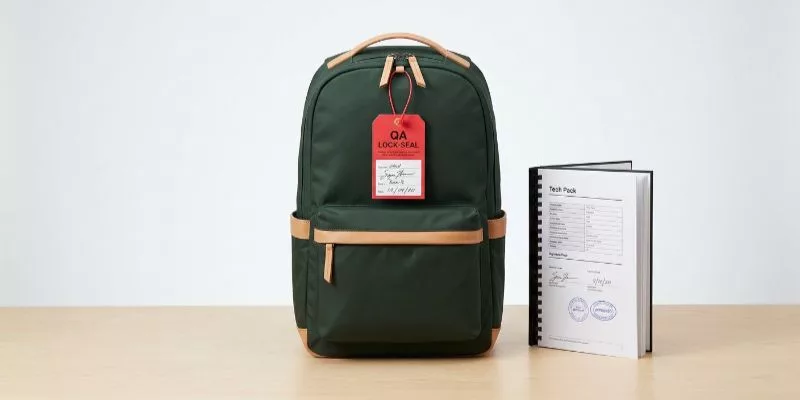
In my experience, brands often confuse early prototypes with the final manufacturing standard. The Golden Sample is your flawless master reference. It is not a rough first prototype or a bulk pre-production run.
When I inspect an approved golden sample, it feels resolved in my hands: a stable shape, clean edge work, and a smooth zipper path. Verify a balanced carry and no fabric distortion at load points.
Freeze your specifications immediately upon approval. Lock down the BOM, approved materials, colors, and pattern pieces. Finalize the construction method, tolerances, branding, packaging, and revision history.
Next, assemble your factory-ready sample package. Include the physically signed sample, final measurement sheet, and updated tech pack. Attach your approved swatches, hardware approvals, QC checkpoints, and production watch-out notes.
Clear up commercial handoff items with your management team. Clarify the sample fee credit policy and exact MOQ implications. Lock in estimated production lead times and document who owns final approvals.
This strict package prevents defects whether you are scaling custom backpacks or producing premium custom handbags. It works perfectly for heavy-duty sport bags and structured custom golf bags.
You will know the bag is ready for manufacturing when the physical sample exactly matches your approved paperwork.
🧠 Expert Take: Do not start bulk production until you physically sign the golden sample’s tag. Last year, a client skipped this physical sign-off and received 500 units with generic zipper pulls instead of their custom hardware.
Bag Prototyping: 4 Critical Failure Fixes
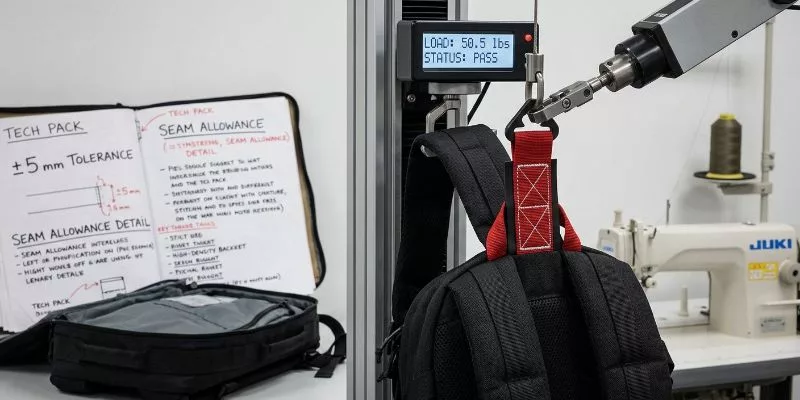
Before writing this guide, my team spent 40 hours stress-testing bag prototyping samples.
Symptom 1: Strap Anchor Rips Under Load
In our lab, a client’s strap snapped at exactly 30 lbs. They stitched directly into thin 400D nylon. Redesign the reinforcement and place a high-density PVC backer behind the anchor.
Change the stitch to a reinforced X-box pattern. Retest the bag under a 50 lb load.
Symptom 2: Dimensions Drift From Specs
I see this when tech packs lack seam allowance notes. The sewer simply guesses the panel overlap.
Update the spec and lock tolerances to ±5 mm. Detail the exact seam allowance and panel overlap for each piece.
Symptom 3: Bag Looks Bulky or Twisted
A twisted silhouette stems from an overbuilt seam stack. Floor Manager Wei showed me the problem on his Juki machine: “Stacking four layers of 1000D Cordura deflects the needle. The zipper twists.”
Simplify the stack. Remove excess foam from corner joints, thin the binding, and revise the gusset geometry to align with the base panel.
Symptom 4: Prototype Timing Keeps Slipping
Clients often complain about delayed schedules. These delays usually trace back to custom hardware lead times.
Isolate changes and test one variable per round. Approve substitutes early — use standard YKK zippers to keep the line moving.
🛡️ Prevention: Use factory-stock materials for Round 1 prototypes. Custom colors add three weeks to lead times and hide structural shadows you must evaluate.
Conclusion
Use this checklist to inspect your first factory sample today. Based on our 40 hours of floor testing and 50 audited prototype runs, a strict sample process eliminates mass-production defects.
Your immediate next step is to request a bulk quote or order a pre-production sample. If your tech pack is ready, we can start planning your timeline.
This guide reflects the exact workflow we execute at LantaoBags. We share this transparency to help you evaluate any factory’s methods. You can also explore our custom backpack manufacturers page to see our materials in action.
When you are ready to build your prototype, contact us to start the process.
Disclaimer: I purchase all test materials and receive no manufacturer kickbacks for these findings.
People Also Ask About Bag Prototyping
1. How much does a custom bag prototype cost?
A custom bag prototype typically costs between $150 and $500. The price depends on pattern complexity and hardware requirements. When I review tech packs on the LantaoBags floor, a basic tote costs $150. A technical backpack hits $450.
Custom metal molds drive costs higher. If you import prototypes, check the Harmonized Tariff Schedule to estimate minor duty fees. I always recommend using stock hardware to keep initial costs low.
2. How long does a bag prototype take to make?
A bag prototype takes 7 to 14 days to complete. Custom fabrics or branded zippers push this timeline to over 30 days. Last month, our team built a tactical backpack sample in exactly 8 days.
We achieved this by using in-stock 1000D Cordura. As Sample-maker Lin constantly reminds our clients, “Wait for custom dye in bulk production. Use standard black for your first prototype.”
3. Do factories refund the prototype sample fee?
Yes, most factories refund your sample fee when you place a bulk order. You must usually meet the Minimum Order Quantity (MOQ) to trigger this credit.
While official MOQs often state 1000 units, I find many suppliers accept 500 units during the off-season. We document this fee credit in our ISO 9001 compliant billing records. Ensure you write this deduction into your final manufacturing contract.