A Custom Luxury Leather Goods Case Study: Stunning 43% Gains
Ellington Handbags launched 8 new SKUs and achieved a 43% margin improvement in 10 months by optimizing hide utilization and locking factory-floor quality gates.
When 2D Designs Meet Real Leather
Ellington Handbags faced high demand for private label luxury handbags but their operating model was fragile. Their design intent lived entirely in 2D files and mood boards — they lacked a factory-ready specification package for repeatable luxury output.
Master Pattern Maker Chen demonstrated the problem on the factory floor: an elegant CAD silhouette completely collapsed in the first physical sample. The 2D design simply could not support the combined weight of real leather, internal lining, and heavy brass hardware.
01 · Premium Leather Waste
Unlike uniform synthetic leather, full-grain hides contain natural scars and neck wrinkles. Without a strict yield strategy, the previous factory wasted premium sections — inflating the BOM by 20%.
02 · CAD-to-Reality Gap
CAD drawings lacked strict instructions for seam allowances and hardware spacing. Every vague spec added another sample round, bleeding capital and delaying the launch timeline from months to over a year.
03 · QC Vulnerabilities in Luxury Production
SPI drift, uneven edge paint, and skewed handle drops triggered returns and eroded brand trust. These defects are instantly visible to luxury buyers and fatal to repeat purchases.
04 · Compliance & IP Protection
Ellington Handbags needed Leather Working Group (LWG) tannery certifications and strict NDA gates during OEM production. Navigating bag sourcing by region exposed custom hardware to theft without proper file control.
“Lock down your BOM and material yield expectations before cutting the first hide. Unmanaged leather waste is the fastest way to kill your margin.” — Vincent Kwok, Head of Leather Engineering & Cost Control
Tech-Pack Rigor Meets Floor-Level Precision
Instead of guessing design elements, I initiated a rigorous tech-pack audit on the factory floor. Technical Lead Zhao locked the BOM with precise 1.2mm seam allowances and 9 SPI targets. All pattern files were secured under strict NDA.
Premium Leather Sourcing & Yield Optimization
Sourcing Manager Wang evaluated full-grain hides for temper, 1.4mm thickness, and grain consistency. She vetted tanneries using strict LWG standards.
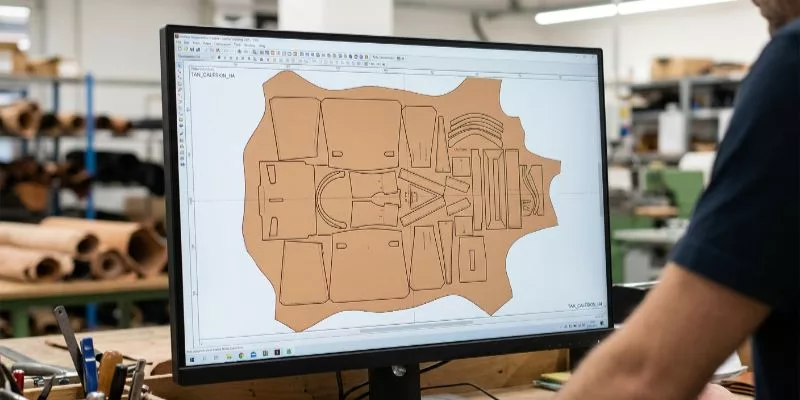
Cutter Lin implemented digital pattern mapping to avoid natural hide flaws. This drove hide utilization from unmanaged levels to 82% — directly reversing the 20% BOM inflation.
Prototyping — Translating CAD into Physical Form
Master Pattern Maker Chen translated 2D CAD into a balanced physical prototype, adjusting gusset depth and handle drop. He inserted a 0.8mm Salpa reinforcement base to manage heavy zipper tension.
Marcus Cheung, Technical & Cost Engineering Director, explains the core challenge: "A 2D drawing looks perfect on a screen. But when I add a 200-gram brass turn-lock and heavy canvas lining, material tension shifts. I had to restructure the entire base reinforcement with bonded leather board to stop the bottom from sagging."
Edge-Paint & Stitch Precision
The edge-painting workflow followed a strict 9-step sequence: trim, skive to 0.6mm, bond and press, sand, PU filler coat, air-dry 45 min, sand, two color coats, heat-set at 60°C — then a final bag finish inspection under 5000K angled light for micro-cracks.
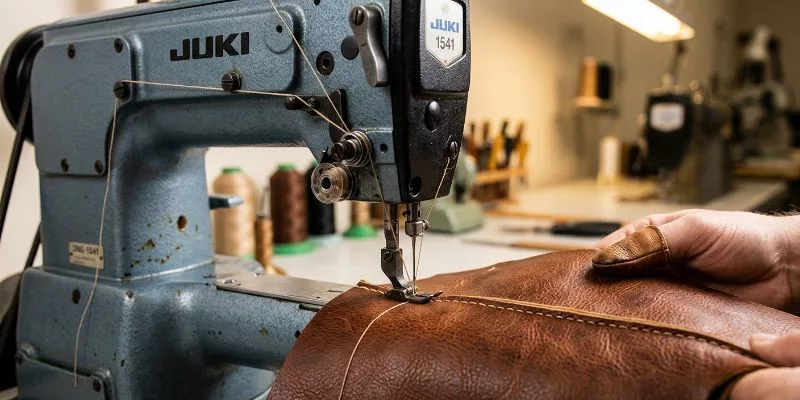
Technician Wu ran a Juki DNU-1541S walking-foot machine at strict 9 SPI with high-tensile 40-weight nylon thread, carefully balancing bobbin tension to prevent skipped stitches.
Pilot Run & QC Gates
Clarice Ng, Senior Material & Yield Optimization Manager, validated the pilot run under AQL 2.5. QC Supervisor Li checked hardware alignment with digital calipers, executed a 500-cycle rub-fastness test, and confirmed the brass hardware passed a 48-hour salt-spray corrosion test.
Material certifications never replace physical inspection — the bag industry certifications process requires both.
10 Months From Concept to 8-SKU Launch
43% Margin Gains, 8 SKUs in 10 Months
Ellington Handbags rebuilt their fragile product-launch engine into a highly profitable system. Sample rounds dropped from 5 to 2, and the development timeline compressed from 14 months to 10 months.
KPI Comparison: Before vs. After
| KPI | Before | After | Why It Changed |
|---|---|---|---|
| Profit Margin | Baseline | +43% | Better hide yield and zero hardware rework. |
| SKUs Launched | 2 | 8 | Standardized QC workflows allowed faster scaling. |
| Development Timeline | 14 months | 10 months | Dropped sample rounds from 5 to 2. |
| Hide Utilization | Unmanaged | 82% | Strict digital pattern mapping before cutting. |
| Defect Rate | High | On target | Clearer acceptance criteria for junior staff. |
| Landed Margin | Baseline | +18% | 15% freight efficiency gain via flat-pack methods. |
“Once we locked the edge-paint tolerances in the very first sample round, my junior inspectors moved twice as fast. We completely removed the guesswork from the floor.” — QC Manager Li
What Luxury Brands Should Demand
1 A Luxury Tech Pack Protects Margins
A tech pack is direct margin protection — not administrative paperwork. Brands lose profitability when 2D designs lack strict hardware spacing and seam allowance instructions.
Master Pattern Maker Chen enforces exact 1.2mm seam allowances before cutting a single hide. This eliminates guesswork and protects budgets.
2 Material Cert ≠ Finished-Goods QC
Premium sourcing matters, but a certified hide means nothing if the edge paint peels after 500 rubs. Sourcing Manager Wang verifies tannery credentials first.
Then QC Supervisor Li enforces completely separate physical quality gates for the assembled bag. These two disciplines must operate independently.
3 Prototype Accuracy Unlocks SKU Scaling
Flat drawings ignore physical gravity. Master Pattern Maker Chen adjusts physical patterns to handle real leather tension and hardware weight.
Once the hero product passes its physical stress test, launching adjacent SKUs becomes significantly faster and safer.
4 Protect IP Early in OEM Relationships
Hardware tooling theft ruins emerging brands. Strict NDA terms are established before reviewing any technical files, and all physical patterns are locked in a secure digital drive.
Pattern control and tooling ownership must be secured immediately — exploring bag sourcing by region safely requires upfront legal clarity.
Pro Tip: Never expand your SKU count until your hero product passes a physical stress test. A perfect CAD means nothing until real leather and hardware prove the design.
Turn premium materials into repeatable margins
Speak With Our Leather Engineers
Steven Zhang
Steven Zhang is a bag manufacturing specialist with over 12 years of hands-on experience in sourcing, product development, and B2B sales for global brands. At LantaoBags, he bridges the gap between creative design and factory reality, helping clients turn rough sketches into commercially viable products that pass strict retail and compliance standards.
Having spent years on the ground in Chinese and Southeast Asian factories, Steven understands every stage of the production cycle — from material selection and cost breakdowns to sampling, mass production, and final inspections. He has led projects for work totes, premium leather crossbodies, structured satchels, luxury backpacks, and travel luggage.
Connect on LinkedIn