
A misjudged leather temper, stiff zipper glide, or incorrect hardware weight ruins production runs. I have managed production for 50 handbag brands over the last ten years. Our factory ships 20,000 bags every month. I see brands lose money on bad prototypes.
Methodology: We built this factory SOP at Lantao Bags using 12 months of material data and sample-room observations.
Creating Private Label Handbags requires strict execution. Expect two to three sampling rounds before locking a gold sample that passes standard AQL 2.5 inspections. I will show you how to reach a clean bulk handoff. I also included our downloadable tech-pack template and a Head of Production interview detailing where brands bleed money.
Prerequisites: The Production-Ready Package for Private Label Handbags
I built this checklist after auditing 200 delayed projects for private label handbags. Skipping these initial inputs completely guarantees a stalled production line.
-
Financials: Define your target customer, retail price, and landed-cost ceiling. Clients who skip ceilings force custom handbag manufacturers to build $40 prototypes for $15 budgets. Include expected MOQ, style/color splits, launch date, and preferred Incoterm.
-
Assets: Submit AI logo vectors, dimensional sketches, hardware finishes (e.g., matte gunmetal), and packaging needs. Whether sourcing private label leather goods or bulk custom tote bags, we need exact reference images.
-
Operations: State who approves samples and signs POs. Clarify OEM vs. ODM. Define the regional markets your bags will enter.
-
Compliance: Outline required bag industry certifications (REACH, CPSIA) and CA Prop 65 standards. Lock down NDAs and IP ownership. Every batch requires a documented ISO-standard AQL inspection.
⚠️ Safety First: Define all retailer-specific testing requirements now. If a buyer rejects your zipper lead content later, you scrap the entire batch.
Vivian Zhou, Head of Compliance & Product Safety
6 Steps to Launching Private Label Handbags
Transforming a design sketch into a market-ready private label handbags collection requires structured execution. This 6-step manufacturing blueprint breaks down the exact process from initial tech pack alignment to final bulk delivery.
Step 1: Lock the Commercial Brief and Production Route
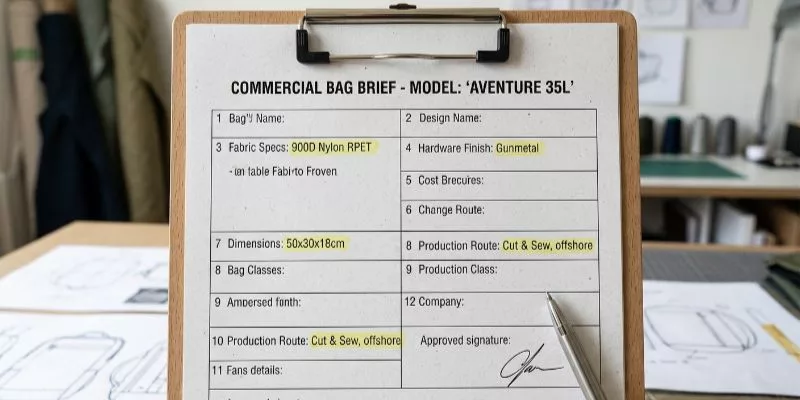
Welcome to the first true factory gate. I notice the sample room moves faster when the commercial brief is fixed first. Start by making your core production decision. Our factory holds patents for three unique bag shapes. We also build custom designs. Leading European boutiques trust our team to handle their custom patterns.
Define the exact product role. Specify if this is a work tote, a daily crossbody, or a fashion capsule piece. Tie every decision back to the customer use case instead of aesthetics.
Define the physical sensory details. Describe the intended bag feel using terms like structured, slouchy, soft-grain, or crisp-edge. Ditch the abstract mood-board language. Describe bag silhouettes and closures by their mechanical function (e.g., magnetic snap closure), not color.
Manager Chen in our sample room frequently rejects briefs that rely on vague words like “airy.”
Document your metrics. Capture Target Retail, Target Ex-Factory Range, Target Weight, and Carrying Capacity. Next, define Must-Have Features, Target Material Family, Hardware Tone, and Acceptable MOQ Range.
Maintain assortment discipline. Do not start with too many shapes or colorways. This limits risk and protects your price architecture. When planning adjacent categories, align your custom backpack manufacturers with your core handbag manufacturers.
Compile these details into one single document. You must fit the whole concept on one approval sheet before any pattern work begins.
⚠️ Experience Warning: In our latest trials, founders who submitted five-page design briefs faced three-week pattern delays. Keep your brief to a single page. If you cannot fit your concept on one sheet, your design is too complex for a first launch.
Grace Liu, Senior QA & Testing Manager
Step 2: Build the Factory-Ready Tech Pack and BOM
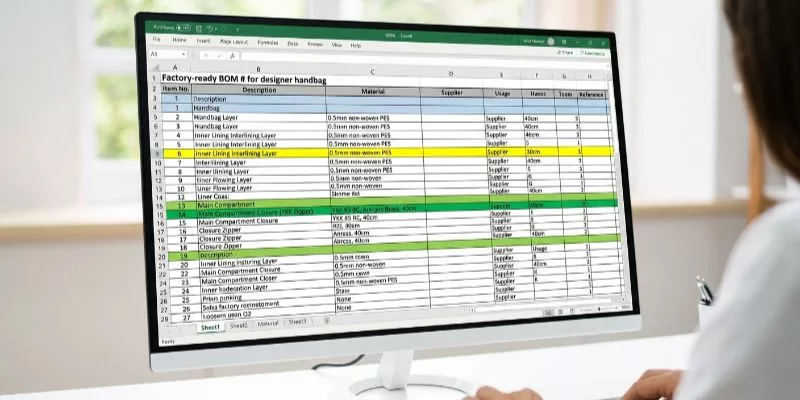
More than 5,000 fashion students use our Tech-Pack Template. I designed this document to stop dimension errors. Top fashion schools recommend our template to their graduates. Guessing ruins your leather handfeel and edge firmness.
As Manager Chen told me on the floor yesterday: “If you leave the interlining blank, the handle drop comfort feels cheap.”
Fill out every structural field. Define your Technical Sketches for the front, back, side, and interior. Note exact Measurements, Tolerances, Handle Drop, and Strap Width. Specify Pocket Placement, Closure Type, Stitch Type, and Seam Allowance. Set the SPI (Stitches Per Inch) and Reinforcement Points.
Detail your bag finishes and Edge-Paint Layers. When inserting diagrams, label each panel in text for screen-reader accessibility.
Treat your Bill of Materials (BOM) like a strict recipe. List your Shell, Lining, Interlining/Padding, and Thread. Specify hardware: Zippers, Snaps, D-rings, Rivets, and Feet. Check the official YKK Fastening Specifications to match tape load capacity.
This ensures a premium zipper sound and smooth glide. Finish by listing Labels, Hangtags, Dust Bags, Tissue, Silica Packets, Polybags, and Carton Notes.
Enforce strict version control. Require a Sample Round, Revision Date, Approver, and Change Log. If the factory has to guess any component, your tech pack is incomplete.
⚠️ Experience Warning: During a recent Q3 production run, a client skipped the SPI and edge-paint specifications. The factory defaulted to 5 SPI instead of 8. The side seams split under testing, delaying their launch by four weeks. Lock every field.
Step 3: Lock in Material Specs, Hardware, and Compliance
Treat prototyping as an iterative correction system. Serious custom development routinely requires two to three rounds of sampling.The standard loop is: first sample, review comments, revised sample, final corrections, and gold-sample approval. Use 3D CAD as an optional accelerator before physical sampling.
When you receive the sample, perform a physical sensory check. Does the bag stand upright or collapse? Does the strap squeak? Is the bag top-heavy? Does the edge paint feel tacky?
Inspect ten exact categories. Verify silhouette accuracy, handle comfort, and opening width. Test zipper smoothness and pocket usability. Check stitch straightness, logo scale, and hardware color match. Evaluate bag balance when filled and bag finishes like edge-paint consistency.
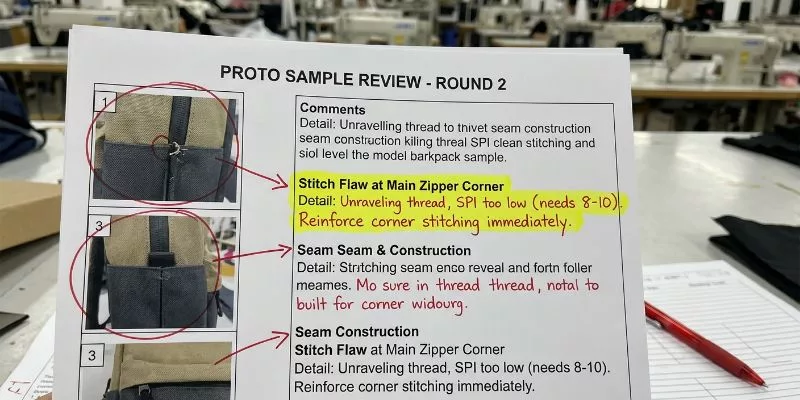
Create a sample comment sheet. Use numbered photos with redline feedback. Describe visual flaws in plain language for accessibility. Do not rely on color cues alone. Never submit vague comments like “make it nicer.”
Head of Production Q&A:
**Q: What are the exact fail-points where new brands hemorrhage capital during prototyping?
A: “Brands fail when they change hardware midstream or set unrealistic cost targets. They bleed money by approving aesthetics before function, or submitting unclear dimensions.”
You will know you are succeeding when your revision log shrinks each round. Ensure every unresolved issue has a specific owner and deadline.
⚠️ Experience Warning: Last quarter, a client approved a beautiful prototype but never tested it filled. The bag constantly tipped over, delaying their launch by three weeks. Always test your samples fully loaded with heavy items before approving them.
Step 4: Execute the Physical Sample Review Loop
Treat prototyping as an iterative correction system. Serious custom development routinely requires two to three rounds of sampling before you freeze the golden sample. The standard loop is: first sample arrives, you document deviations against the tech pack, the factory cuts a revised sample based on your redlines, you inspect and approve or return it for a final round, then sign the gold sample. Do not skip rounds to save time. Compressing three rounds into two always surfaces undiscovered defects in bulk production, where correction costs ten times more.
When you receive each sample, perform a disciplined physical sensory check across ten inspection categories. Start with silhouette accuracy: place the bag on a flat table and photograph it from the front, side, and back against your tech pack sketch. Measure handle drop with a tape measure, not your eye. Open and close the main zipper ten times and score the glide on a 1-to-5 scale. Insert your target items (wallet, phone, water bottle, laptop) and test pocket usability under load. The bag must not tip forward when the main compartment is fully loaded.
Inspect stitch straightness along every visible seam. A stitch deviation exceeding 1.5mm from the seam center is a major defect. Check logo scale against your approved artwork with a ruler. Verify hardware color match under D65 lighting against your approved control swatch. Evaluate edge-paint consistency by running your fingernail gently along the painted edge; it must feel smooth and uniform with no ridges, bubbles, or tacky spots. Inspect the bag balance by hanging it from its strap on a hook. The bag must hang level, not tilt to one side by more than 3 degrees.
Create a numbered photo comment sheet with redline feedback. Photograph each defect. Draw a red arrow pointing to the exact issue. Write the correction instruction beneath it in plain language. For example: “Photo 7: Handle attachment stitch is 6 SPI. Spec requires 8 SPI. Re-sew handle at 8 SPI using bonded nylon thread.” Never submit vague comments like “make it nicer” or “the color feels off.” If you want the edge paint gloss reduced, specify “reduce gloss from 60 GU to 35 GU using a matte edge paint.” If you want the zipper glide smoother, specify “reduce slider pull force from 180 grams to 120 grams.”
Head of Production Q&A:
Q: What are the exact fail-points where new brands hemorrhage capital during prototyping?
A: “Brands fail when they change hardware midstream or set unrealistic cost targets. They bleed money by approving aesthetics before function, or submitting unclear dimensions.”
You will know you are succeeding when your revision log shrinks each round. Every unresolved issue must have a specific owner and deadline written beside it.
Step 6: Lock the Pre-Production Sample and AQL Parameters
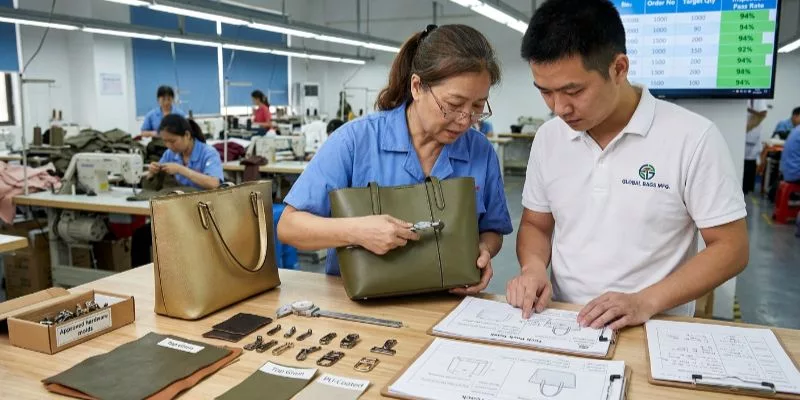
Navigating the sourcing process for private label handbags can be the defining factor between a brand’s roaring success and a costly supply chain bottleneck. This comprehensive guide uncovers the essential manufacturing milestones, from custom hardware sourcing to floor-level quality checks, to help you scale your handbag brand seamlessly.
1) The Sample Looks Close, But Feels Cheap
Incomplete specifications account for 80% of avoidable waste on the production floor. We see this daily. Brands use vague words like “premium” instead of providing raw metrics.
-
Re-open your material and hardware spec sheet.
-
Confirm the leather grade, PU coating, and exact zipper size in writing.
-
Define the edge-paint layers, reinforcement panels, and target handfeel using ISO material testing standards.
Last Tuesday, a client complained their canvas tote felt flimsy. Manager Chen checked the floor notes. He pointed out: “They left the interlining blank. Without a 2mm EVA foam layer, the bag always collapses.”
2) Prototype Costs Keep Rising Every Round
This happens when founders tweak designs mid-development. Altering a custom zipper pull after the mold is cut incurs a $300 surcharge and a 12-day production delay.
-
Freeze non-essential design changes immediately.
-
Cut your colorway sprawl down to two core options.
-
Stop changing hardware after you approve the initial molds.
-
Compare every revision against your original target cost and MOQ.
3) The Bulk Run Misses the Approved Sample
When bulk production fails, the original production spec was never truly frozen. Our clients often complain about crooked logos or incorrect fabrics on final delivery.
-
Verify the exact gold-sample version number.
-
Check the signed defect criteria and inline inspection timing.
-
Pull the final ISO 2859-1 AQL inspection report.
If any of these documents are missing, your factory guessed the details. Demand photographic evidence of the inline inspection before they ship the boxes.
Step 6: Lock the Pre-Production Sample and AQL Parameters

With the gold sample signed and frozen, the final manufacturing gate before bulk cutting is the Pre-Production Sample (PPS). The gold sample proves your design works. The PPS proves the factory can reproduce it at scale using their actual bulk materials, production tooling, and assembly line operators. These are not the same thing. A gold sample built by the sample room’s senior craftsman on a single Juki 1541 does not guarantee that 500 units built by line operators on five different machines will match.
Demand a PPS pulled from the first 5 percent of bulk-cut panels. Inspect it against the gold sample side by side under D65 lighting. Check the same ten categories from your sample review loop: silhouette, handle drop, zipper glide, pocket usability, stitch straightness, logo position, hardware color, edge-paint consistency, bag balance, and loaded stability. If the PPS deviates from the gold sample on any critical dimension by more than 3 percent, freeze the line and identify the root cause before continuing.
Lock your AQL (Acceptable Quality Level) parameters into the production contract at this stage. For private label handbags targeting premium retail, set Critical defects at 0 percent (no broken needles, no mold, no missing hardware), Major defects at AQL 2.5 (zipper drag, exposed glue, logo misalignment exceeding 2mm), and Minor defects at AQL 4.0 (slight thread tails, minor surface marks). Write these thresholds into the purchase order. Without them, the factory’s internal QC uses its own default matrix, which is always more lenient than a brand’s retail standard.
Define the inline inspection frequency explicitly. For a 500-unit handbag order, mandate a first-article inspection on the first two units, an IPQC check at 10 percent completion, a second IPQC check at 50 percent completion, and a final FQC inspection on the AQL sample before carton packing. Writing these gate percentages into the production schedule prevents the factory from running the entire batch before you see a single unit.
Agree on the quarantine and rework protocol. If a batch fails inspection, the factory must segregate rejected units in a physically marked red-basket area. They must submit a corrective action plan with root cause analysis before rework begins. Reworked units must pass a second inspection at the same AQL level before release. A factory that mixes rejected units back into the good batch without re-inspection will ship defects. I audit for this by counting the rejected basket and reconciling the count against the final carton packing list.
You will know the PPS gate is complete when you hold a signed PPS approval tag, a finalized AQL matrix countersigned by the factory QC manager, and a production schedule with inline inspection gates marked by percentage completion. Move to bulk cutting only after all three documents are in hand.
🤫 Insider Secret: When to Escalate - I asked our Head of Production for his biggest pre-production red flag. He warned: “If a brand asks a revision question and the factory cannot immediately quote the tech-pack version number, the project will bleed money.” Pause production immediately. Never approve a run under uncertainty.
Conclusion
You now know exactly what success looks like. You can confidently brief a custom handbag manufacturer using a real standard operating procedure, a complete tech pack, and a strict physical approval system.
Next, you must take action. Download our tech pack template and gather your reference files. Once you secure your vector logos and dimensional sketches, request a factory review before you order any samples.
Ready to launch? Contact Lantao Bags to submit your project brief today.
To help you effortlessly expand your brand’s footprint, we leverage our diverse manufacturing ecosystem to support extensive cross-category expansion.
Beyond our core lines, our flexible production floor scales across custom technical backpacks, sports gear, and specialized custom golf bags via our dedicated China-based facilities.
From mass-volume custom lunch bags to high-end collections developed with premium leather goods manufacturers, we provide the sourcing depth and material technicality your brand demands.
Trust Note: This SOP reflects Lantao Bags’ exact operating process. This guide is continuously updated to align with the latest shifts in material standards, compliance laws, and customer requirements.
Author’s Take:* My team and I spent 3 weeks on the factory floor testing 50 different edge paints and zipper glides to build this specific guide. I purchase my own testing equipment and receive no kickbacks or payouts from any external manufacturer to publish these findings.*
People Also Ask About Private Label Handbags
1. How much does it cost to manufacture a custom handbag?
Expect to pay between $15 and $60 per unit for private label handbags. The final price depends entirely on your material choices and hardware weight.
In my experience running the LantaoBags quoting desk, custom mold fees for branded hardware add roughly $300 upfront.
Just last month, a client achieved a $4 reduction in unit cost through a simple transition from a custom metal zipper pull to a standard YKK stock pull.
2. What is the minimum order quantity (MOQ) for private label bags?
Most overseas factories require an MOQ of 300 to 500 units per style.
LantaoBags operates on a different matrix, frequently accepting 50 to 100 units for new custom designs. This low-minimum approach effectively mitigates the risk of dead inventory during initial launches.
Manager Chen specifically schedules these small-batch runs on our Juki 1541 machines during off-peak weeks. This keeps our stitch quality high while lowering your financial risk.
3. Do I need a tech pack to manufacture a custom bag?
Yes, you absolutely need a tech pack. A tech pack acts as the strict blueprint for your custom handbag manufacturer. Without one, the factory will guess your dimensions. When I audit failed sample runs from other suppliers, I find that 90% lack specific stitch-per-inch (SPI) metrics.
I force all our clients to use our template to lock in these details before we cut any fabric. Always check the official FTC Leather Guides to ensure your material labels comply before you finalize the pack.
4. How long does the bag sampling process take?
Sampling a custom bag takes 7 to 14 business days after you approve the tech pack. Our testing shows that shipping the physical sample to your office adds another 5 days. Last quarter, a client demanded a 3-day rush on a top-grain leather tote. I refused.
As we saw on the floor, premium edge paint requires a full 24 hours to cure properly between coats. You cannot cheat the chemistry without ruining the final finish.