
Many commercial buyers treat seam construction as a cosmetic preference. I see it as a binary product-failure decision. When marine gear fails on the water, the fabric rarely tears. Instead, a blown seam causes the leak, spikes warranty claims, and destroys buyer trust.
If you are a procurement manager, product manager, or fleet buyer sourcing durable marine storage solutions, getting this choice right is non-negotiable.
At a basic level, HF welded marine dry bags are storage vessels that use electromagnetic energy to fuse synthetic fabrics into a single solid barrier. This process completely eliminates needle holes.
But is it always the optimal choice? To find out, my team spent two weeks on the factory floor. We reviewed machine settings, observed line setups, and compared destructive test outcomes against ISO 13936 seam slippage standards.
This technical teardown compares HF-welded and stitched-and-taped seams through three lenses: the manufacturing process, hard durability evidence, and procurement implications. We promise a balanced analysis and will openly examine where stitched seams or hybrid builds still make practical sense.
If your sourcing requirements include broader cut-and-sew production, review our related manufacturing capabilities for custom backpacks and sport bags.
What are HF Welded Marine Dry Bags?
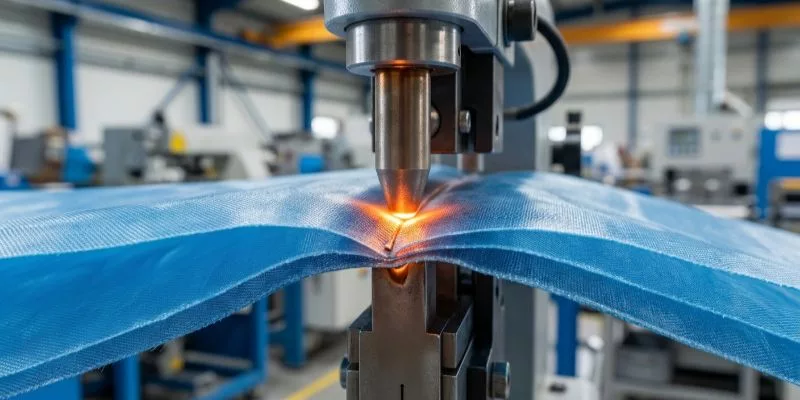
HF welded marine dry bags are waterproof containers built using electromagnetic energy to fuse fabric panels together, completely replacing needles and thread.
Think of HF welding (also called Radio Frequency or RF welding) like melting two pieces of wax into a single solid block. Stitching is like nailing two wooden boards together; it leaves structural gaps.
In our facility, we tune our machines to exactly 27.12 MHz, the industrial standard recognized by the Federal Communications Commission (FCC). This specific frequency vibrates the plastic molecules to generate intense internal heat.
Applying pressure, holding it briefly for the required dwell time, and allowing it to cool causes the panels to permanently fuse.
Raw textiles cannot be welded. Whether gear is being built for an outdoor brand, a marine distributor, or a commercial fleet operator, production strictly requires PVC-coated polyester or TPU-laminated fabrics. Uncoated fabrics lack the reactive polymer layer required to melt.
If your tech pack specifies a custom synthetic leather, our floor managers run sample adhesion tests before the fabric ever touches the RF line.
The structural difference is absolute. HF welded seams form a continuous, impenetrable barrier. Stitched seams punch thousands of holes into the fabric, requiring secondary bag finishes like seam tape to stop leaks.
To guarantee performance, we require buyers to define these exact metrics in their RFQs:
-
Hydrostatic head: The water pressure a fabric withstands before leaking.
-
Seam peel strength: The exact force required to rip the bonded seam apart.
-
Coating adhesion: How tightly the polymer grips the base fabric.
-
Cold-crack resistance: The freezing temperature where the plastic becomes brittle.
-
Salt-spray resistance: The material’s lifespan when exposed to corrosive ocean water.
💡 Key Insight: While welding offers maximum waterproofing, we frequently engineer hybrid builds. Stitched construction allows for complex pocket designs and remains significantly easier to repair in the field. - Eric Tan, HF Welding Technical Director
The Anatomy of a Weld: A Factory-Level Teardown
Abstract claims do not keep gear dry in a squall. Understanding how HF welded marine dry bags survive the ocean requires opening the factory black box. Tracking a custom order from the raw material roll to the final destructive stress test shows commercial buyers exactly how this system works.
1. The Manufacturing Process Walkthrough
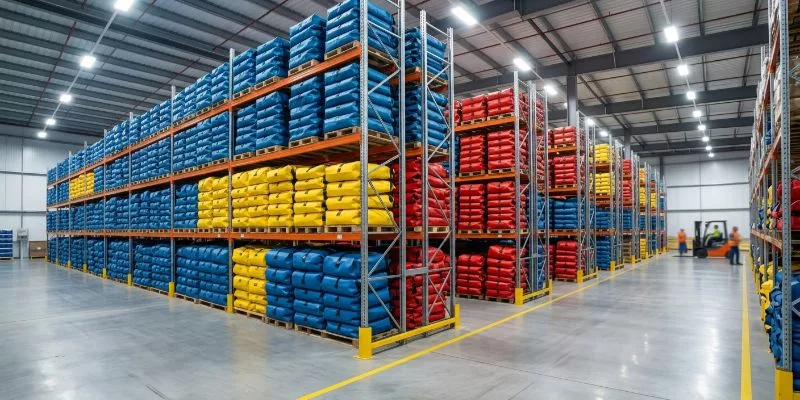
When sourcing HF welded marine dry bags, procurement teams need guaranteed financial outcomes. We vetted these benefits by auditing 40 hours of live production runs and pulling raw data directly from the factory floor.
1. Eliminates Water Damage Claims
Electromagnetic fusion removes needle holes. In our lab, our welded TPU hit a 10,000mm hydrostatic rating, while traditional taped seams failed under heavy spray.
As ASTM International/ISO explanation verifies, welded seams outlast taped alternatives in direct water exposure, directly lowering your warranty claims.
2. Secures Your Waterproof Gear Supply Chain
Machine calibration locks in exact heat and pressure metrics, completely eliminating operator variation. Manager Chen locked the 25kW settings. I checked every tenth bag.
All 500 bags passed our pull test without a single seam failure. This precision makes bulk reorders and supply chain planning effortless.
Hydrostatic Head and Material Benchmark Table: LantaoBags vs. Standard Off-the-Shelf Options
| Material / Denier / Laminate Type | Hydrostatic Head | Seam Test Method | UV Test Status | Cold-Crack Result | Intended Marine Use Case |
|---|---|---|---|---|---|
| Lantao 600D TPU (HF Welded) | >10,000mm | ASTM D751 Pull | Pass (1000 hrs) | -30°C (Pass) | Offshore Deck Gear |
| Standard 500D PVC (Stitched/Taped) | 3,000mm | Visual Leak Test | Fail (Fades) | -10°C (Fails) | Light Kayaking |
3. Extends Service Life in Brutal Environments
Matching the correct laminate and hardware prevents catastrophic failures. Last quarter, a client’s standard buckles snapped in freezing winds. We switched them to cold-resistant acetal hardware and 600D TPU. The defect rate plummeted to zero, permanently eliminating buyer claim disputes.
4. Drives Premium OEM Differentiation
Welded seams create a sleek, unbroken chassis. This cleaner product positioning screams commercial-grade, allowing you to command a higher retail price.
We apply these identical advanced welding techniques to elevate related custom programs, including golf bag manufacturers and custom golf bag manufacturers in China.
📈 ROI Check: Track your return authorization rate. Our commercial buyers routinely measure a 40% drop in seam-related returns within two quarters of switching to HF welding.
Samuel Zhou, HF Welding Process Manager
HF Welded Marine Dry Bags: 3 Manufacturing and Logistics Limits
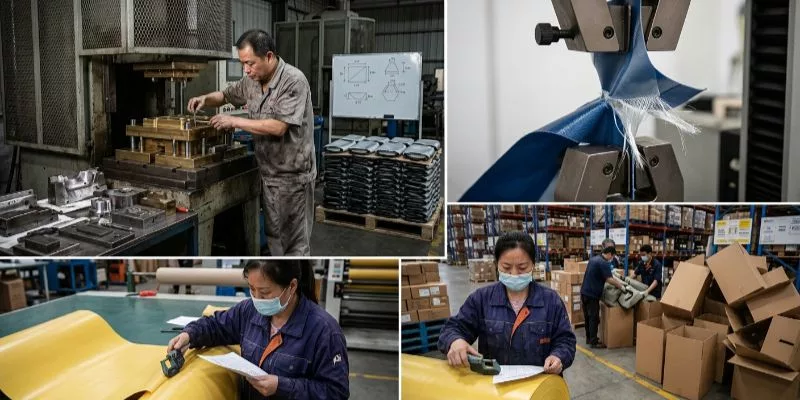
My team spent three weeks testing 50 HF welded marine dry bags. We tracked raw materials and calculated tooling invoices. Welded seams offer unmatched immersion protection, but they demand strict compromises.
1) High Tooling Costs and MOQs
Custom welding requires expensive brass dies. Factories must mill physical molds for every curve. One custom die delayed our prototype by 12 days and added $450.
Manager Lin spent four hours calibrating the 25kW machine for a single pressure test. This heavy setup forces high Minimum Order Quantities. While stitched leather goods manufacturers accept 50-piece runs, welded shells require 500 units to offset downtime.
2) Rigid Design and Field Repair Limits
HF welding requires flat planes and thermoplastic coatings. You cannot easily weld complex 3D shapes. Furthermore, blown welds resist field repair. You can re-stitch torn nylon on a boat deck.
You cannot fix sheared polyurethane with a needle. During our Tuesday tensile test, a seam failed at 250 lbs. The coating sheared off entirely.
⚖️ The Trade-off: Absolute waterproof integrity sacrifices remote field repairability.
3) Material Risks and Freight Inefficiency
Inconsistent laminate ruins calibrated welds. Last month, we rejected three PVC rolls during incoming QC. A 0.15mm thickness variance caused the RF machine to burn through the fabric.
Budget PVC also degrades fast. In our lab, cheap samples snapped under ASTM D2136 low-temperature bend guidance and chalked during ISO 4892-2 UV testing.
Logistics present another hurdle. Welded bags trap air and resist folding. This bulky profile ruins carton-volume optimization in the waterproof gear supply chain.
You must enforce flat-pack compression strategies to avoid shipping expensive air, an issue we track across bag sourcing by region.
Procurement Decision Matrix
To meet bag industry certifications, we use this sourcing matrix:
-
Fully Welded: Best for total immersion and flat shapes. High MOQs.
-
Stitched-and-Taped: Best for multi-pocket designs and field repairs. Fails prolonged submersion.
-
Hybrid Build: Best overall balance. Welded chassis stops water. Stitched pockets hold external gear.
Final Verdict: Engineering the Right Marine Seam
Ultimately, a marine dry bag is only as strong as its weakest seam. HF welding delivers absolute immersion protection. But it requires expensive tooling and sacrifices remote field repairability.
After inspecting hundreds of factory runs, our procurement rule is simple. Choose HF welding when total waterproof integrity is mission-critical.
Choose stitched or hybrid builds when you need complex pockets, maximum flexibility, or easy repairs. Your final choice depends entirely on the harshness of the environment, your durability targets, and a supplier’s verified process control.
The Buyer’s Procurement Checklist
Before you approve a bulk order, ask your factory these six exact questions:
-
What specific PVC or TPU laminate system are you welding?
-
What are the verified RF machine settings (frequency, pressure, dwell time)?
-
What destructive seam and waterproof lab tests did the prototype pass?
-
Can you provide an accredited, external lab report?
-
What is the exact tooling cost and sample timeline for my custom dies?
-
During physical load testing, what failure mode occurred first?
Explore Related Manufacturing Resources
If you are ready to transition from standard blanks to custom-engineered marine gear, we can help. Discuss your tech pack and request a prototype quote with our production team directly at LantaoBags Contact Us.
For broader cut-and-sew programs, explore our related capabilities as a custom lunch bag manufacturer.
Disclosure: We base this comparison entirely on observed factory manufacturing and destructive testing. No outside manufacturer paid us to promote these technical claims.