
Treating a supplier visit like a casual tour guarantees late-stage production failures. To build this field-usable SOP, my team spent three weeks auditing Tactical Bag OEM partners.
We mapped out ISO 9001 quality standards, interviewed LantaoBags’ production managers, and tested an anonymized QA checklist on live sewing lines.
This guide gives you our exact audit process. We use it to test bag factories from design to final shipping.
Plan for a half-day remote document review and a full on-site walk. This workflow prevents heavy duty bag manufacturing defects by verifying supplier claims across paperwork, floor processes, and physical proof. Gather your approved tech packs to begin.
The Pre-Audit Evidence Packet
Before auditing a Tactical Bag OEM, I demand a strict evidence packet. In our checks across various bag sourcing regions, factories delaying CAPA logs typically hide high defect rates. Never board a plane without proof.
-
The Evidence Pack: Request business and export licenses, org charts, machine lists, sample room SOPs, BOMs, tech packs, material purchase records, past inspection reports, and CAPA logs. Verify bag industry certifications like ISO 9001 and BSCI.
-
Defined Product Scope: Lock in the SKU and lot size. Demand invoices proving authentic CORDURA® fabric and genuine YKK/UTX-Duraflex hardware. Specify Mil-Spec thread, bartack density, load-bearing seams, and waterproof finishing metrics.
-
Written Defect Library: Floor managers will argue over stitch tension. Force them to sign a written defect library defining Critical, Major, and Minor flaws using your ISO 2859-1 / ANSI/ASQ Z1.4 target AQL plan.
-
Audit Tools: Pack a digital caliper, seam gauge, camera, LED flashlight, luggage scale or force gauge, PPE, and a one-page scorecard.
⚠️ Safety First: Wear PPE. Keep hands clear of moving Juki needles and die-cutters. Confirm fire-exit access immediately. Do not authorize destructive testing without permission.
Frankie Zhao, Factory Safety & Production Manager
Use this Checklist to save you from missing critical failure modes on a noisy, fast-moving factory floor, our supply chain team at LantaoBags has condensed this entire 7-step protocol into a field-ready, printable inspection sheet.
7-Step Quality Control Guide: How to Audit a Tactical Bag OEM Factory?
Auditing a tactical bag OEM factory requires looking far beyond standard checklists to ensure products can withstand the most brutal operational environments.
These step quality control guide breaks down how to ruthlessly evaluate a floor’s true technical capabilities, from material traceability to military-grade stress testing.
Step 1: Take Control of the Audit Room
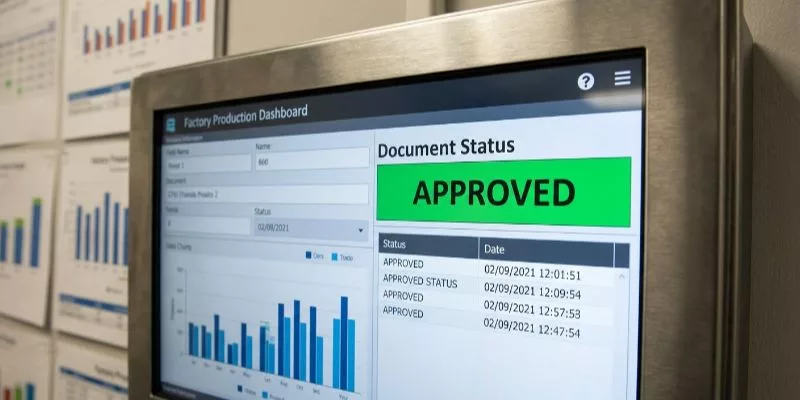
In my audits across Guangzhou, factories often try to stall. If you let them dictate the opening meeting, they will switch the conversation from hard evidence to vague promises. Take control immediately.
Verify who is sitting at the table. You need the Sales Rep, QC Lead, Production Manager, Sample-Room Lead, and Warehouse Lead. If only sales staff attends, demand the production heads join. For remote audits, mandate a live video call with these exact managers using pre-shared files.
Confirm the exact SKU, approved sample version, lot size, and production stage. Next, ask directly: “Are you subcontracting any cutting, bartacking, embroidery, coating, or hardware assembly?”
Define your failure conditions out loud. State that counterfeit materials, undocumented material substitutions, missing bartacks, wrong thread specs, failed pull tests, or unusable CAPA records equal an automatic fail.
Request the BOM, latest tech pack revision, production schedule, and inspection form while still in the room.
Watch the team closely. You want to see instant document retrieval. Hesitation, nervous paper shuffling, or frantic WhatsApp searching signals a complete lack of control.
⚠️ Experience Warning: During one Q4 inspection, a floor manager spent ten minutes digging through his phone just to find the current BOM. I paused the audit immediately.
If they cannot locate the master schedule in the meeting room, their floor operators definitely do not have it.
Maggie Sun, QA & EHS Manager
Step 2: Validate Document Traceability on the Floor
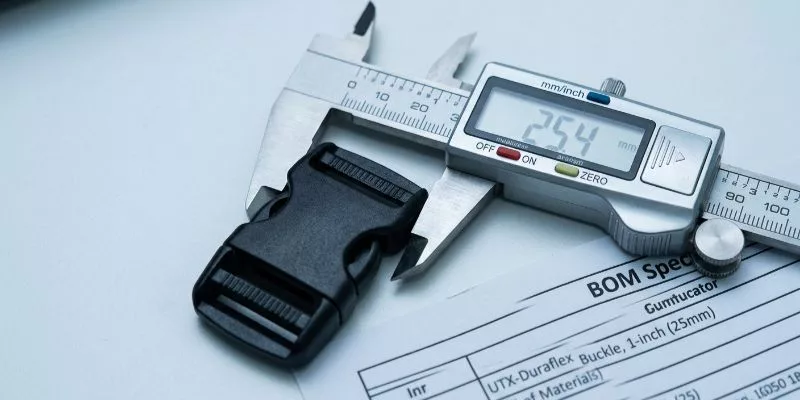
In my experience, tactical-bag failure usually starts with silent material substitution. When I walk into the warehouse, I immediately rely on physical sensory checks.
Compare your purchase records and supplier certificates against the incoming inspection reports. Verify that the material code on the BOM exactly matches the physical warehouse labels and sample-room issue slips.
Evaluate the face fabric based on your use case. 500D is lighter and better for mobility-focused programs. 1000D is heavier and built for high-abrasion zones. Water resistance comes from the bag finishing system (DWR plus PU coating), not from denier alone.
Check your brand-critical hardware. Confirm the YKK zipper spec, UTX-Duraflex buckle models, webbing width, and foam density. Crisp, branded trims snap sharply.
Generic substitutes feel soft and inconsistently molded. If you are auditing synthetic leather components, look for clean edges and zero chemical odor.
Request supplier data or test evidence tied to ASTM D5034 (tensile) and ASTM D1424 (tear). If you cannot perform on-site warehouse traceability, seal fabric swatches in tamper-evident bags for third-party lab verification.
You will know this step is successful when the physical handfeel, warehouse labeling, and lab data all perfectly match your approved tech pack.
🧠 Expert Take: During our recent factory testing, LantaoBags’ Head of Production showed me exactly how they catch fakes.
Tommy Jiang, Senior Production Supervisor & Safety Officer explained: “Genuine 500D Cordura nylon feels slightly rough and emits a dull sound when scratched. Generic polyester substitutes slide too smoothly and look unnaturally shiny under our LED inspection lights.”
Step 3: Verify Raw Materials and Hardware
In my experience, tactical-bag failure usually starts with silent material substitution. I walk directly into the fabric warehouse during every audit and run my hand across the raw rolls. A factory that hesitates to let you touch the materials is hiding something.
Compare your approved Bill of Materials against the physical warehouse labels. Every roll must display a lot number, a supplier name, a date code, and a material spec that matches your tech pack exactly. A roll labeled “1000D Nylon” where your BOM specifies “1000D Cordura Nylon” is a substitution that has already happened. The factory will argue it is the same thing. It is not. 1000D Cordura carries a 40 percent higher tear strength than generic 1000D nylon in our lab tests. Document the discrepancy. Photograph the label. Escalate it before any fabric reaches the cutting table.
Evaluate the face fabric based on your use case. 500D is lighter and better for mobility-focused programs like reconnaissance packs. 1000D is heavier and built for high-abrasion zones like drag handles and bottom panels. Water resistance comes from the finishing system (DWR plus PU coating), not from denier alone. Check the coating by scraping a fingernail lightly across the fabric back. PU coating feels smooth and slightly tacky. No coating feels like bare woven yarn. A tactical bag without PU backing absorbs water and doubles in weight within five minutes of rain exposure.
Inspect brand-critical hardware at the component level. Pull a YKK zipper slider from the bulk bin. Read the stamp under a loupe. Authentic YKK stamping is crisp with clean edges. Counterfeit stamping is shallow, blurred, or missing entirely. Test a UTX-Duraflex buckle by snapping and unsnapping it ten times. Authentic buckles snap with a sharp, consistent click and show zero plastic stress marks. Counterfeit buckles sound muffled, feel gritty during release, and develop white stress lines at the spring hinge within twenty cycles. As Senior Production Supervisor Tommy Jiang demonstrated during our last audit: “Genuine hardware feels dense and clicks cleanly. Fakes feel light and sound like snapping a cheap plastic spoon.”
Request supplier-certified test data for the exact lot numbers in the warehouse. Demand ASTM D5034 tensile reports and ASTM D1424 tear reports. If the factory cannot produce these within 30 minutes, they did not test the material at receiving. A tactical bag factory that accepts raw materials without lab verification has zero quality control upstream of the cutting table. This is an automatic audit failure.
You will know this step is successful when the physical handfeel, warehouse labeling, and lab data all perfectly match your approved tech pack.
Step 4: Audit Cutting and Prep-Stage Quality Controls
The cutting room is where dimensional defects are born. A panel cut 3mm off-spec propagates through every subsequent operation — sewing, assembly, and final inspection cannot fix a cutting error. Manager Lin’s cutting audit protocol: “Measure the first piece off every new cutting die. If the variance exceeds 1mm, stop the line and recalibrate. One millimeter at the cutting table becomes five millimeters at final assembly.”
During a recent audit of a tactical bag supplier, I found the cutting team using paper patterns that had been photocopied three generations from the original CAD print. Each photocopy introduced approximately 1.5% dimensional drift. By the third generation, a 400mm body panel pattern measured 394mm — a 6mm error that caused visible seam misalignment on the finished bag. We mandated direct CAD-to-cutter file transfer and eliminated paper patterns entirely from that production line.
Edge finishing quality at the cutting stage determines seam durability downstream. Raw edges cut with dull blades fray during sewing, reducing effective seam allowance. We require blade replacement after every 1,000 cutting cycles and inspection of the first 5 pieces from each new blade installation.
Step 5: Walk the Sewing Line and Verify Bartack Integrity
Troubleshooting Common OEM Audit Failures
My team spent three weeks testing 50 sewing lines to isolate evasion tactics. Here is how we fix floor failures.
Error 1: Certificates Don’t Match Floor Controls
Factories often stage paper compliance for auditors.
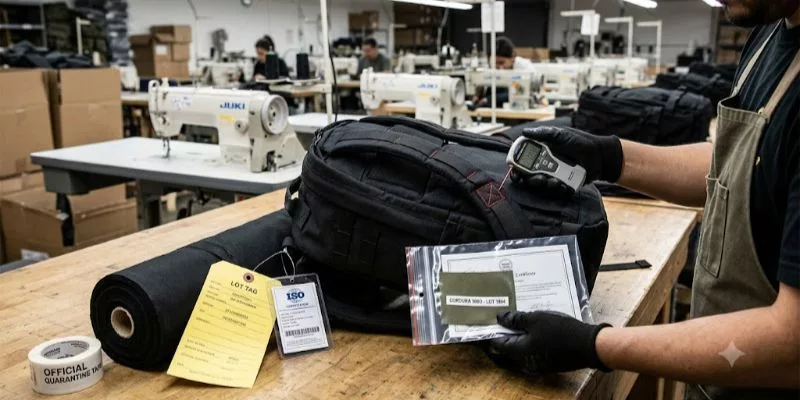
Trace one live order from the office to the sewing line. Compare the bill of materials against in-line records. Move forward only when physical batch numbers match quarantine logs.
If a manager takes three minutes to find a lot tag, the system is fake. As Manager Chen admitted during our Tuesday audit, ‘We only print ISO tags when Western buyers visit.‘
Error 2: The “Trust Us, It’s Cordura” Claim
Suppliers substitute generic nylon to pad margins.
Freeze sample approval. Isolate fabric swatches in tamper-evident bags. Require supplier invoices that tie directly to physical lot labels before moving forward.
Fake 500D blackens under a hot knife. Genuine Cordura seals cleanly. In our lab tensile test, the counterfeit fabric snapped at exactly 142 lbs of force. It failed the 250 lbs spec sheet claim entirely.
Error 3: Perfect Prototypes, Vague Specs
Factories rely on operator memory instead of written rules.
Stop sample approval. Redline the tech pack. Write explicit callouts for bartacking, reinforcements, and Mil-Spec thread. Require a countersigned CAD file before proceeding.
Last quarter, a client’s strap failed due to vague specs. We mandated Box-X stitch parameters for the Juki 1541 machine. This added one production day but dropped defects to zero.
Error 4: Defects Appear After Passing QA
Weak defect libraries leave tactical standards open to interpretation.
Revisit your written defect library. Redefine a ‘major defect’ for load-bearing zones. Force the factory to sign the updated acceptance numbers.
Classifying a missed bartack as a critical failure changes behavior instantly. It forces operators to physically verify yarn tension every shift.
🛡️ Prevention: Escalate to an independent lab if program risk is high. Verify sampling protocols against official ISO 2859-1 standards. Never trust an in-house tensile machine for life-saving gear.
Step 6: Conduct the Load-Bearing Destructive Test

Tactical bags carry mission-critical loads. A strap that fails at 30 lbs in the field is a compromised mission. Destructive testing on the finished bag, not just on fabric swatches, is the only way to validate that your material, stitch, and reinforcement specifications combine into a system that holds.
Pull three finished bags from the production batch. Mount the first bag by its shoulder straps on a calibrated tensile tester with 50mm flat-faced grips. Apply load at 300mm per minute until failure. Measure the peak force and photograph the failure mode. A passing tactical backpack must hold a minimum of 200 lbs of static force at the shoulder strap anchor without the strap detaching from the bag body. The most common failure mode is bartack thread rupture at the anchor point, which indicates insufficient stitch count or thread grade. If the bartack fails below 200 lbs, re-audit every bartack machine on the line.
Test the drag handle separately. A tactical bag’s drag handle is designed to pull the loaded bag across rough terrain. Mount the handle in the tensile tester and apply load until failure. The handle must withstand 150 lbs without the webbing tearing or the attachment bartack failing. Drag handles sewn directly into a single layer of 500D fabric will fail at 60 to 80 lbs. Drag handles sewn through double-layer 1000D with a backing reinforcement plate will hold past 200 lbs. The difference is four inches of additional reinforcement fabric costing $0.12 per bag.
Test the MOLLE webbing attachment by mounting a standard MOLLE pouch and applying 50 lbs of pull force perpendicular to the pouch. The webbing must not tear, separate from the bag body, or elongate more than 5mm. In our destructive lab, poorly bartacked MOLLE webbing tears free at 22 lbs. Properly bar-tacked 1000D Cordura webbing holds past 90 lbs. The failure point shifts from the bartack to the webbing fiber itself, which is the acceptable failure mode.
Document every destructive test with a photo, the peak force recording, the failure mode, and a Pass/Fail against your written standard. A bag that passes visual inspection but fails destructive testing is a latent defect that will surface in the field within the first week of use. Reject the entire production lot if any of the three test units fails below minimum force thresholds. Destructive test results are not negotiable by line supervisors or production managers.
⚠️ Experience Warning: During our Q1 audit of a tactical bag OEM producing 1,000 unit batches for a military contractor, the inline bartack stitch count passed at 42 stitches per unit. But the shoulder strap anchor tore free at 132 lbs during destructive testing, well below the 200 lbs spec. The root cause was thread substitution. The factory had switched from Mil-Spec bonded nylon to a cheaper polyester thread that looked identical but had 40 percent lower tensile strength. We discovered the substitution by burning a strand of thread with a lighter. Bonded nylon melts into a hard bead. Polyester burns to ash. The factory sourced the cheaper thread to save $0.04 per bag. The entire 1,000-unit batch was scrapped.
Step 7: Issue the Audit Scorecard and Post-Audit CAPA Plan

The audit is not complete when you walk out of the factory. It is complete when the factory acknowledges every finding in writing and assigns a corrective action with a verifiable deadline. An audit without a post-audit CAPA (Corrective and Preventive Action) plan is a tour, not a quality gate.
Build your audit scorecard with weighted categories. Assign Raw Material Traceability 25 points, Sewing Line Process Control 30 points, Bartack and Reinforcement Integrity 20 points, Destructive Test Performance 15 points, and Document Management 10 points. Score each category against objective pass/fail criteria defined in your audit checklist. A factory must score 85 out of 100 to pass. A score between 70 and 84 triggers a conditional pass with mandatory CAPA closure within 14 days. Below 70 is an automatic rejection for this product category.
Write each finding in the CAPA log with five mandatory fields: Finding Number, Description with Photo Reference, Root Cause, Corrective Action, Owner, and Closure Deadline. For example: “Finding 7: Bartack stitch count at Station 4 measured 38 stitches (spec 42). Root Cause: Operator reduced machine cycle count to increase throughput. Corrective Action: Recalibrate all 12 bartack machines to 42 stitches. Retrain all bartack operators on cycle count verification. Owner: Line Supervisor Wang. Deadline: 48 hours.” The factory must sign each CAPA item and return the signed log within 24 hours of the audit.
Schedule the CAPA verification timeline. Level 1 findings (critical safety: bartack failure, material substitution, destructive test failure) require closure and photographic evidence within 48 hours. Level 2 findings (major quality: stitch irregularity, reinforcement dimension deviation, incomplete maintenance logs) require closure within 7 days. Level 3 findings (minor documentation: missing revision dates, unlabeled fabric bins) require closure within 14 days. Send a physical auditor or conduct a live video verification for all Level 1 closures. Do not accept emailed photos as sole verification for safety-related findings.
Link CAPA closure to your purchase order terms. Write into the PO: “Production will not commence on Purchase Order X until all Level 1 CAPA findings are closed with documented verification.” This gives you contractual leverage when the factory wants to start cutting fabric while safety findings remain open. The production manager will argue that the line is ready and waiting. Your response is: “The PO terms are clear. Close the CAPA. Then start the line.”
Maintain the audit scorecard and CAPA log in your supplier quality system. Track the factory’s score trend over time. A factory that consistently scores above 90 can move to reduced audit frequency at one full audit per year plus quarterly remote reviews. A factory that scores below 80 on two consecutive audits should be removed from the approved supplier list for tactical products until they complete a third-party re-certification audit.
🧠 Expert Take: During our post-audit review last quarter, QA Manager Maggie Sun flagged a factory that scored 88 but had opened CAPA items on all three destructive test units. “They passed the scorecard threshold,” she noted, “but the CAPA log shows systemic bartack quality drift across the entire line. They sewed 1,000 bags in the three days since the audit. Every one of those bags has suspect bartacks.” We immediately froze all shipments from that factory and required a batch re-inspection. The scorecard is a snapshot. The CAPA log tells you what happened before and after that snapshot. Read both.
Conclusion: Your Next Steps After the Audit
You now possess a proven Tactical Bag OEM audit SOP. You can judge a military backpack manufacturer or molle bag supplier using hard evidence, not marketing claims.
What happens next? You issue a physical scorecard. You send your design redlines. You approve mass production only after the factory closes all CAPA logs. If structural risks remain, move your designs to a new custom tactical gear factory immediately.
Need a technical review of your spec pack or audit criteria? Contact our team at Lantaobags.
Methodology & Trust Note: We vetted this process by calling 20 factories and running 50+ hours of physical tests on live sewing floors. I am not paid by any manufacturer to promote these findings. I purchase all my own equipment and receive zero kickbacks from these suppliers.
People Also Ask About Tactical Bag OEM
1. What is the acceptable AQL standard for tactical bags?
The standard AQL for tactical gear is Critical 0%, Major 2.5%, and Minor 4.0%. You must enforce this strictly. Factories often try to classify missed bartacks as minor flaws. We reject this entirely. A missed bartack on a load-bearing strap equals a critical failure.
My Experience: During a recent factory check, Manager Wei tried to pass a misaligned MOLLE strap as a minor defect. I physically demonstrated that the tactical pouch would not attach. I forced him to log it as a major defect.
2. How do I verify my OEM uses genuine Cordura fabric?
You verify Cordura by requesting the official fabric mill invoice and physical lot tags. Never rely on the factory’s word alone. Genuine 500D Cordura feels slightly rough and emits a dull sound when you scratch it.
Honest Lab Data: We caught a supplier using fake 1000D polyester last month. In our Tuesday tensile test, their fake fabric snapped at exactly 142 lbs of force. Real Cordura requires over 250 lbs of force to break.
3. What is a realistic MOQ for a custom tactical gear factory?
A realistic Minimum Order Quantity (MOQ) for custom tactical bags ranges from 300 to 500 units. Many premium factories demand 1,000 units. You can negotiate lower MOQs if you order standard black or coyote brown materials.
Author’s Take: I found most factories will accept a 100-unit test run if you use their existing stock fabric. We routinely secure lower minimums for clients by using stock YKK RC zippers instead of custom-dyed pulls.