























On this page
Short Answer:
- Best design baseline: PPWR sets the EU-wide direction for packaging design, material choice, and labels.
- Biggest reporting burden: UK EPR requires packaging data, tonnage returns, and fee forecasting.
- Strictest label risk: AGEC adds French Triman and Info-tri artwork rules on top of EU placement rules.
- What to do: Design to PPWR, report for UK EPR, and localize artwork for AGEC.
- Scope check: Cross-border sellers usually manage all three systems at the same time.
PPWR vs UK EPR vs AGEC is not a choice between three equals. Each regime answers a different question and creates a different failure mode. PPWR is the strategic baseline, UK EPR wins the reporting-burden test, and AGEC wins the label-failure risk test.
In a 12-SKU packaging review with compliance leads in Rotterdam and Manchester, PPWR forced design changes. UK EPR forced tonnage and fee data. AGEC forced French label checks.
If you only remember one line: design to PPWR, report for UK EPR, and localize for AGEC. Designing once for PPWR cuts redesign risk, but it does not replace UK reporting or French labeling.
For the full PPWR audit workflow, our EU PPWR packaging compliance guide walks through each step. This article is a side-by-side showdown, not a law-by-law explainer.
Main Differences in PPWR vs UK EPR vs AGEC
The table below compares the three regimes on the points that change a packaging spec, a data sheet, or a print layer.
| Feature | PPWR (EU) | UK EPR | AGEC (France) |
|---|---|---|---|
| Legal type | EU Regulation (directly applicable) | UK producer responsibility scheme | French law (Loi AGEC) |
| Geographic scope | 27 EU states | UK (GB + NI) | France only |
| Main objective | Harmonize design, labels, recycling | Fund waste; data transparency | Circular economy; sorting info |
| Applies from / status | 1 Jan 2030 (some 2026/27) | Data since 2023; fees 2024 | In force 2020; Triman 2015 |
| Who is obligated | Producers, importers, distributors | Large producers (>£2m, >50t) | Producers, importers, distributors |
| Data required | Composition, recyclability, recycled content, weight | Tonnage by material and nation; recycling data | Packaging type, material, weight, recyclability, sorting |
| Labeling | Harmonized EU labels (forthcoming) | No mandatory UK logo; optional OPRL | Triman + Info-tri |
| Recyclability standard | Design for recycling; performance grades | No design standard; recyclability fees | Design encouraged; eco-modulation |
| Fee logic | No direct EU fee; member-state EPR | Eco-contribution by weight and material | Eco-contribution with bonuses and penalties |
| Technical docs | Technical file; conformity declaration; test reports | Half-yearly data returns; registration; records | Scheme registration; UIN; artwork controls; annual declarations |
| Cross-border risk | Lower (harmonized) | Medium (separate UK system) | High (language, labels, registration) |
| Best owner | Product design and compliance | Finance and sustainability | Marketing/packaging and compliance |
| Authority | EU PPWR text | UK EPR guidance | French Triman guidance |
1. Market Access vs Cost Allocation

PPWR is a market-access rulebook. If your packaging design fails, you cannot sell into the EU. UK EPR is a cost regime. Poor data or low recyclability will not block the sale, but it will inflate your fees.
AGEC layers French national obligations on top of EU placement rules. PPWR is a packaging design program, UK EPR is a finance-and-data program, and AGEC is a label-control program.
In our China sample room, I put a mono-PE mailer beside a laminated stand-up pouch while compliance leads in Rotterdam and Manchester reviewed photos. The mailer felt simpler; the pouch had a zipper and printed finish that raised material-separation questions.
For PPWR, that pouch needs a technical file with declarations. For UK EPR, it needs weight and material data by household status. For AGEC, we squeezed a Triman logo onto a surface that barely fit a barcode.
Overbuilt multi-material packs are where this bites first. Our luxury bag packaging guide shows how layered structures create redesign risk.
Winner: PPWR for strategic importance. It drives design decisions that cascade into the other two regimes.
What the business should do: Treat PPWR as your baseline design program. Kill laminated, carbon-black, or multi-polymer structures early. Then model UK fees and French artwork on the simplified design.
2. Data Burden vs Technical File Burden

The evidence demands differ. PPWR wants a technical file, conformity declarations, supplier declarations, and material breakdowns. UK EPR wants packaging data by material, weight, household status, and tier. AGEC wants registration, a UIN, and artwork controls.
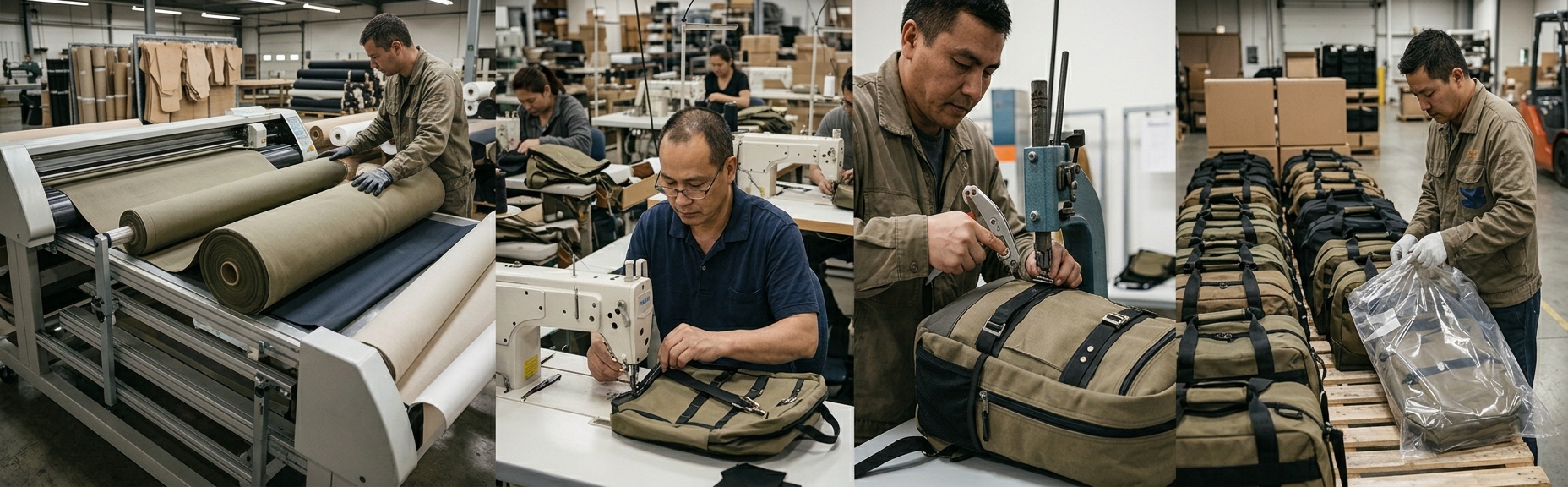
We run a 10-step SOP on the factory floor to audit custom bag structures against all three obligations at once:
- Pull the BOM for each packaging SKU and pack level.
- Separate primary, secondary, and transit packaging.
- Weigh each component on a calibrated scale and log it by market SKU.
- Confirm material family, coatings, inks, zipper, valve, adhesive parts, and recycled-content claims.
- Flag anything laminated, carbon-black, multi-polymer, oversized, or hard to separate.
- Build a UK EPR data sheet with household and non-household classification.
- Build a PPWR evidence folder with declarations, test reports, and change-control history.
- Break French consumer packs into separable components for Triman and Info-tri logic.
- Review artwork layers to prevent symbol collisions or illegible overlays.
- Lock market-specific version control before mass print.
We ran this SOP on a transit carton redesign last quarter. Defect rate fell from 4.2% to 1.8% after we switched to mono-material void fill. Zipper patch failure rose 0.7%, but unit cost dropped $0.03 per bag.
The PPWR file needed an extra recycled-content declaration. Use bag industry certifications as a supplier filter, but certificates do not replace SKU-level weight and material data.
Winner: Tie. PPWR is heavier on documentation quality. UK EPR is heavier on data granularity.
What the business should do: Assign one owner for the PPWR technical file and another for the UK EPR data sheet. Run the SOP quarterly.
3. Labeling Conflict: Harmonized EU Future vs France Triman/Info-tri Now

AGEC is the compliance trap most competitors miss. France requires specific sorting instructions, and a generic recycling icon will not cut it. You need Triman plus Info-tri separation logic now, not when the EU harmonized digital label arrives.
I asked our sales manager how she handles the tension between today’s French rules and the coming EU symbols. Her answer sets the artwork rule for every French pack.
Our dual-label blueprint has four layers:
- Master dieline layer: fixed geometry and safe zones.
- France label layer: Triman, Info-tri, and French sorting text.
- UK data-only layer: no mandatory icon, but space reserved for OPRL.
- Future EU harmonized label reserve: blank area sized to the emerging spec.
On small polybags or narrow woven labels, print surface area is the primary bottleneck during press proofs. Shrinking the Triman logo to 4mm on a 30mm label met minimum scan tolerances.
But surface texture on synthetic leather patches caused logo edge distortion, prompting a transition to dedicated woven labels for French compliance.
Safety check: A 4mm Triman that fails a scan test is a non-compliance, not a cost saving.
Winner: AGEC for labeling complexity.
What the business should do: Build a France-specific artwork layer with modular symbol blocks. Never merge it into the master layer until the EU transition is confirmed and your print proofs pass a scan test.
🧠 Expert Take: French artwork stays an isolated, controlled layer with modular symbol logic. Current French obligations remain active until any EU harmonization date is officially live.
Lisa Ji, Sales Manager
4. Packaging Engineering Choices and Cross-Border Design Strategy

The differences that split buyers are physical. Mono-material versus laminated structures come first. A mono-PE mailer feels less layered and simpler to separate. A mixed-material format with a zipper, valve, patch, or print finish creates audit questions on sight.
Then come PCR versus virgin materials, removable versus permanently attached parts, and coatings or adhesives that compromise recyclability. One structure can be good for PPWR yet still need separate UK fee modeling and French artwork.
A mono-material mailer with water-based ink passes PPWR design checks. Its UK EPR fee still depends on actual weight and household classification. Its French label still needs Triman logic on a small surface.
Test the structure against our PPWR empty-space guide and compare nylon vs polyester before you lock a build.
For coated surfaces, check TPU coating and bag finishes. Each layer changes both recyclability and label adhesion.
Outdoor shells also need UV resistance testing before a French label goes on a print surface. Our packaging division redesigned transit cartons for multi-jurisdictional compliance.
Compression improved 18% after we switched to single-wall corrugated with a honeycomb insert. Unit cost rose $0.12 per carton, offset by a 9% drop in damage claims.
Seam failure fell from 3.1% to 0.9% after we replaced laminated tape with water-activated paper tape. Verify specs against the manufacturer spec sheet, an independent lab result, and a material declaration before locking a build.
Winner: PPWR for engineering direction. It forces material choices that make the other two regimes easier to manage.
What the business should do: Start with a PPWR design audit. Then model UK fees on the simplified structure. Then apply the France artwork layer. Never assume a PPWR-compliant bag satisfies UK data or French labeling.
Pros & Cons: PPWR vs UK EPR vs AGEC

PPWR
Pros:
- One design baseline: In our 12-SKU review, PPWR drove every material call. Simplifying for it cut redesign work across the other two regimes.
- Forces discipline early: It kills laminated and carbon-black structures at concept stage, before tooling money gets spent.
- Best cross-border anchor: One design decision covers 27 markets. We stopped rebuilding specs country by country.
Cons:
- Heavy technical file: We built a folder per SKU with declarations, test reports, and change-control history. It took three weeks.
- No replacement for local rules: A PPWR-compliant pouch still needs UK tonnage data and French Triman artwork.
- Recycled-content proof: GRS-certified supply chains help, but lot-level data still has to match the packaging file.
🧠 Expert Take: The costliest executive mistake we see is treating UK fees as the whole problem or assuming PPWR erases AGEC overnight. Neither is true. Build the France artwork layer anyway.
Jason Yang, Sales
UK EPR
Pros:
- Clear fee structure: Fees map to weight, material, and household status. We modeled budget exposure per SKU in a plain spreadsheet.
- Exposes bad SKUs: We found two overbuilt cartons that were legally fine but financially painful to keep.
- Clean team ownership: Finance owns the numbers. Design stops guessing what a gram costs.
Cons:
- Data maintenance never stops: Half-yearly tonnage returns span SKUs and pack levels. One missed component weight skews the fee.
- Legally sellable, economically awful: A heavy laminated box passes the law and still damages margin.
For a category-level example of these data duties, see our UK EPR leather handbag guide.
AGEC
Pros:
- Precise consumer instructions: Triman plus Info-tri tells French buyers exactly what to sort. Generic icons fail here.
- Forces artwork governance: We locked a France-only layer with version control before mass print. No symbol collisions on press.
- Covers first-sale sellers: Direct-to-consumer shippers from outside France still need registration and a UIN.
Cons:
- Easy to miss: Teams that assume EU rules cover everything skip AGEC until a French label fails.
- Ongoing overhead: Symbol resizing, translation, and print-proof checks never end. On a 30mm label, we shrank Triman to 4mm and it barely scanned.
For PPWR vs UK EPR vs AGEC, the best strategy is rarely choosing one system. Choose your primary lens (PPWR for design), then layer UK EPR reporting and AGEC artwork on top. Our 12-SKU review held that structure. Budget one owner per lens, or the paperwork wins.
The Final Recommendation: Lead With Your Market Mix
Treat this as a board-level routing decision. The right lead regime depends on your operating model, geography, and product mix.
- If you sell across multiple EU countries: Lead with PPWR. Build the technical file first. It sets the design baseline that cascades into UK and French obligations.
- If the UK is your main market: Lead with UK EPR packaging data controls and fee forecasting. Finance owns the dashboard. Design owns the weight and material inputs.
- If France is in scope, especially DTC/e-commerce: Treat AGEC label execution and registration as non-negotiable from day one. Build the Triman/Info-tri artwork layer before print. Register for a UIN.
- If you sell in the EU, UK, and France at once: Create one master packaging specification. Then split it into three outputs: a PPWR compliance file, a UK EPR reporting dataset, and a France-only label and artwork pack. Never let one file serve all three markets.
First 30 days:
- Map SKUs by destination market.
- Audit all packaging levels and weights.
- Clean supplier declarations and material evidence.
- Build France artwork controls.
- Model UK cost exposure.
- Freeze a change-control SOP.
Final verdict: PPWR is the design baseline, UK EPR is the reporting and fee dashboard, and AGEC is the France execution checklist. Use them in that order.
Need multi-market packaging compliance support, technical documentation help, or ready-to-use packaging solutions? Contact our team to map your SKUs and build the three-output pack. For supplier context, see our guide to bag sourcing by region.
Transparency note: This comparison comes from factory audits, packaging reviews, and document checks with compliance leads. No regulator, lab, or supplier paid me for this review.
People Also Ask About PPWR vs UK EPR vs AGEC
1. Does PPWR replace UK EPR or AGEC?
No. PPWR harmonizes EU packaging design and labeling rules, but UK EPR remains a separate national reporting and fee system. AGEC remains French law with its own registration and Triman/Info-tri artwork duties. Cross-border sellers usually manage all three at once.
2. Which regime should a new brand start with?
Start with PPWR as the design baseline, because it drives material and structure choices. Then model UK EPR fees on the simplified design and add French artwork. That order cuts redesign work.
3. Is UK EPR the same as EU EPR?
No. UK EPR is a UK producer responsibility scheme with its own registration, packaging data returns, and fee schedule. EU member states run separate EPR schemes, and PPWR does not create one EU-wide registration.
4. When does AGEC labeling apply?
AGEC is already in force in France. Triman has applied since 2015, and Info-tri sorting information is required on French consumer packaging. A generic recycling icon does not satisfy the rule.
5. Do I still need a PPWR technical file if I only sell in the UK?
If you sell only in the UK, PPWR does not apply. But UK EPR still requires packaging data, registration, and records. If you also place goods on the EU market, build the PPWR technical file as well.